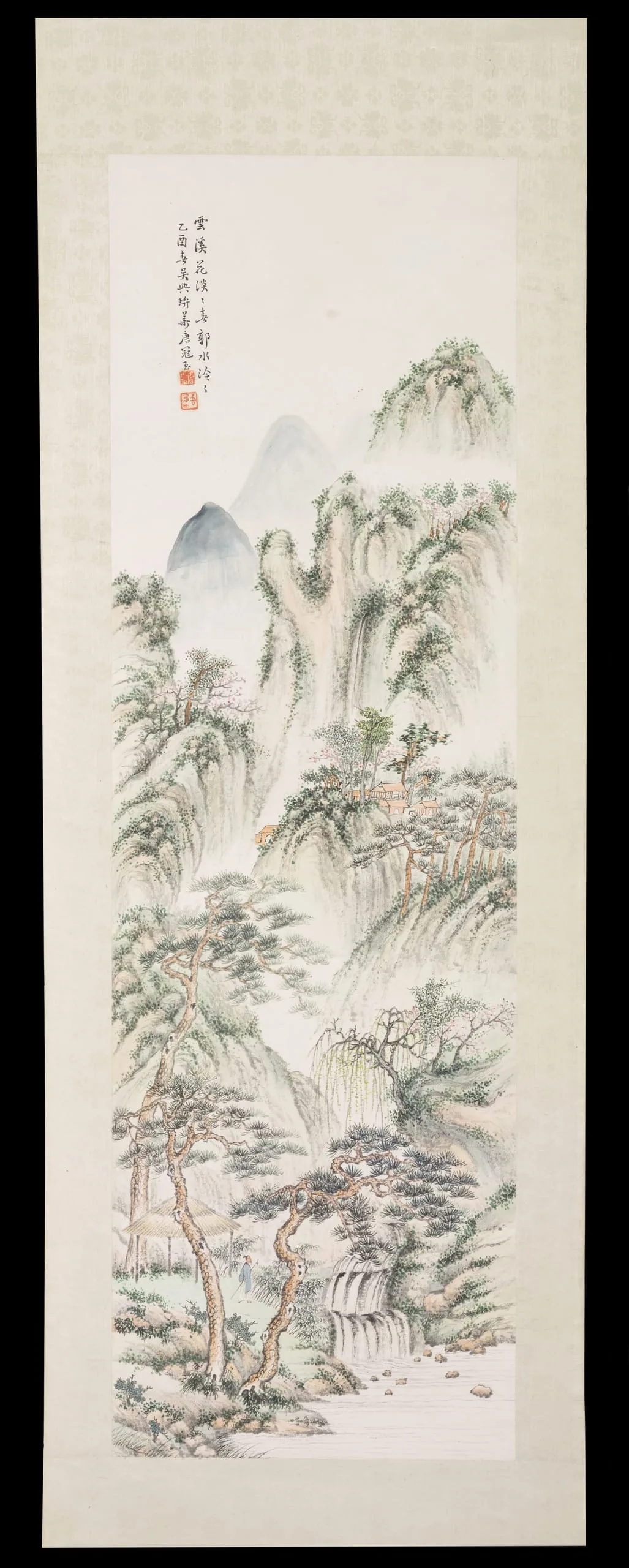
This superbly executed landscape painting is by the relatively unknown artist Tang Guanyu, a cofounder of the Chinese Women’s Painting and Calligraphy Society (Zhongguo nüzi shuhua hui), China’s first female artist association, established in 1934. Tang was trained in the traditional style under Feng Chaoran, and her landscapes were largely influenced by the Yuan master Wang Meng (1308−1385), while her works in the flower-and-bird genre were inspired by Bian Wenjin (c. 1356−c. 1428). Spring Landscape is a typical literati-style painting. Its straightforward composition with rich variations features well-modeled trees, rocks, mountains, waterfalls, and houses depicted in detail. Two tall pine trees at the bottom open up the entire picture and also serve to frame the scholar in the foreground. Carrying a staff, he seems to have just emerged from the thatched hut to gaze at the waterfall. Willow trees in the lower middle section, together with pink blossoms that dot the scene and the dark green shades of hilltop vegetation, suggest springtime in a moist mountain environment. The ochre-colored houses, situated high up on a hilltop and partly hidden by greenery, capture the notion of the secluded existence prized by scholars. The color palette is typical of the modern period.
The inscription reads: “Among clouds and rivers, flowers emit light fragrance, / The springtime in the village, the waters are cold and chilly. / In the spring of the year yiyou [1945], Wuxing[?] Tang Guanyu.”
Wan Kong
2024