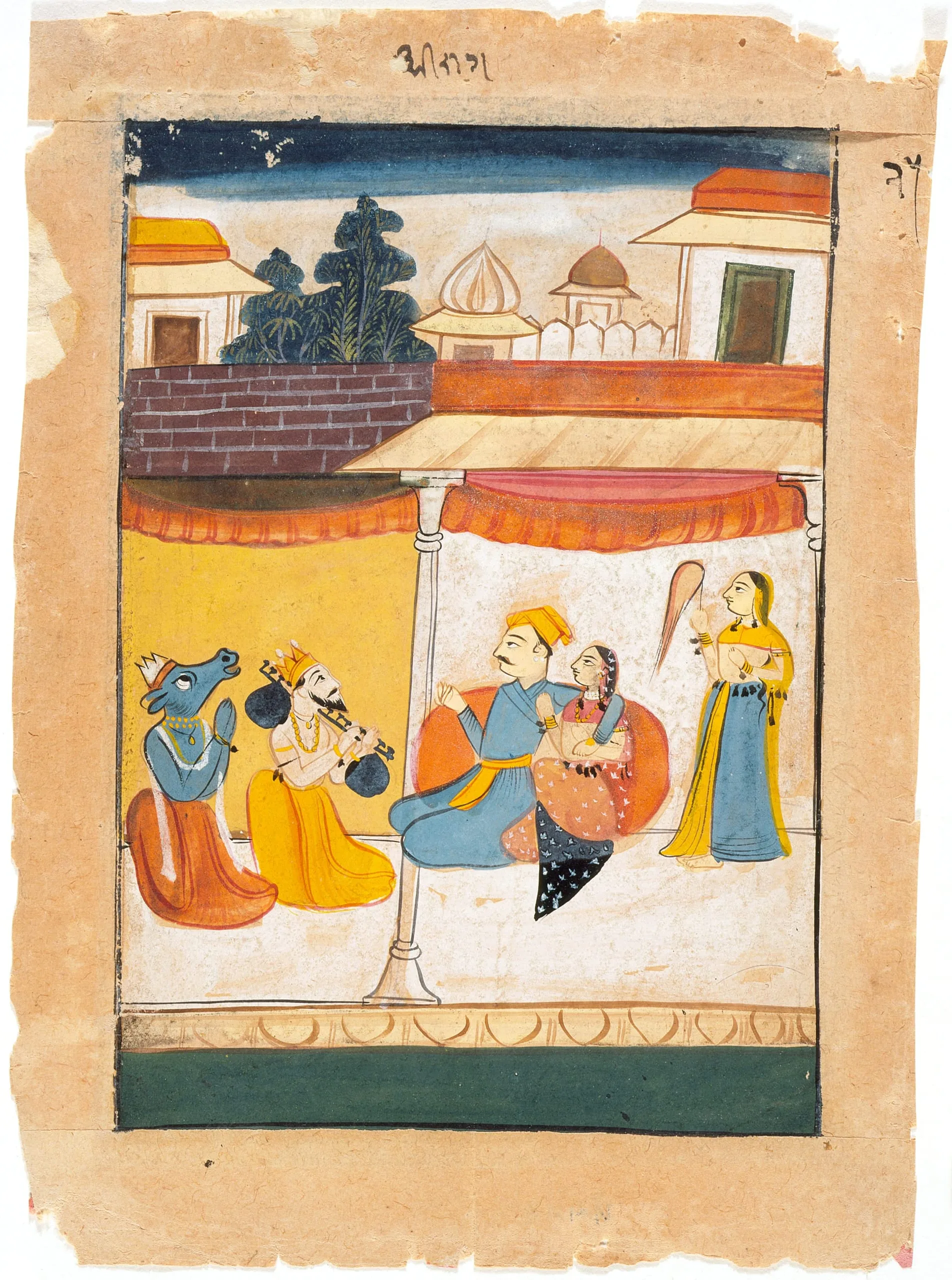
The devanagari inscription in the upper border identifies the melody as Shri Raga. In the righthand border, the folio is listed as number twenty-five in the ragamala (garland of melodies) series, which is Shri Raga’s sequence in the variant ragamala classification system known as Hanuman’s system (developed by the ancient musical theorist Hanuman). Shri Raga is the fifth raga in Hanuman’s system. In the more widespread Rajasthani system, Shri Raga is the sixth raga (number thirty-one). It is a melancholic melody associated with late afternoon or early evening and Winter (December-January). See also M.70.59, M.75.113.3, and AC1999.127.27.
Here, Shri Raga is envisioned as a prince and his consort seated in a palace verandah listening to a musical performance. He is keeping the rhythm with his left hand. The singer is Tumburu, a horse-headed celestial singer and musician (gandharva). The bearded musician playing a vina is the legendary poet-saint Narada. Behind the royal couple, a maidservant holds an honorific fly whisk made from the white tail-hairs of a yak (cauri or chowri).
Four folios from this dispersed series were formerly in the Sri Motichand Khajanchi Collection, Bikaner. The colophon on the Bhairava Raga identifies as the artist as “Brindaban, son of Paramanand, painter of Mathura.” It states that the complete ragamala of thirty-six paintings was painted for Todarmal in 1711 (samvat 1768).