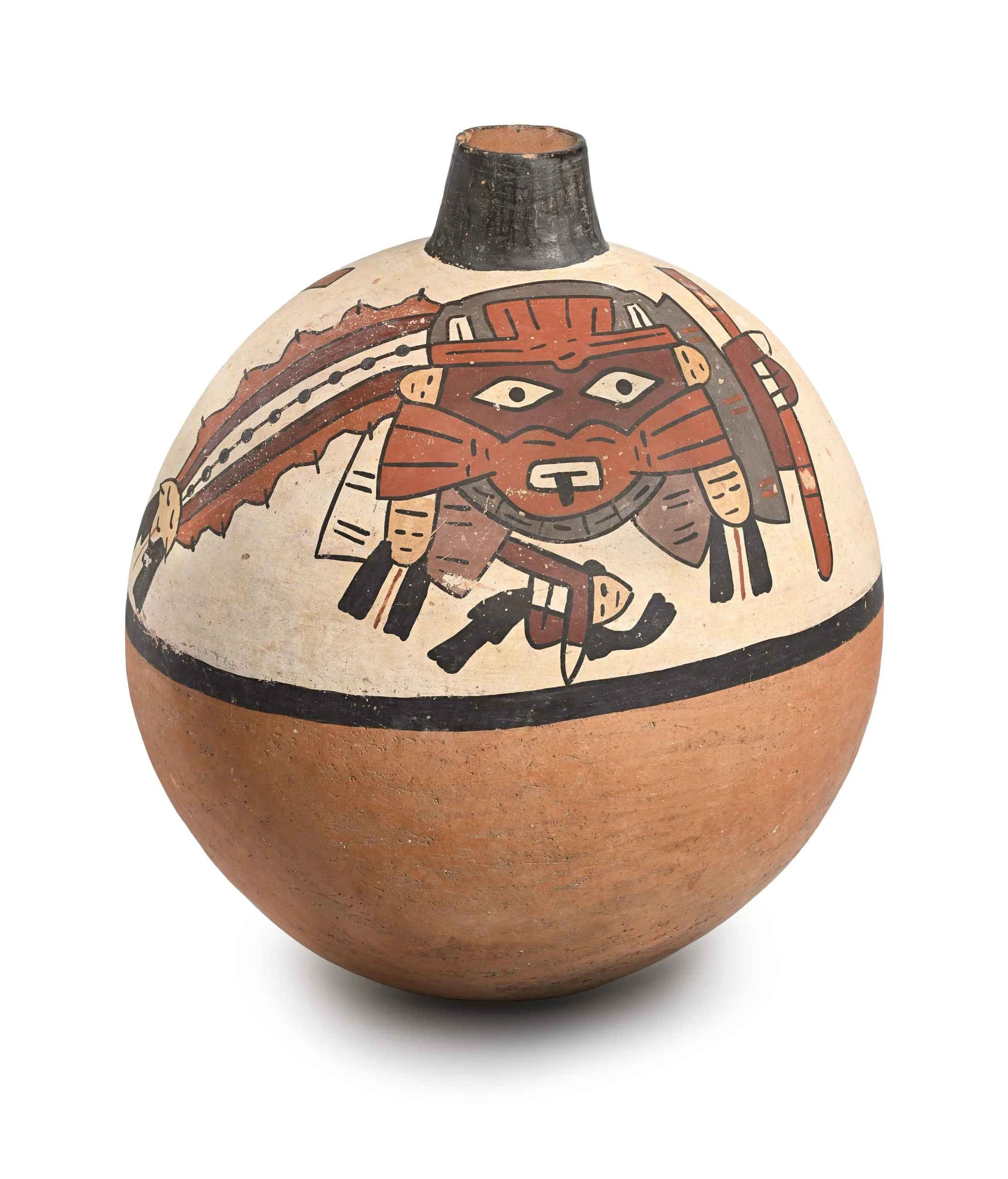
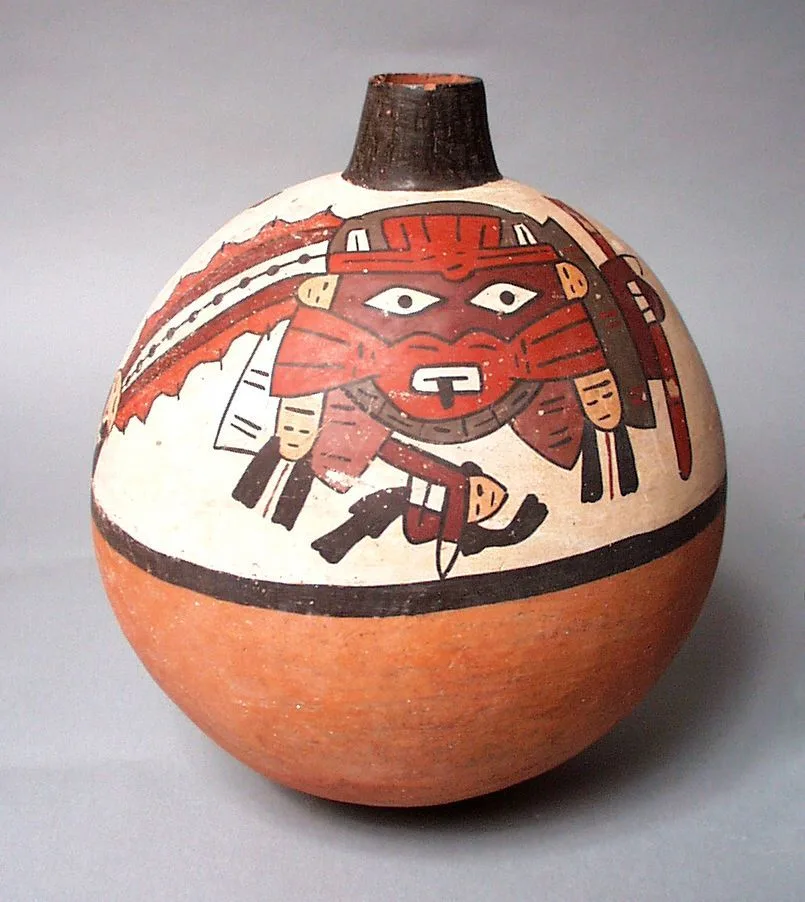
Depicted on both sides of this Early Nasca bottle is the Anthropomorphic Mythical Being. Painted on a white ground, he wears a diadem and mouth ornaments, probably representing felinelike whiskers, and holds a small human figure in one hand and a spear in the other. The position of his serpentlike body, decorated with spikes, suggests that he is in flight. Trophy heads decorate his body and tail. The Anthropomorphic Mythical Being, one of the paramount Nasca ancestral deities, is ubiquitous in the culture’s religious art. Its depictions change from figurative, humanlike renditions in the Early Nasca period (as seen here) to more abstract, hybrid versions in later eras.
The Nasca people lived in one of the driest deserts on the globe, the Peruvian Pacific coast. They evolved resilient and creative strategies for coping with extreme living conditions, conceiving ways to exploit scarce resources and mitigate the impact of catastrophic climatic episodes such as torrential rainfall and drought. As they secured the means of subsistence, they simultaneously devised a system of beliefs and practices to control and survive in their harsh surroundings. Religion and ritual helped them resist hardships and reconceive the wild desert as a domesticated and social landscape: a sacred cosmos inhabited and dominated by fantastical creatures, mythological beings, and powerful ancestors. These figures brought fear and chaos to humans but at the same time provided them with spiritual mechanisms to confront, with divine intervention, the destabilizing forces of the natural world. Both ecological and spiritual adaptations were essential to thriving in the desert.
Luis Muro
2024