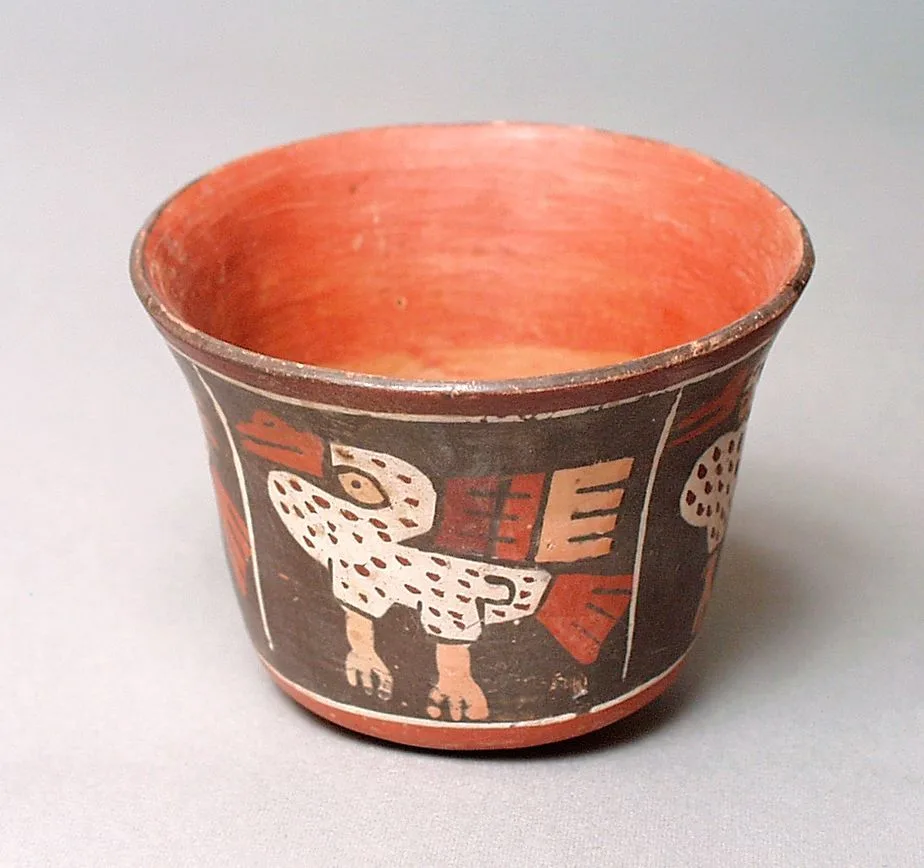
Nasca artists frequently depicted birds on their ceramics, choosing from a huge number of species whose behaviors and habitats no doubt dictated their meanings or roles in Nasca life and mythology (see also M.73.48.39, .40, and .42). The birds painted on this cup, standing on tall legs and with prominent caruncles on their beaks, may represent male Andean condors (Vultur gryphus). The condor has been revered as a central figure in Andean cosmology for millennia, symbolizing a connection between the earthly and celestial realms (see also M.2010.115.309). With a wingspan of up to ten feet, it is the unrivaled ruler of the sky, including the apus (spirits) that inhabit the highest mountain peaks.
Having divided the exterior surface of this cup into four approximately equal panels, the artist painted the four near-identical birds using white, buff, red, and purple against a very dark brown or black background. Although not making use of the full suite of colors developed by Nasca artists in the first centuries CE, the opacity (covering ability) and consistency of tone of each of these slip paints is testament to the high level of technical knowledge employed in their making. As is common on cups or small bowls like this, the inside has been roughly burnished and slipped partially in red, but not decorated.