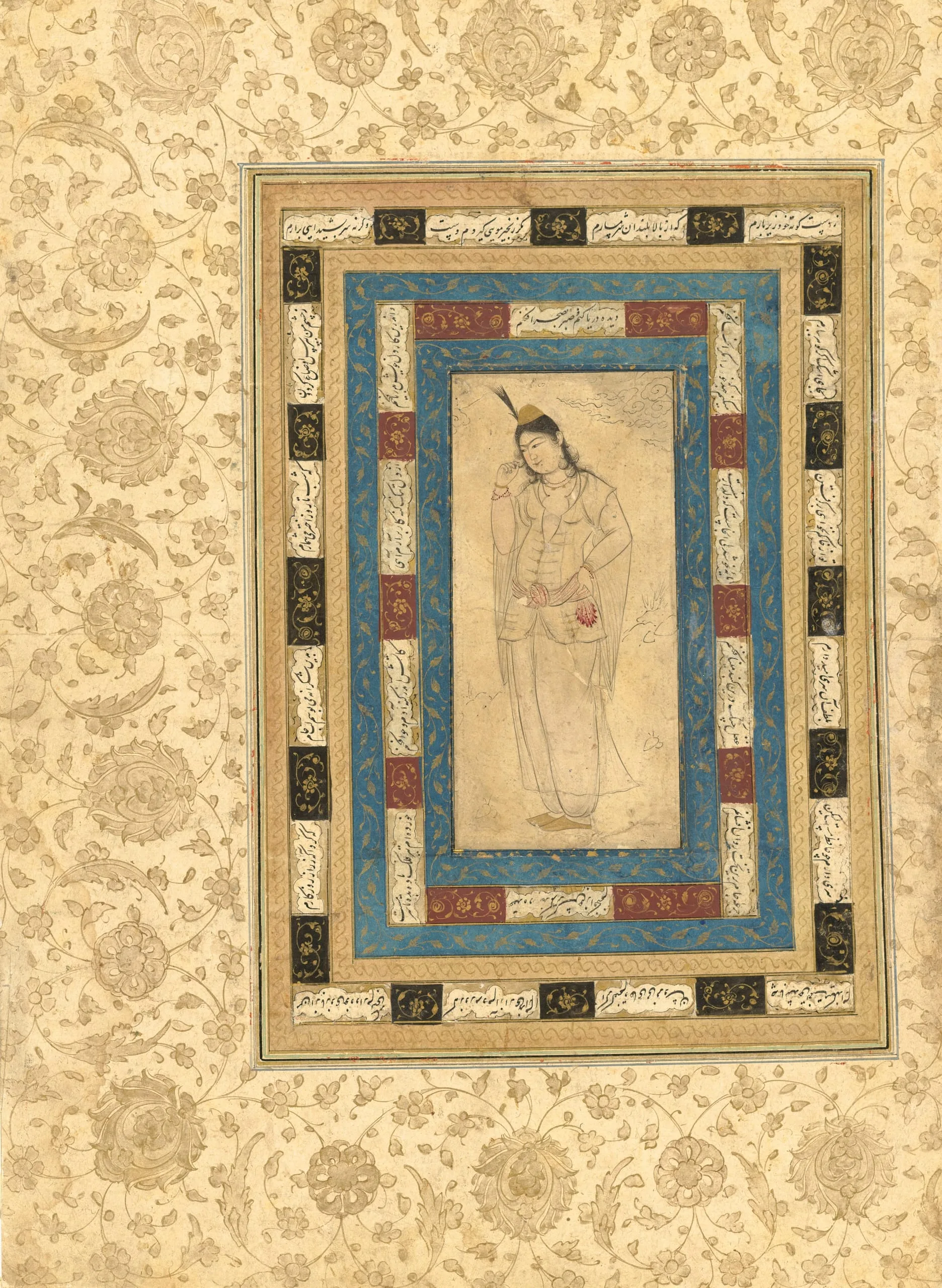
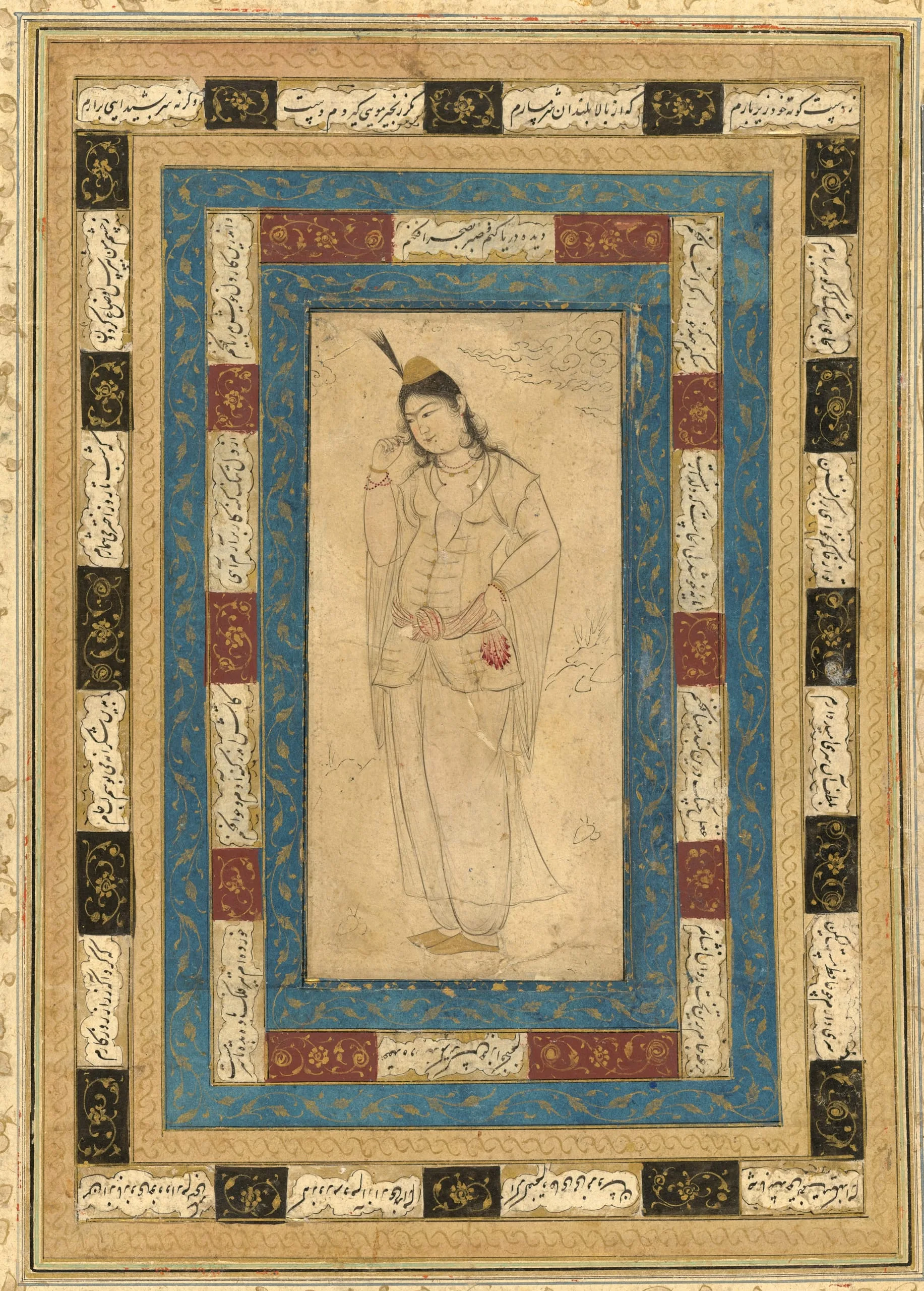
In the late sixteenth century, a new type of painting emerged in Iran that favored individual subjects painted on a single folio, with no relation to a manuscript illustration or narrative text, as had been the prior tradition. Such single-page compositions reached their peak in popularity during the seventeenth century at Isfahan, the capital of the Safavid dynasty, which blossomed into a hub of commerce and social change. No longer confined by court patronage, artists found a willing market among the cultured social elite, producing popular themes such as portraits of idle youths like this one. These paintings were often enjoyed individually or gathered in an album known as a muraqq‘a.
As opposed to earlier depictions of youthful beauties, which showed them as slender-bodied and loosely robed, Isfahan artists favored heavier and more sensual bodies, accentuated by tailored clothing and curving, almost swaying, stances. The face of this figure adheres to a long-standing tradition of depicting beautiful people with a “moon face,” which was round and pale, had curving eyebrows, and a small mouth. This visual trope was applied to representations of both male and female youths, often making them difficult to distinguish from one another. The poetry surrounding the drawing includes lines by Hafiz (c. 1315−1390) and does not relate to the painted subject.
2025