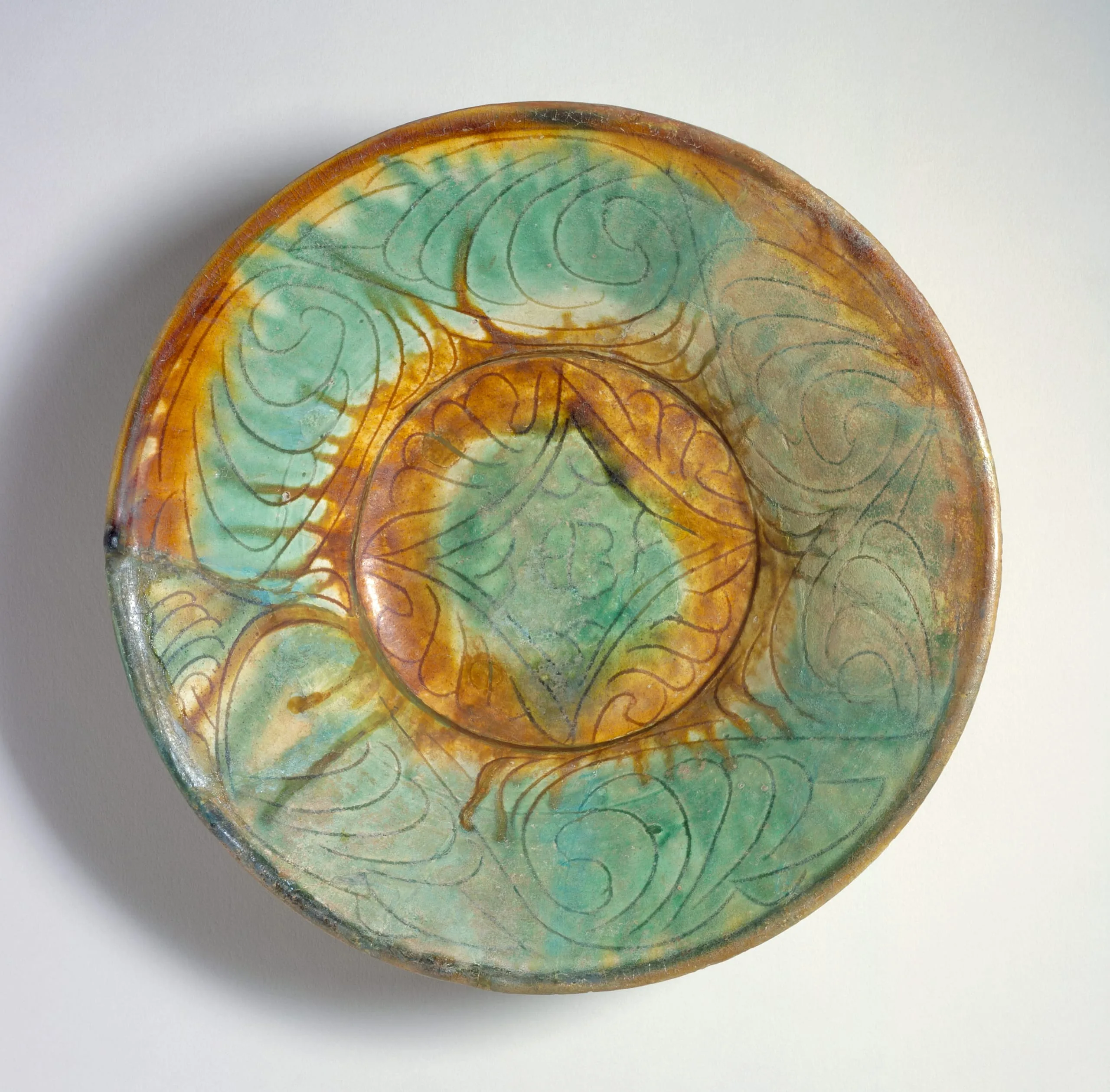
Under the Samanid dynasty (874−999), which ruled large parts of Iran and Central Asia, Nishapur, in northeastern Iran, was a center of trade, religious study, and poetry. It was also an important site for the production of ceramic wares. In the 1930s and 1940s, excavations conducted by the Metropolitan Museum of Art uncovered kilns and large quantities of pottery and wasters (flawed, discarded pots). Since then, many undocumented wares have been attributed to Nishapur, as is the case with this bowl, which is stylistically and technically related to pottery excavated at that site.
The bowl belongs to a distinctive group of ceramics designated as splashware on account of the characteristic way the colorful glazes, here green and amber, are splashed onto the surface over incised geometric and floral designs. It is generally believed that such splashware was inspired by imported Chinese Tang-dynasty ceramics decorated in amber/brown, green, and cream, and known as sancai (tricolor) wares (see M.91.133). Indeed, fragments of Tang color-splashed wares were excavated at Nishapur.
2024