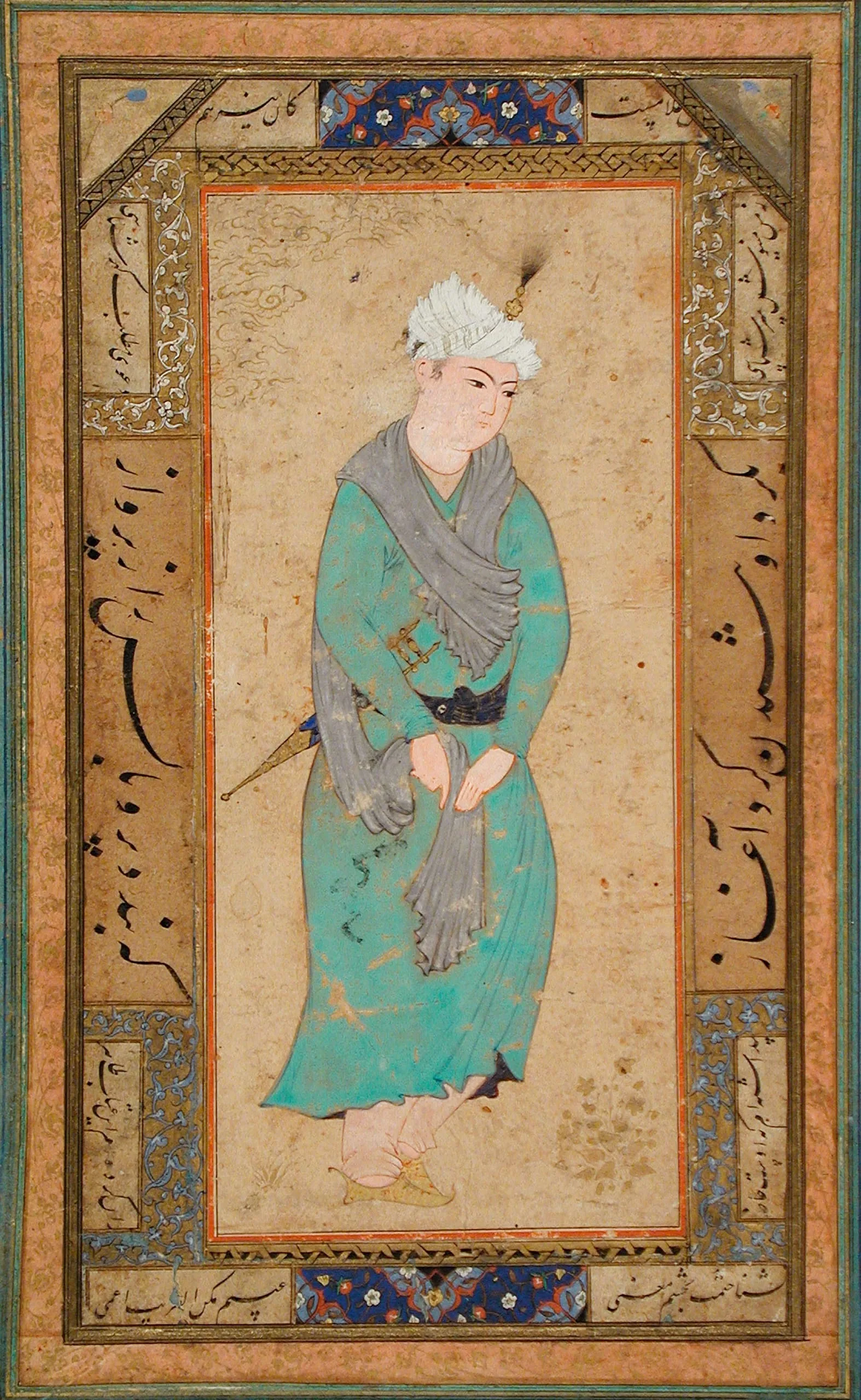
This portrait of a youthful courtier standing in a traditional Persianate posture was first attributed, specifically because of the turban style, to possibly Bijapur, Karnataka by Edwin Binney, 3rd (1974). He wears a white turban graced with a feather plume (jigha), green outer garment (jama), gray shawl, black waist sash, pinkish-white pajamas, and gold-and-red shoes. He carries a long sheathed punch dagger (katar) tucked into his waist sash. The katar has a distinctive hilt style with the terminals of the dual grips projecting through the side bars. Because the katar is partially obscured by the figure’s arm and shawl, the painter apparently used artistic license to include the idiosyncratic grips by repositioning them closer than normal to the end of the side bars.
Long katars with this hilt style are also found in the late 16th-17th centuries in Ahmadnagar, Maharashtra. For example, see a portrait of Sultan Murtaza Nizam Shah I (r. 1565-1588) attributed to Ahmadnagar, circa 1575 in the Bibliothèque Nationale, Paris (Supplement Persian 1572/26). A katar with this hilt style attributed by Robert Elgood (2017) to Ahmadnagar, circa 1675-1700 is in the Sardar Samand Palace, Jodhpur, Rajasthan (213E). The background has clouds and flowering plants in gold. The painting is mounted with margins of arabesques and nastaliq calligraphic panels and a blue border with gold blossoms.
For translations of the verses, see Pratapaditya Pal, Indian Painting (LACMA, 1993), p. 325, no. 98.