LACMA

ShopMembershipMyLACMATickets
LACMA
Los Angeles County Museum of Art
5905 Wilshire Blvd.
Los Angeles, CA 90036
info@lacma.org
(323) 857-6000
Sign up to receive emails
Subscribe
© Museum Associates 2026
  • About LACMA
  • Jobs
  • Building LACMA
  • Host An Event
  • Unframed
  • Press
  • FAQs
  • Log in to MyLACMA
  • Privacy Policy
© Museum Associates 2026
Collections

Riza-yi Abbasi
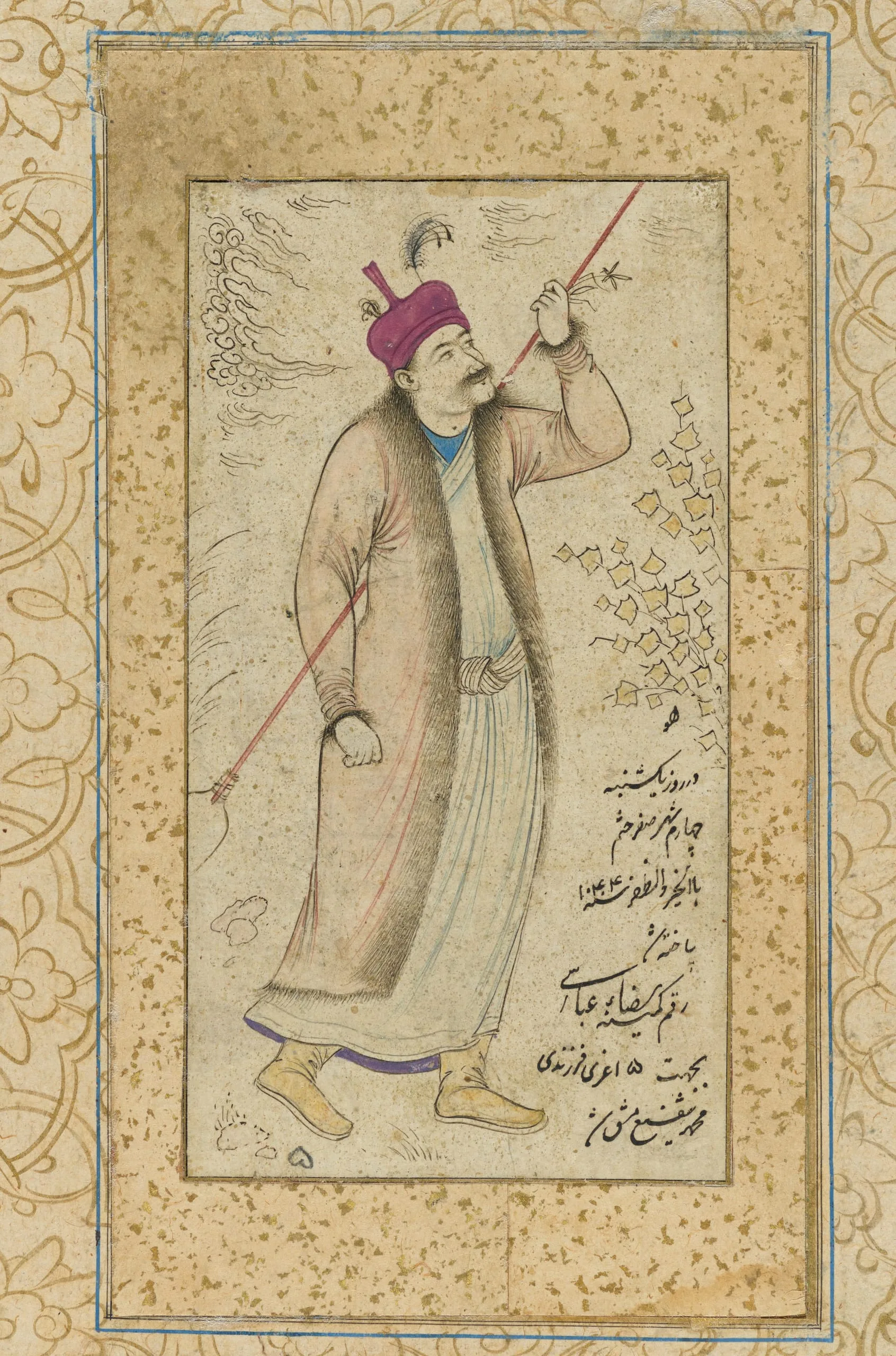
Man with a Pitchfork, Page from an Albumdated July 11, 1634 (4 Safar, A.H. 1044)

On view:
Geffen Galleries
Persian manuscript drawing in ink and wash on cream paper, a standing male figure in a long robe and red hat tilts his head back while gripping a long diagonal staff, with Persian script to the right

Riza-yi Abbasi, Man with a Pitchfork, Page from an Album, dated July 11, 1634 (4 Safar, A.H. 1044) (alternate view), Los Angeles County Museum of Art, The Nasli M. Heeramaneck Collection, gift of Joan Palevsky, Photo © Museum Associates/LACMA

Artist or Maker
Riza-yi Abbasi
Iran, Isfahan, died 1635
Title
Man with a Pitchfork, Page from an Album
Place Made
Iran, Isfahan
Date Made
dated July 11, 1634 (4 Safar, A.H. 1044)
Period
Safavid (1501-1732)
Medium
Ink and color washes on paper
Dimensions
Inner Image: 4 1/2 × 2 3/8 in. (11.43 × 6.03 cm) Sheet: 4 5/16 × 2 3/8 in. (10.95 × 6.03 cm) Frame: 20 × 15 × 1 1/2 in. (50.8 × 38.1 × 3.81 cm)
Credit Line
The Nasli M. Heeramaneck Collection, gift of Joan Palevsky
Accession Number
M.73.5.474
Classification
Manuscripts
Collecting Area
Art of the Middle East: Islamic
Curatorial Notes

During the late sixteenth and especially the seventeenth century in Iran, the increased popularity of paintings independent of text but intended for placement in albums gave rise to new artistic developments in which portraiture was paramount. More generic representations than exacting likenesses, such portraits depicted not only sophisticated and refined courtly figures but a variety of other types as well, including mendicants, soldiers, foreigners, and peasants. By the mid-seventeenth century, translucent washes of color applied over drawings, emphasizing bold calligraphic lines, had replaced the rich opaque colors previously favored. This charming tinted drawing, likely a folio detached from an album, is inscribed with the name Riza-yi ‘Abbasi, the preeminent painter of his day, and dated 4th of Safar AH 1044 (July 11, 1634 CE).

Although many paintings and drawings are inscribed with Riza’s name, not all are by the hand of the master. Some may be entirely or partially the work of a student. Such may be the case with this drawing, which was perhaps begun by Riza but completed by his son and student, Shafi, to whom he inscribed the work. The fur lining of the man’s coat lacks the fine, downy texture (produced by hundreds of tiny brushstrokes) that characterizes Riza’s undisputed works. Nonetheless, the eccentric subject matter (a well-dressed man carrying a gardener’s tool), the emphasis on line over color, and the accentuation of the figure’s curved contours to impart a sense of movement are all features of Riza’s manner, which took hold in seventeenth-century Isfahan.
Selected Bibliography
  • Pal, Pratapaditya, ed. Islamic Art: The Nasli M. Heeramaneck Collection. Los Angeles: Museum Associates, 1973.
  • Komaroff, Linda. Islamic Art at the Los Angeles County Museum of Art. Los Angeles: Museum Associates, 2005.
  • Lo Terrenal y lo Divino: Arte Islámico siglos VII al XIX Colección del Museo de Arte del Condado de Los Ángeles. Santiago: Centro Cultural La Moneda, 2015.

  • Pal, Pratapaditya, Thomas W. Lentz, Sheila R. Canby, Edwin Binney, 3rd, Walter B. Denny, and Stephen Markel. "Arts from Islamic Cultures: Los Angeles County Museum of Art." Arts of Asia 17, no. 6 (November/December 1987): 73-130.