- Title
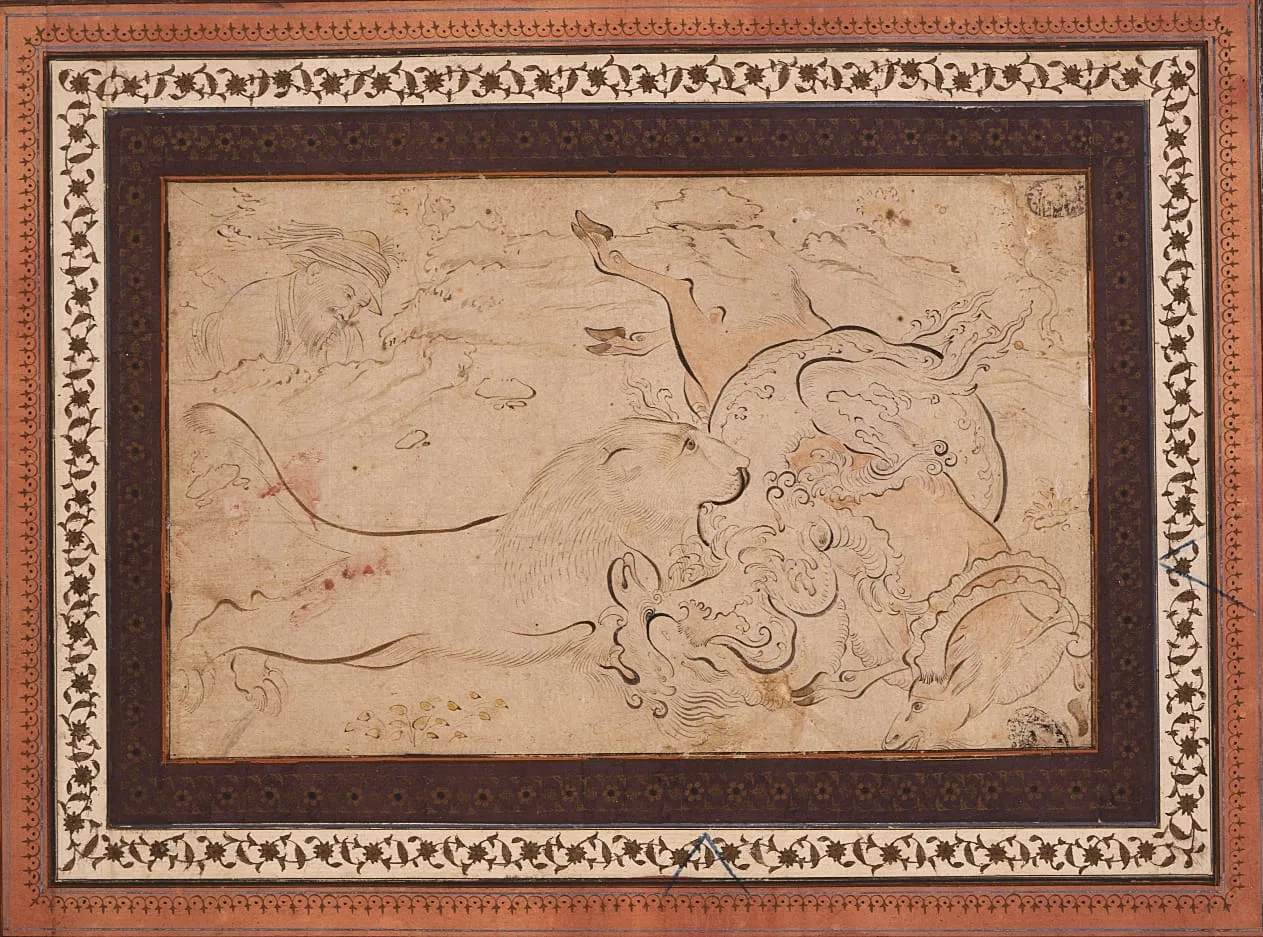
- Lion Attacking a Dragon Wrapped Around a Ram, Page from an Album
- Date Made
- dated AH 27 Rajab 1103/ AD April 14, 1692
- Medium
- Ink and color washes on paper
- Dimensions
- 5 x 8 in. (12.75 x 20.25 cm)
- Accession Number
- M.73.5.12
- Curatorial Notes
The theme of animal combat, particularly dragons battling other creatures, holds a significant place in Persian art, where it crossed over from painting into the decoration of ceramics and tilework, bearing witness to its impact (M.73.5.4). The theme was refined by seventeenth-century Safavid artists, who drew inspiration from Chinese prototypes to create their own distinctive compositions. A prime example of this tradition is this single-page composition, signed and dated by Mu‘in Musavvir, whose work is closely associated with the style of his teacher Riza-yi ‘Abbasi (d. 1635). The painting exemplifies Safavid artistry, characterized by fluid calligraphic lines coupled with minute attention to expressive detail. The heavily stylized dragon coils around a ram or goat, whose face is rendered vividly; the dragon’s barely discernible head turns to snap at a charging lion. Dynamic textures and spontaneous contours amplify a sense of motion, while an observer at upper left adds dramatic tension.
2024
- Selected Bibliography
- Taylor, Alice. Book Arts of Isfahan: Diversity and Identity in Seventeenth-Century Persia. Malibu, CA: J. Paul Getty Museum, 1995.
- Pal, Pratapaditya, ed. Islamic Art: The Nasli M. Heeramaneck Collection. Los Angeles: Museum Associates, 1973.
Pal, Pratapaditya, Thomas W. Lentz, Sheila R. Canby, Edwin Binney, 3rd, Walter B. Denny, and Stephen Markel. "Arts from Islamic Cultures: Los Angeles County Museum of Art." Arts of Asia 17, no. 6 (November/December 1987): 73-130.