LACMA

ShopMembershipMyLACMATickets
LACMA
Los Angeles County Museum of Art
5905 Wilshire Blvd.
Los Angeles, CA 90036
info@lacma.org
(323) 857-6000
Sign up to receive emails
Subscribe
© Museum Associates 2026
  • About LACMA
  • Jobs
  • Building LACMA
  • Host An Event
  • Unframed
  • Press
  • FAQs
  • Log in to MyLACMA
  • Privacy Policy
© Museum Associates 2026
Collections

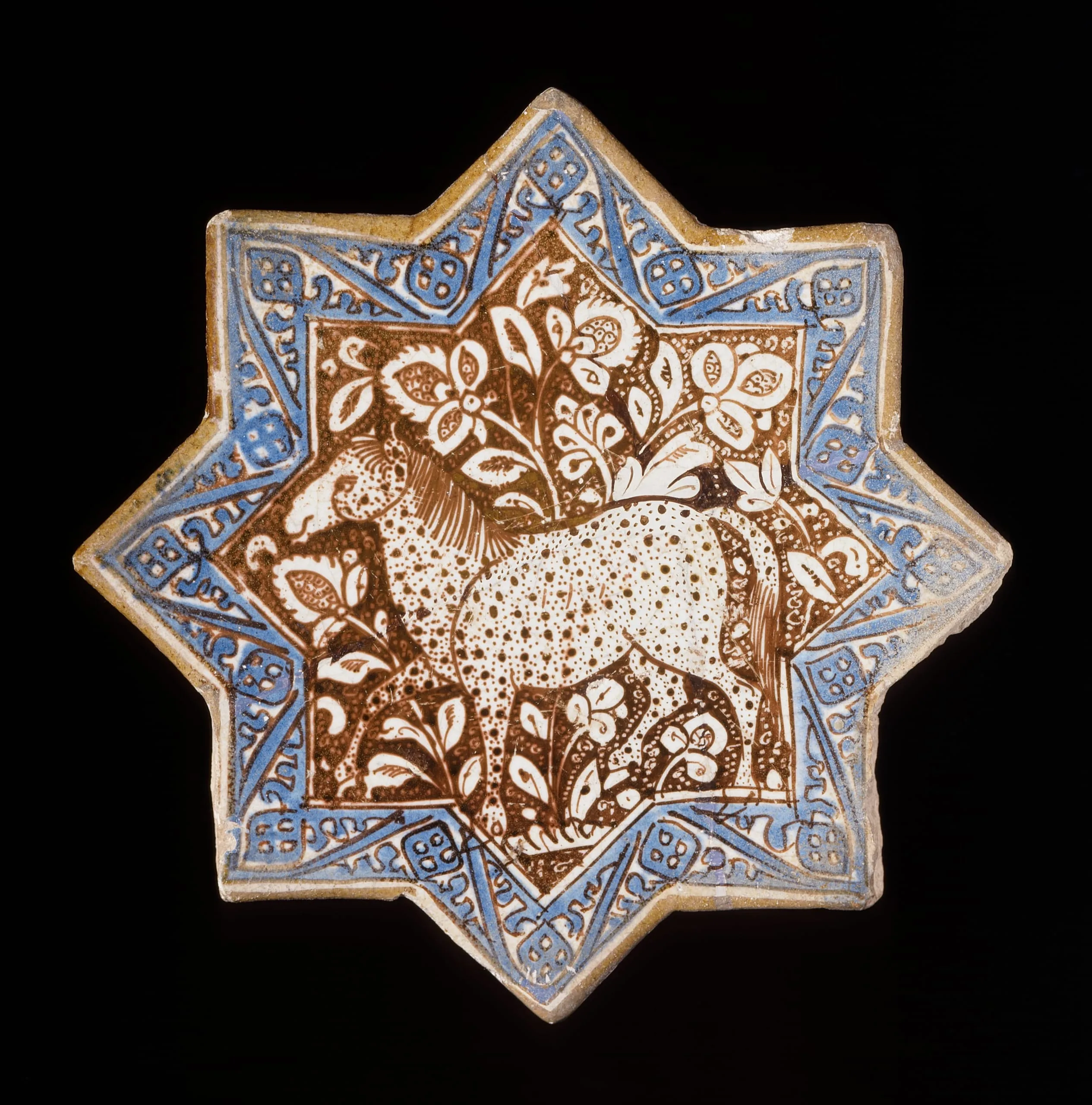
Star Tilecirca 1300

Not on view
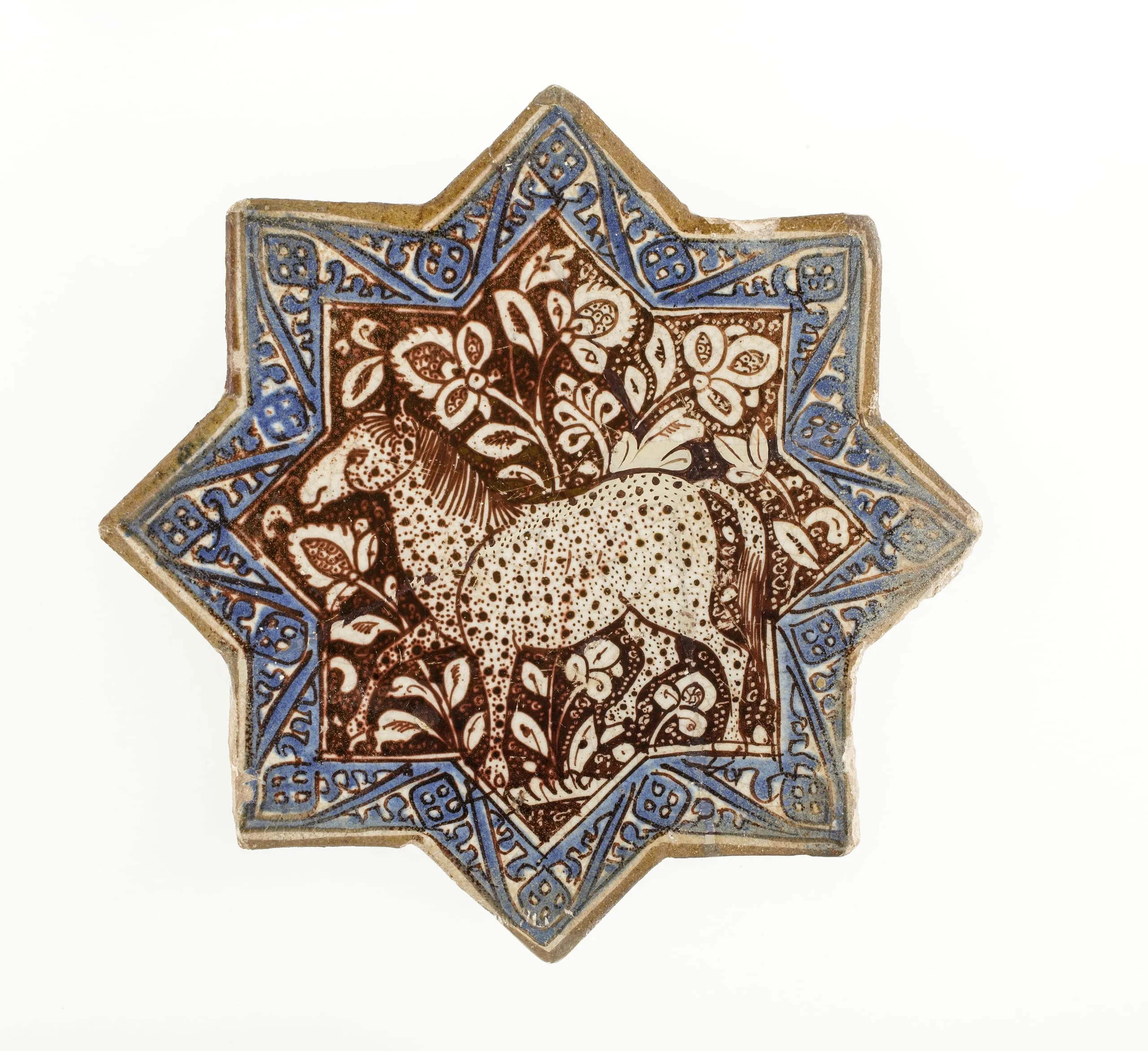
Eight-pointed star ceramic tile with cobalt blue scrollwork border and reddish-brown luster central field depicting a spotted quadruped among stylized flowering plants
Eight-pointed star-shaped ceramic tile with lusterware decoration; a spotted horse amid flowering foliage rendered in white against a rich brown ground at center, framed by a blue-glazed geometric border with scrolling vine motifs at the points.

Unknown, Star Tile, circa 1300, Los Angeles County Museum of Art, The Nasli M. Heeramaneck Collection, gift of Joan Palevsky, photo © Museum Associates/LACMA

Title
Star Tile
Place Made
Iran, Kashan
Date Made
circa 1300
Medium
Fritware, overglaze luster-painted, with cobalt blue
Dimensions
Diameter: 8 1/4 in. (20.96 cm)
Credit Line
The Nasli M. Heeramaneck Collection, gift of Joan Palevsky
Accession Number
M.73.5.377
Classification
Ceramics
Collecting Area
Art of the Middle East: Islamic
Curatorial Notes

Luster-painted ceramics, which represent one of the most original and spectacular contributions of the Islamic potter, is an especially long-lived technique, and the resulting products must have always been considered as a form of luxury ware, in part because they required two firings. In the first firing, an opaque, generally white glaze was applied, and in the second, the design was daubed from a paste that included silver and copper compounds ground with sulfur. The second firing took place in a special kiln that restricted the flow of oxygen; this reducing atmosphere forced the metals to give up their oxygen, thereby creating a thin, lustrous film that fused with the glazed surface.

From the late twelfth to the early fourteenth century, Kashan, in Central Iran, was the most prolific center for lusterware. During this period, a chief duty of the Kashan potters was to produce dazzling luster tile ensembles to cover the walls of newly constructed palaces and religious monuments. This star-shaped tile, depicting a horse in a landscape, may have originally formed part of one such assemblage, composed of dozens of interlocking pieces that featured various animal and human figures. The horse’s spots represent a convention of Kashan luster painting rather than an observation based on natural appearance.

2025
Selected Bibliography
  • Pal, Pratapaditya, ed. Islamic Art: The Nasli M. Heeramaneck Collection. Los Angeles: Museum Associates, 1973.
  • Hess, Catherine. The Arts of Fire: Islamic Influences on Glass and Ceramics of the Italian Renaissance. Los Angeles: J. Paul Getty Trust, 2004.
  • Lo Terrenal y lo Divino: Arte Islámico siglos VII al XIX Colección del Museo de Arte del Condado de Los Ángeles. Santiago: Centro Cultural La Moneda, 2015.

  • Komaroff, Linda. Beauty and Identity: Islamic Art from the Los Angeles County Museum of Art. Los Angeles: Los Angeles County Museum of Art, 2016.