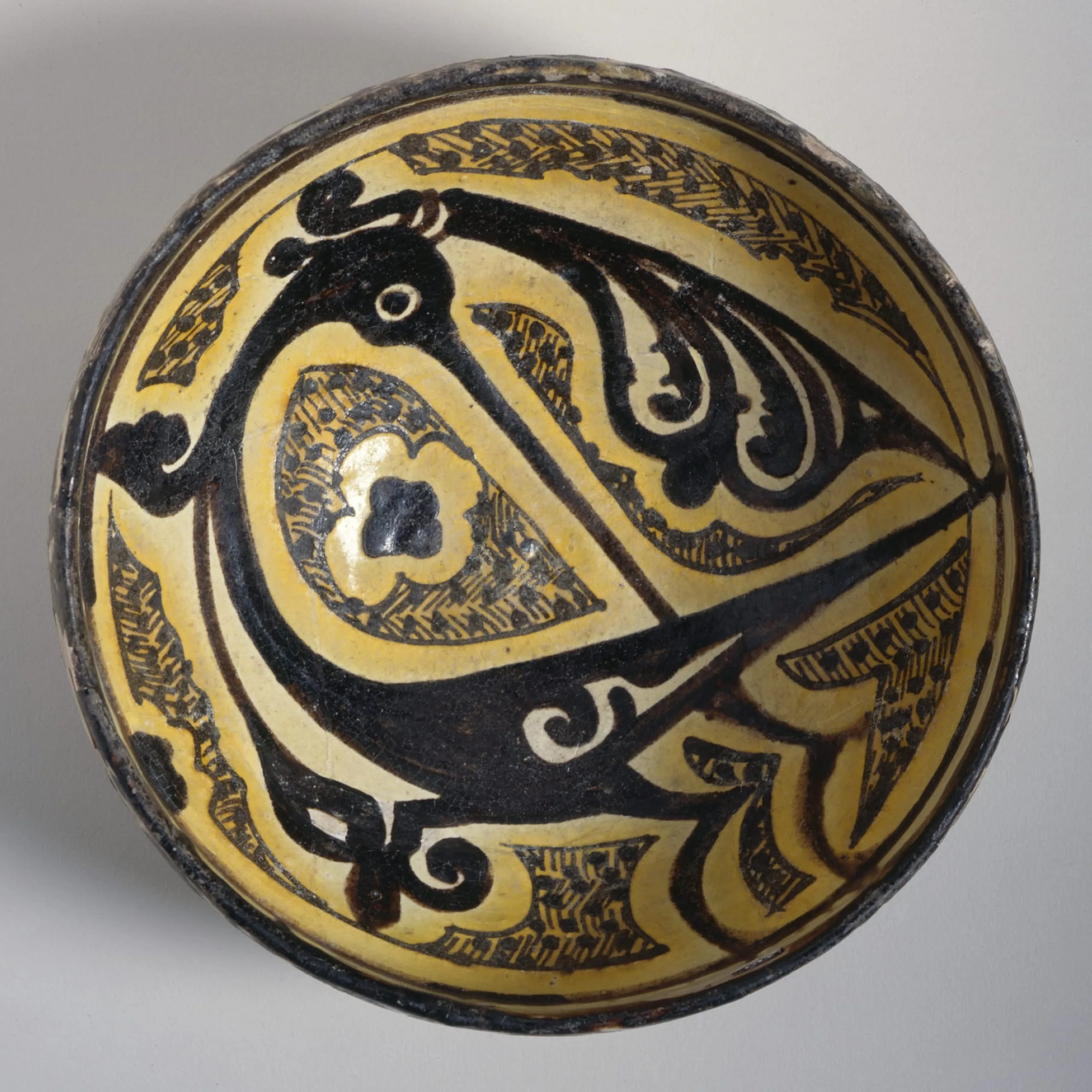
Under the Samanid dynasty (874−999), which ruled large parts of Iran and Central Asia, Nishapur, in northeastern Iran, was a center of trade, religious study, and poetry. It was also an important site for the production of ceramic wares. In the 1930s and 1940s, excavations conducted by the Metropolitan Museum of Art uncovered kilns and large quantities of pottery and wasters (flawed, discarded pots). Since then, many undocumented wares have been attributed to Nishapur, as is the case with this bowl, which is stylistically and technically related to pottery excavated at that site.
Among the decorative themes of Nishapur wares, bird motifs are especially prominent (see M.73.5.226). In this remarkable example, the centrally placed bird is painted in purple-black against a mustard yellow background under a clear glaze. Depicted in a dynamic stance, the bird’s head faces backward, its beak meets its tail, and its feathered crest forms a large half-palmette. The design is complemented by dotted and hatched fillings.
2024