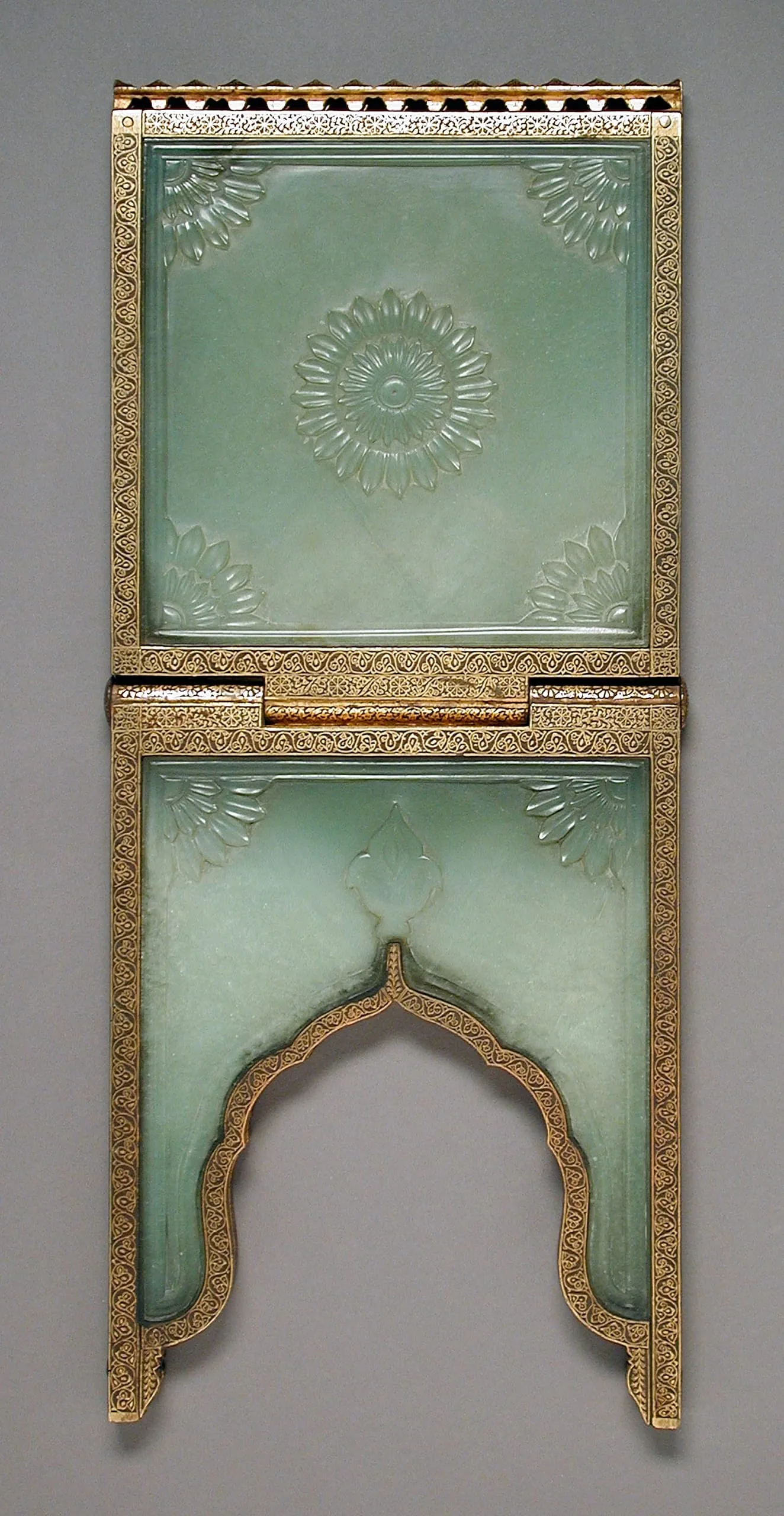
This collapsible bookstand (X-shaped when open and in use) was made for supporting an Islamic Qur'an during reading and recitation. The bookstand is bound with a steel frame decorated principally with a bud-and-creeper scroll design that is inlaid with gold wire in the koftgari technique characteristic of Panjabi metalware. Diamond-shaped crenulations articulate the frame’s top edges. Encased within the frame are panels of light green lizardite serpentine, which is occasionally employed as a jade simulant because of its close visual similarity, and because it is easier to carve than nephrite jade due to having a softer surface. The panels are adorned on the exterior with concentric lotus flowers in the center and quarter-flowers in most corners. The legs of the stand are formed into pointed architectural-style arches, which are surmounted by a palmette-shaped pinnacle sometimes found on Islamic architecture and ceremonial standards.
The production of jades and jade simulants in the Panjab was centered near Bhera, an ancient trade center northwest of Lahore. A wide range of jade simulants were made in Bhera, including Qur'an stands, hilts for daggers and table cutlery, cups, boxes, cane handles, necklaces, and paperweights. Serpentine was reportedly imported from Afghanistan and sold at Attock, northwest of Bhera. Jade simulants from Bhera were featured artifacts in the grand art exhibitions held in India and internationally in the late 19th and early 20th centuries.
See Stephen Markel, "Non-Imperial Mughal Sources for Jades and Jade Simulants in South Asia," Jewellery Studies 10 (2004): pp. 68-69, fig. 2.