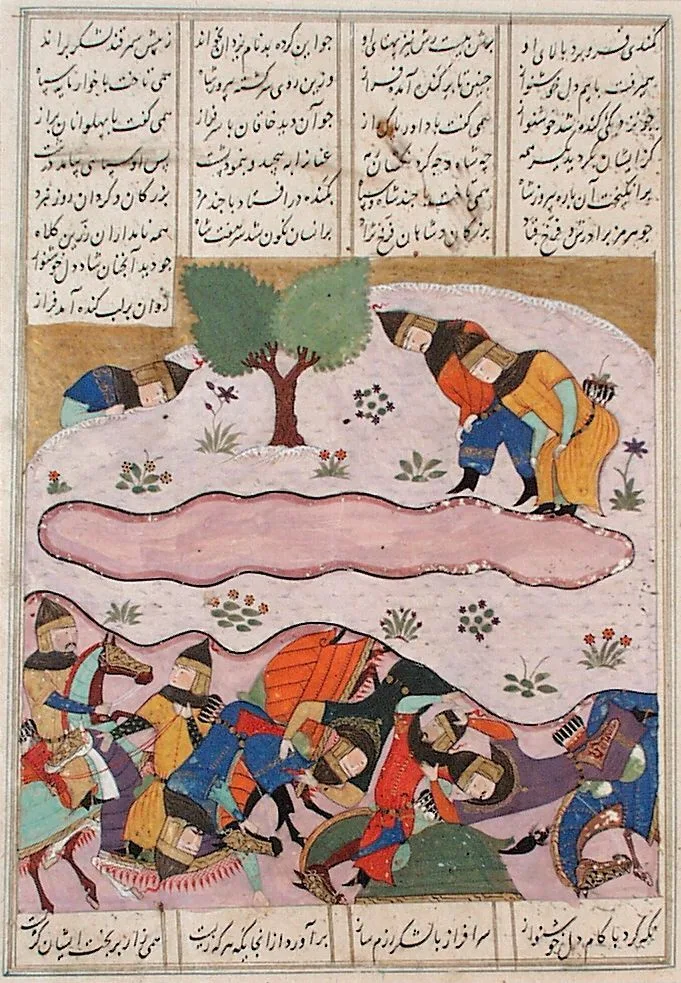
The Shahnama (Book of Kings), the Iranian national epic, was composed by Firdawsi and completed around 1010. It chronicles in verse the legendary and historical kings and heroes of the Persian Empire up to the Arab Muslim conquest in the seventh century. Illustrated manuscripts of the text, usually made under courtly patronage, only survive from the early fourteenth century onward; many of these were broken up in modern times for the sake of their paintings. Typically, the architectural settings and costumes of the depicted characters reflect the era in which the manuscript was made, drawing a connection between ancient kings and heroes and the then present-day court. On that account, the commissioning of such anachronistically illustrated manuscripts appealed to great kings and provincial rulers alike.
This illustration has to do with the historical king Piroz (r. 459−84), who violated a treaty with a neighboring state, bringing about his demise and disaster to his kingdom. To avoid an outright confrontation with Piroz’s army, the opposing forces dug an enormous trench, which hid them from sight. When Piroz advanced, he and his cavalry fell into the pit. In this painting, from late fifteenth-century Shiraz, the artist has divided the infamous scene into two registers, with Piroz and his horsemen dramatically crushed below in the pit and the victors looking down on them from above. This folio is one of seven illustrations from the same Shahnama in LACMA’s collection (see M.73.5.410, .411, .413, .462, .463, and .590).
2024