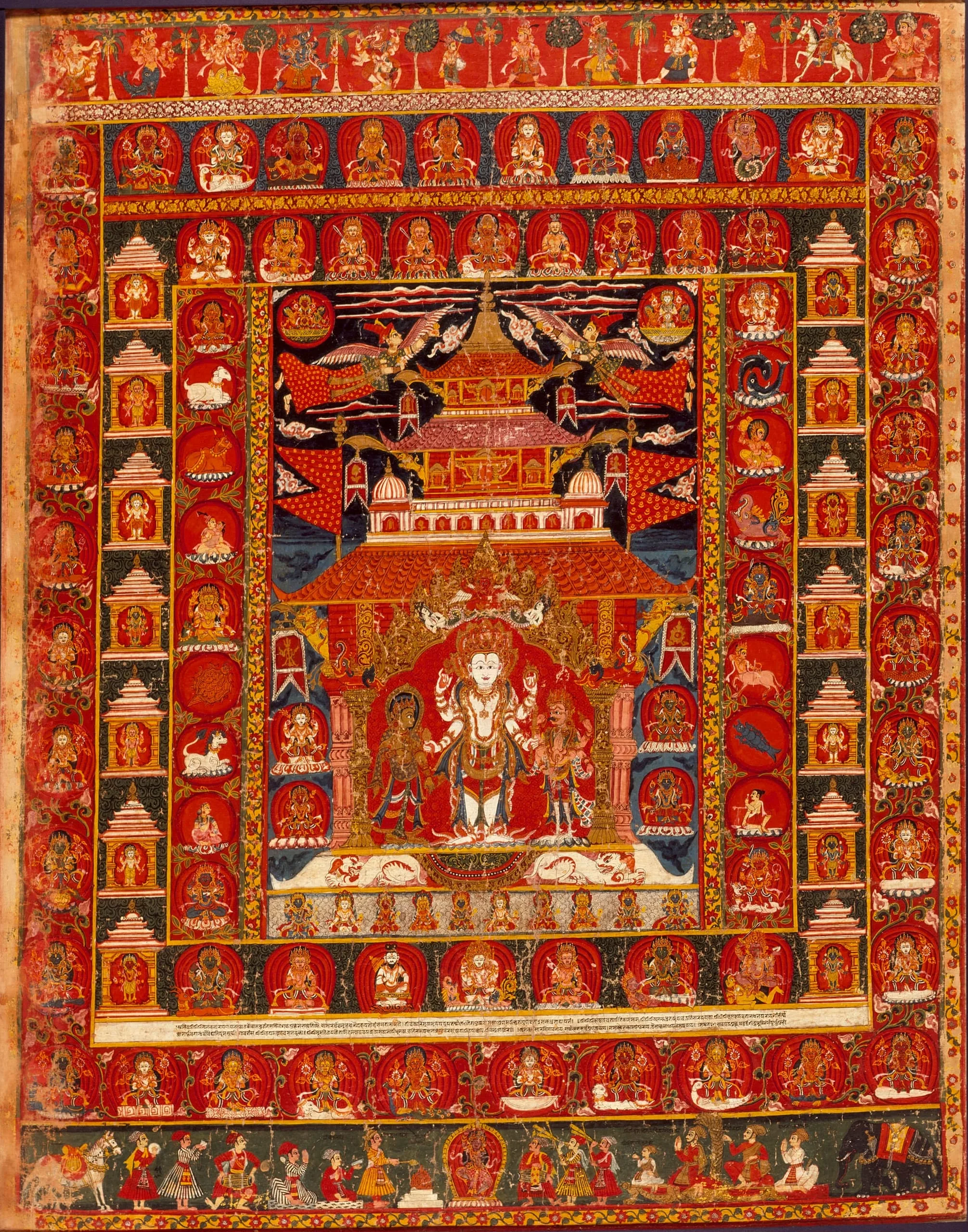
This painting commemorates the performance of the ritual of anantavrata (ceremony in honor of Ananta/Vishnu) in 1681 by King Jitamitramalla of Bhaktapur (r. 1673–96) and his younger brother, Ugramalla. Inside a Nepalese temple Vishnu is depicted in his form of Anantanarayana (the Infinite Lord). The multiple hoods of Ananta, a serpent symbolizing infinity, extend above Vishnu’s head as his coiled body supports him from behind. To the left of Vishnu is his wife, Lakshmi, and to the right stands his half-avian mount, Garuda. The temple floats on the cosmic ocean, which is inhabited by eight demigods representing the treasures of the ocean and two other forms of Vishnu. The top register depicts the ten avatars of Vishnu, and fourteen other images of Vishnu are enshrined.
Cosmic imagery is interspersed throughout the painting with additional depictions of Vishnu, various gods, and guardian deities. In the sky above the temple the sun god, Surya, and the moon god, Chandra, are shown riding in their chariots. The nine planetary deities (navagraha) are below Vishnu’s avatars. On the vertical border flanking the temple are the twelve signs of the zodiac as well as Ganesa, Bhairava, Manjushri, and guardians.
In the bottom register at the right King Jitamitramalla sits beneath the serpent Ananta, indicating the king to be an incarnation of Vishnu. Seated behind King Jitamitramalla are his brother Ugramalla and Bhagirama Pradhananga, his chief minister. In front of the king is his son and successor, the future King Bhupatindramalla (r. 1696–1722). In the center of the bottom register the goddess Taleju is shown dancing on a lotus pedestal. Taleju, a manifestation of the Hindu goddess Durga, was the tutelary deity of the Malla dynasty (1482-1769), to which this anantavrata ceremony was dedicated. The priest pouring oblations into the fire in front of Taleju is Chandrashekhara Upadhyaya, the royal guru.