LACMA

ShopMembershipMyLACMATickets
LACMA
Los Angeles County Museum of Art
5905 Wilshire Blvd.
Los Angeles, CA 90036
info@lacma.org
(323) 857-6000
Sign up to receive emails
Subscribe
© Museum Associates 2025

Museum Hours

Monday

11 am–6 pm

Tuesday

11 am–6 pm

Wednesday

Closed

Thursday

11 am–6 pm

Friday

11 am–8 pm

Saturday

10 am–7 pm

Sunday

10 am–7 pm


  • About LACMA
  • Jobs
  • Building LACMA
  • Host An Event
  • Unframed
  • Press
  • FAQs
  • Log in to MyLACMA
  • Privacy Policy
© Museum Associates 2025
Collections

Unknown
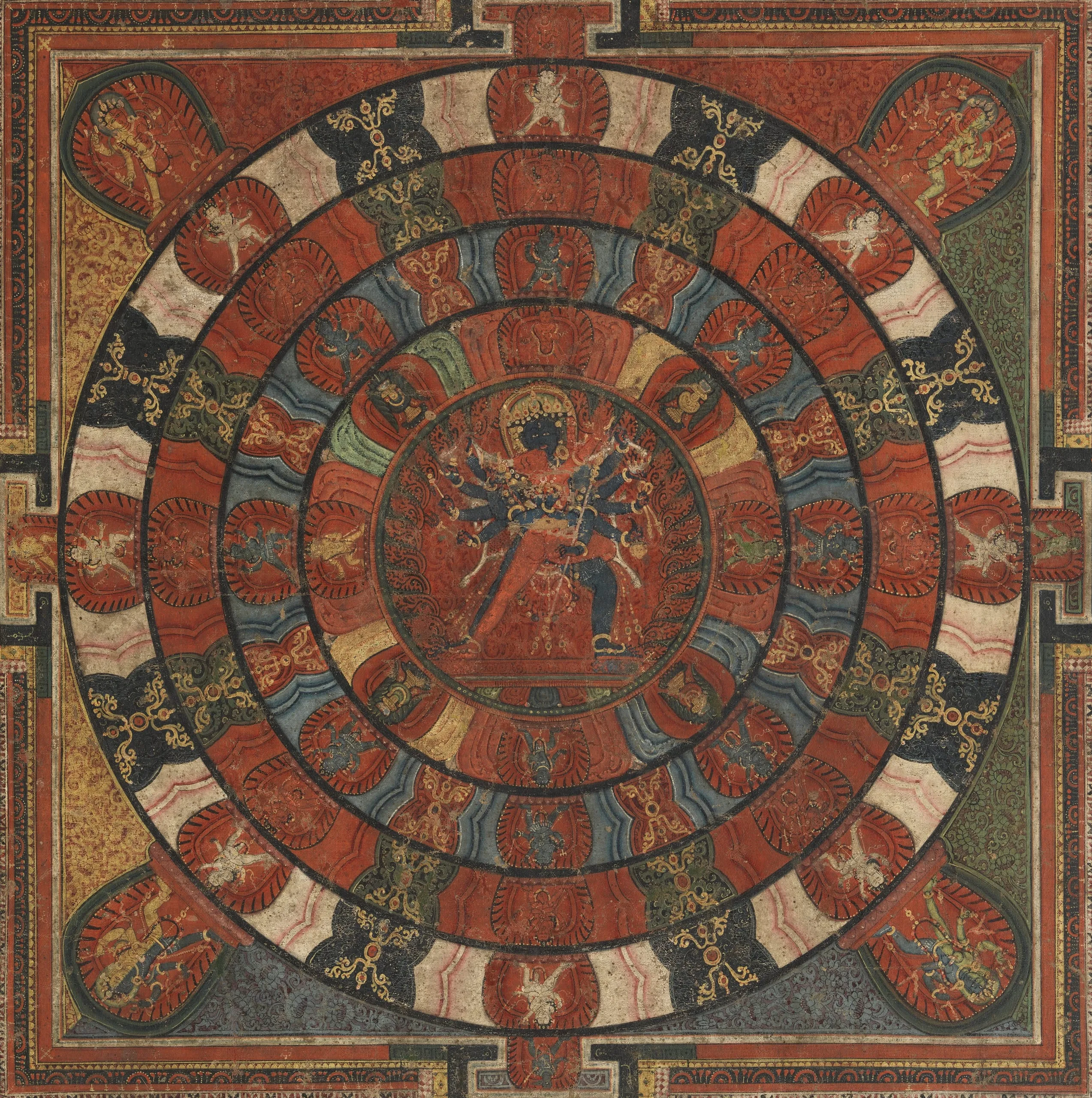
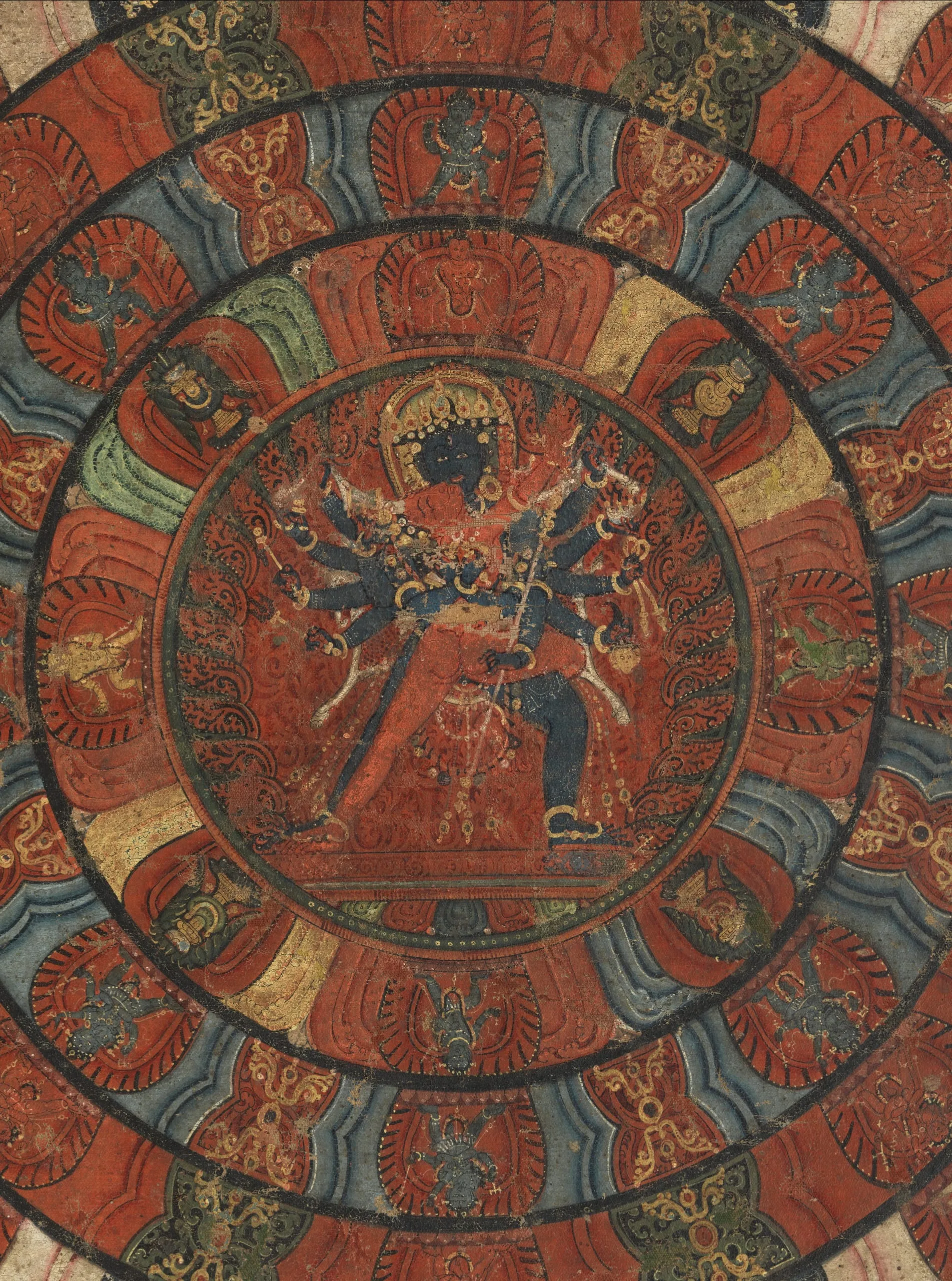
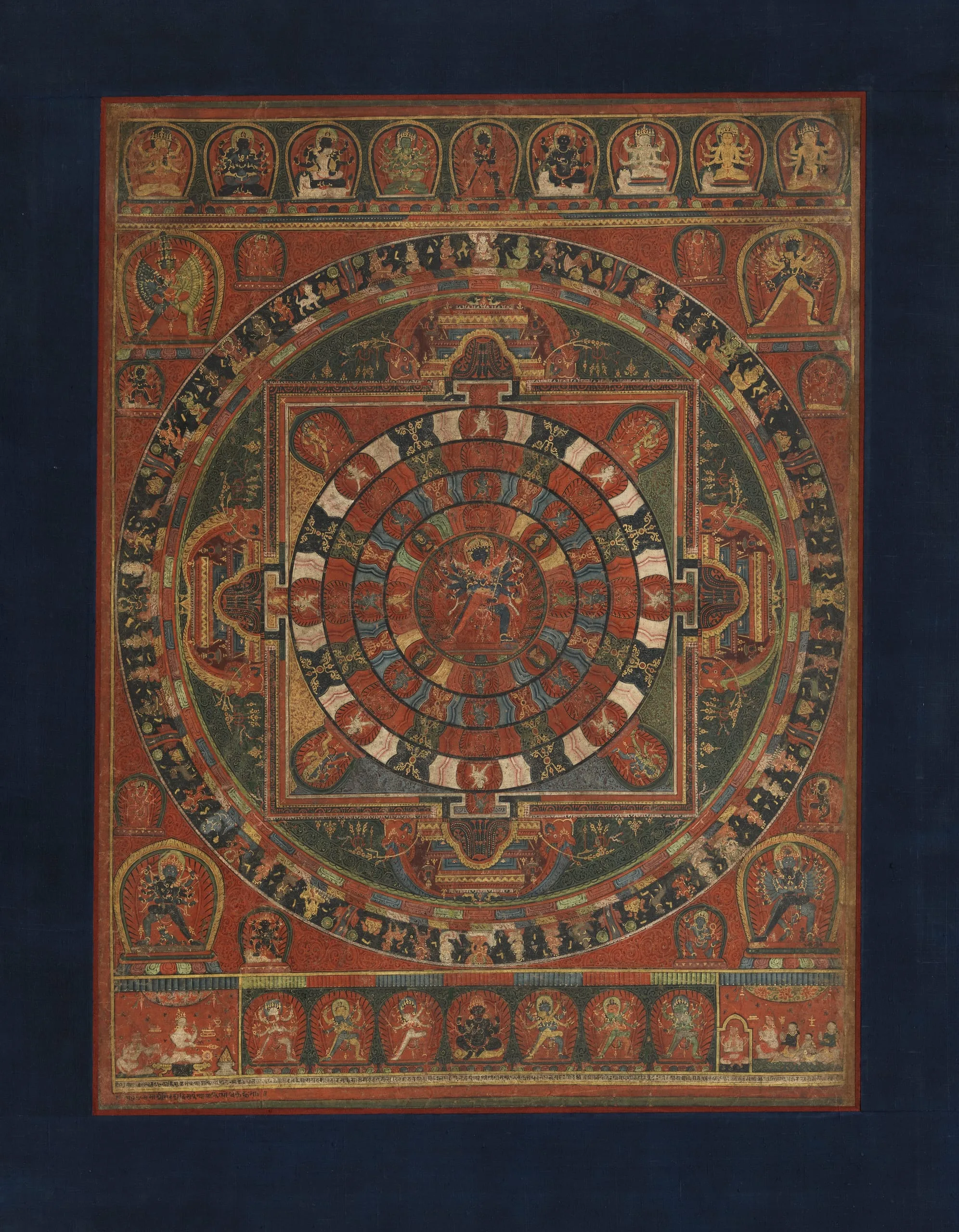
Mandala of the Buddhist Deity ChakrasamvaraDated 1490

On view:
Geffen Galleries, Pan-Asian Buddhist Art
Himalayan Buddhist mandala painting on cloth, concentric circles of deity figures in crimson, gold, green, and blue surrounding a central multi-armed figure, with deity registers along all four borders
Tibetan thangka mandala, mineral pigments on cloth, featuring concentric circles and a square palace structure in red, blue, green, and gold. Deity figures populate the central medallion and outer rings, with wrathful and peaceful figures in the four corners against a deep red ground. Fine brushwork throughout.
Painted mandala on cloth, concentric circles in deep red, black, and gray radiating from a central deity figure with multiple arms, surrounded by rings of lotus petals and smaller figures; four corner panels with additional figures on patterned grounds; fine gilt detailing throughout.
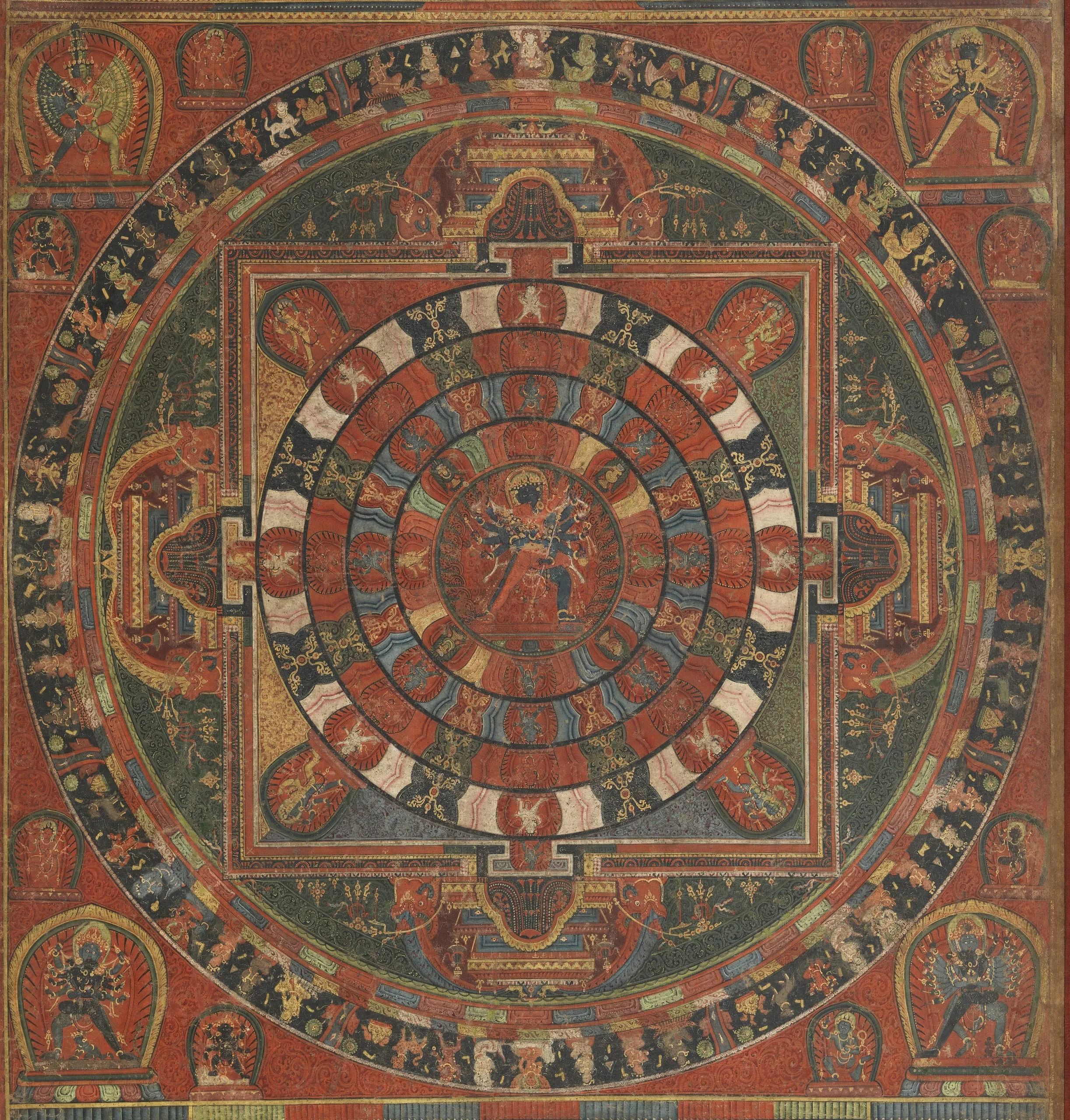
Tibetan mandala painting on cloth, dominated by deep red, blue-gray, and gold tones. A multi-armed dark blue deity in union pose occupies the central medallion, surrounded by concentric rings of lotus petals, smaller deity figures, and ornamental bands with fine gold detailing.
Nepalese or Tibetan mandala painting on cloth, upper register showing a row of multi-armed deities in arched niches against a red ground, lower section featuring a large circular cosmic diagram with densely painted figures, architectural elements, and celestial beings in red, black, and gold.
Pigment on cloth painting, lower portion of a mandala on a vivid red ground; a curved band densely populated with multi-armed deities in dark tones arcs across the upper half, flanked by two large blue and black figures in dynamic stances. Below, a horizontal register shows a row of seven multi-armed figures set within flame-shaped aureoles, with narrative scenes at far left and right. Fine detail throughout, with gold accents and Tibetan script along the lower border.
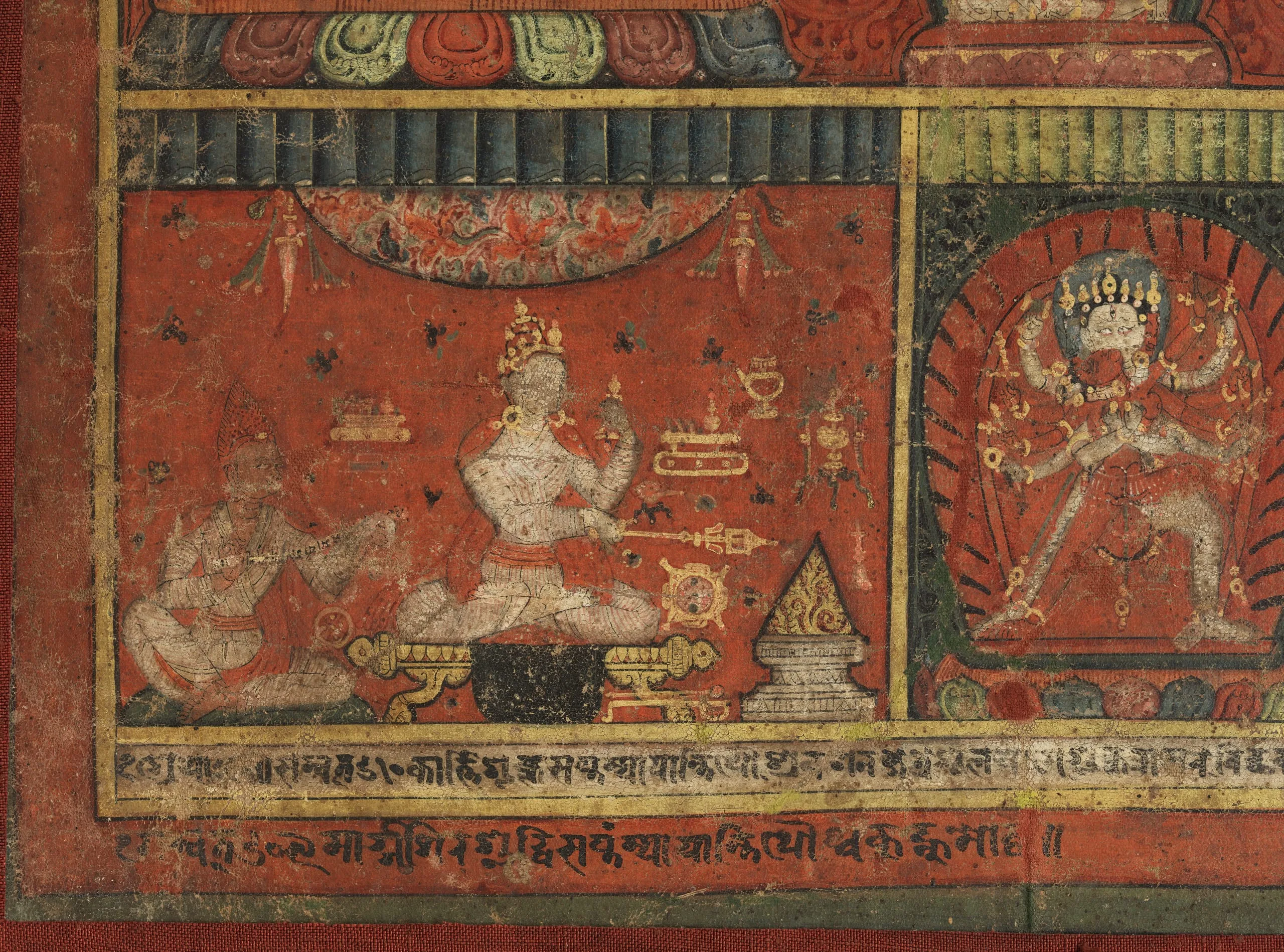
Detail of an illustrated manuscript page with red ground; a crowned, light-skinned deity seated in lotus position holds ritual objects, flanked by smaller attendant figures and ceremonial implements; at right, a multi-armed deity stands within an arch; two lines of Devanagari script appear along the lower border; gold and blue architectural banding at top
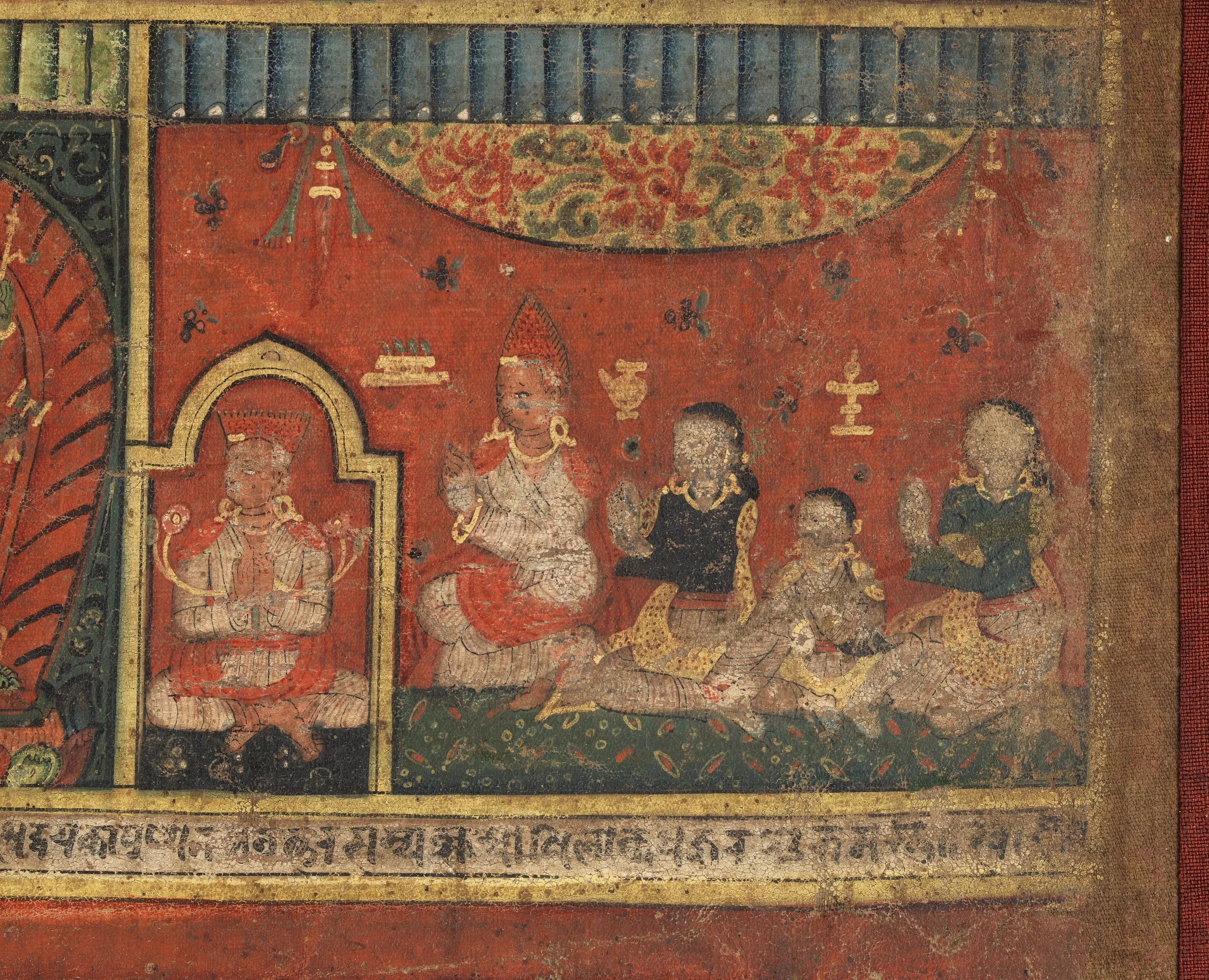
Manuscript painting on paper with red ground; a crowned figure seated cross-legged faces four attendants on a patterned green floor beneath a floral canopy; at left, a multi-armed deity is depicted within a gold arch; Devanagari script inscription along the lower border; flat opaque pigments with gold details.
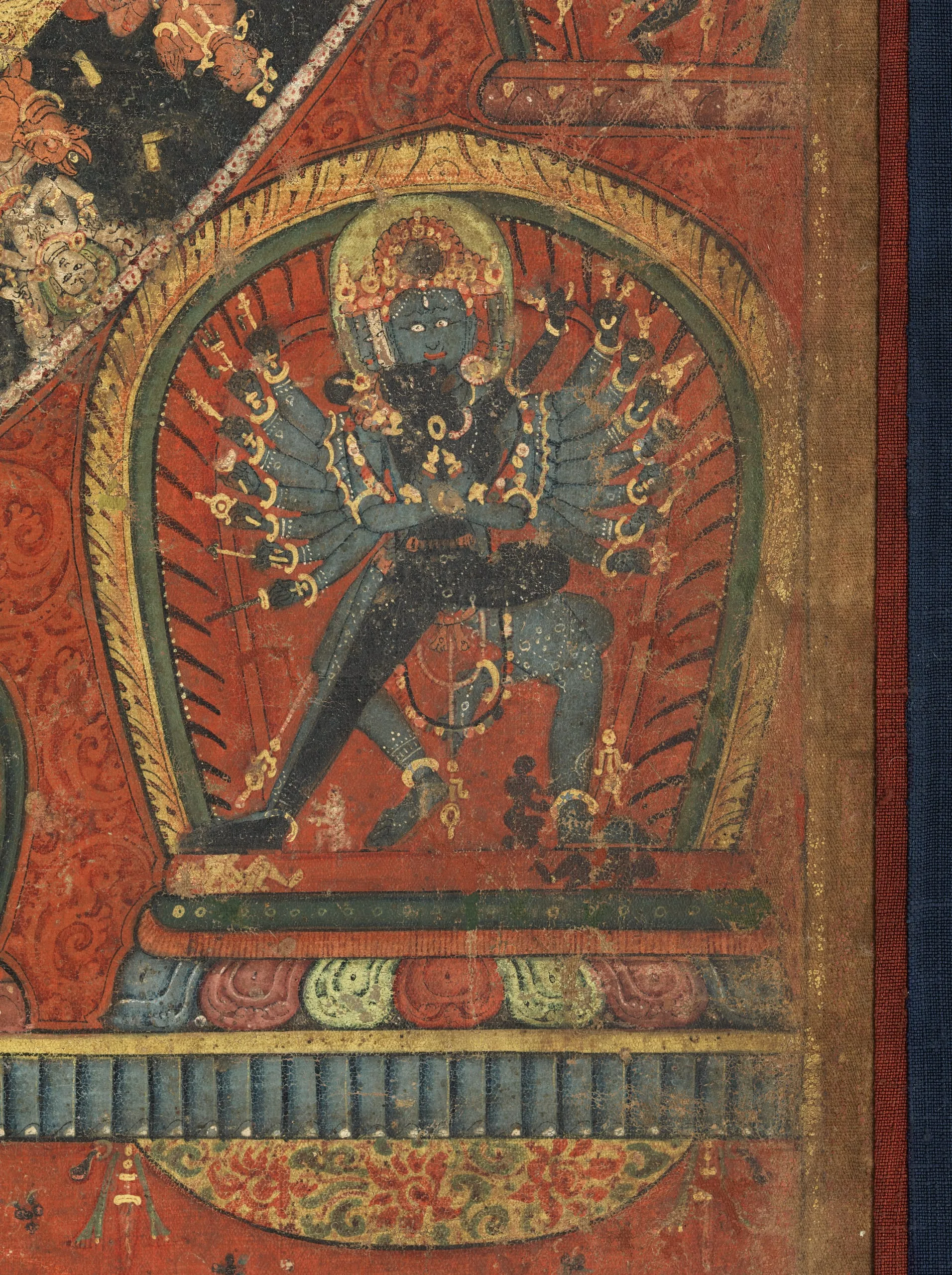
Himalayan thangka detail, dark blue multi-armed deity in dynamic stance within an arched red aureole, adorned with gold jewelry and skull ornaments, standing on a lotus throne with decorative border below
Detail of a Himalayan manuscript painting depicting a multi-armed, dark blue wrathful deity in a dynamic standing pose within a flame-edged aureole, set against a red ground with gold scroll ornamentation; fine mineral pigments with visible aging.
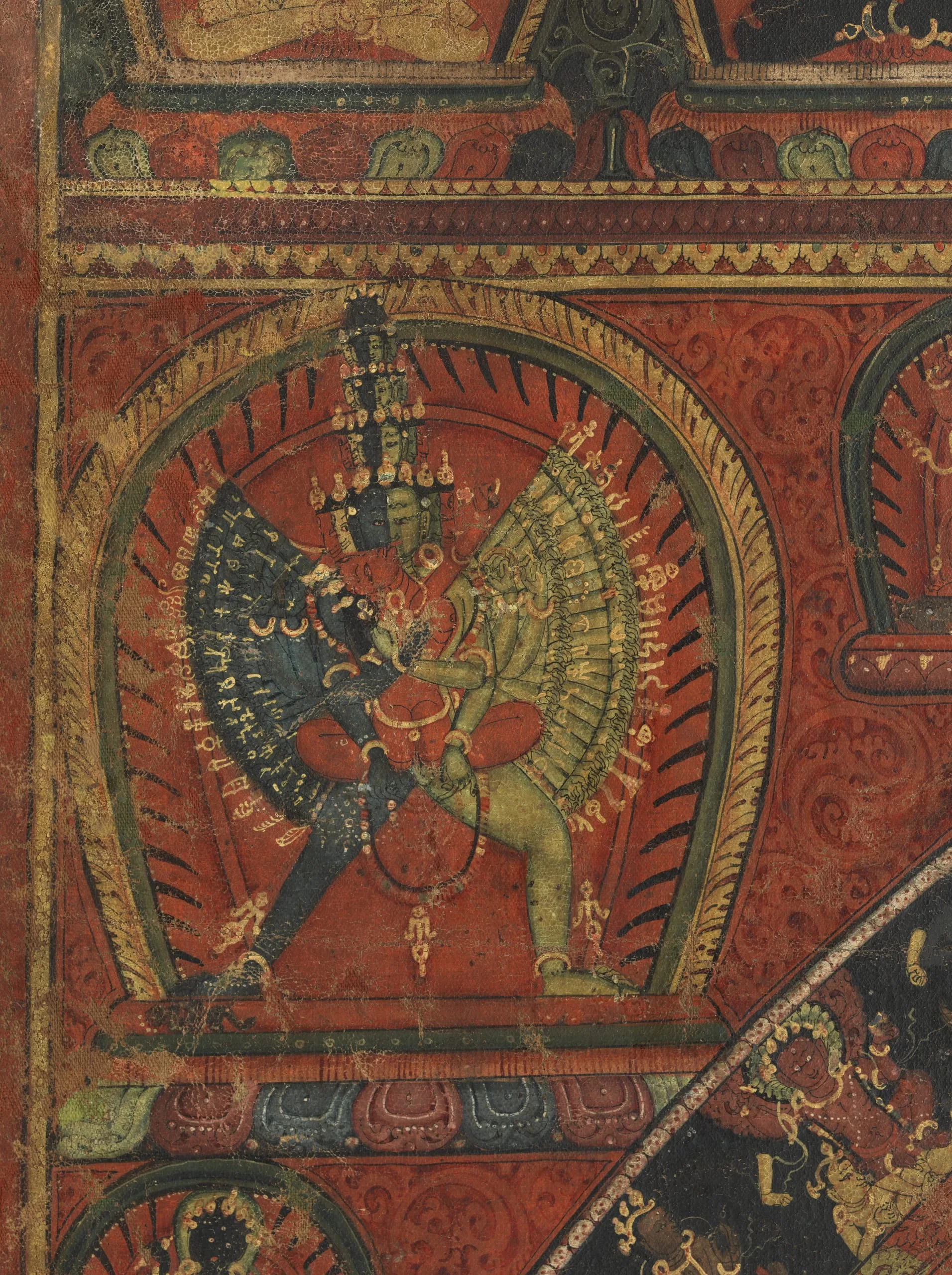
Himalayan thangka painting detail, two multi-armed deity figures in yab-yum embrace within a flaming mandorla, rendered in red, dark blue, and green against a deep red ground with gold decorative borders and Tibetan script inscriptions.
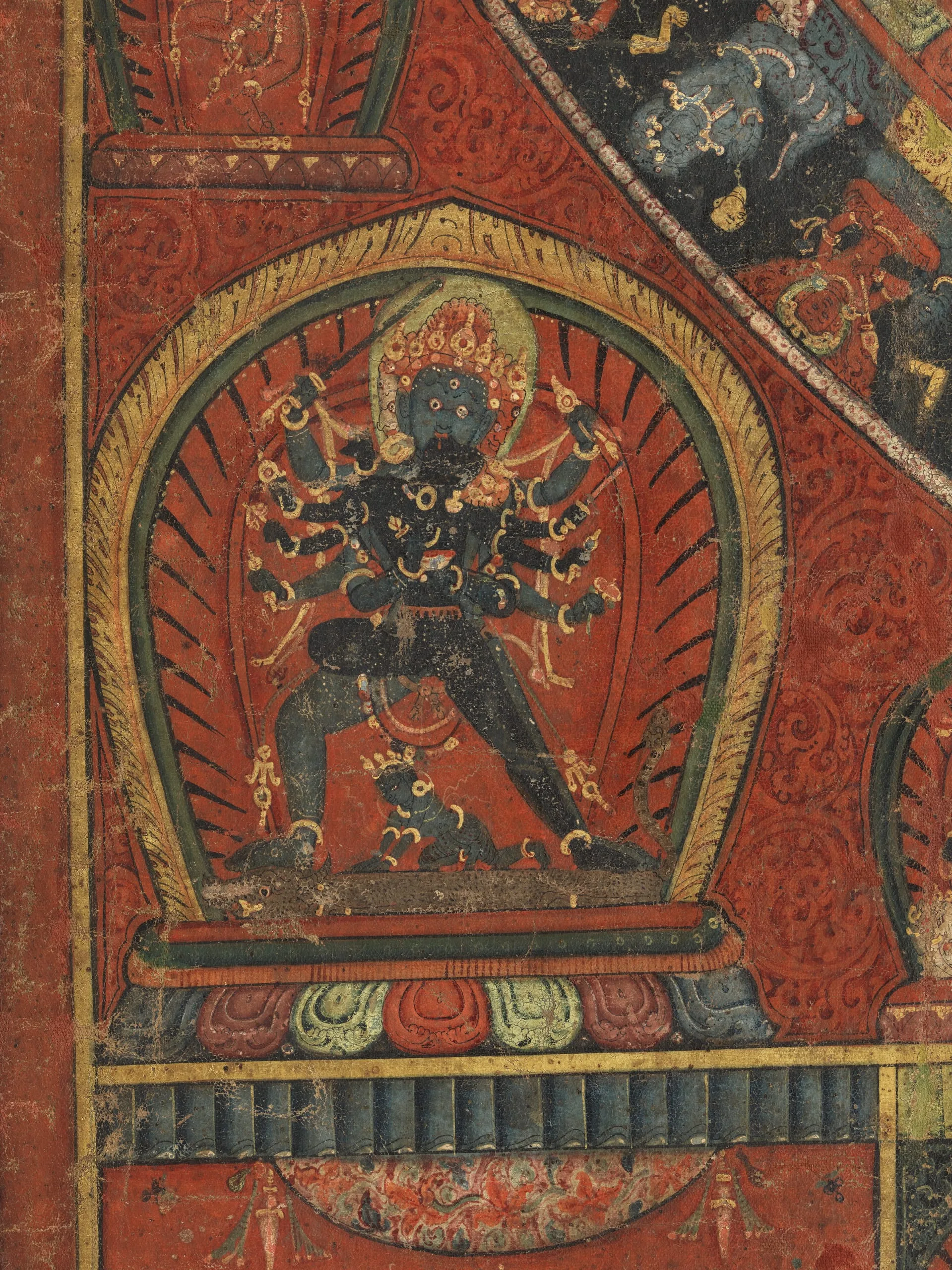
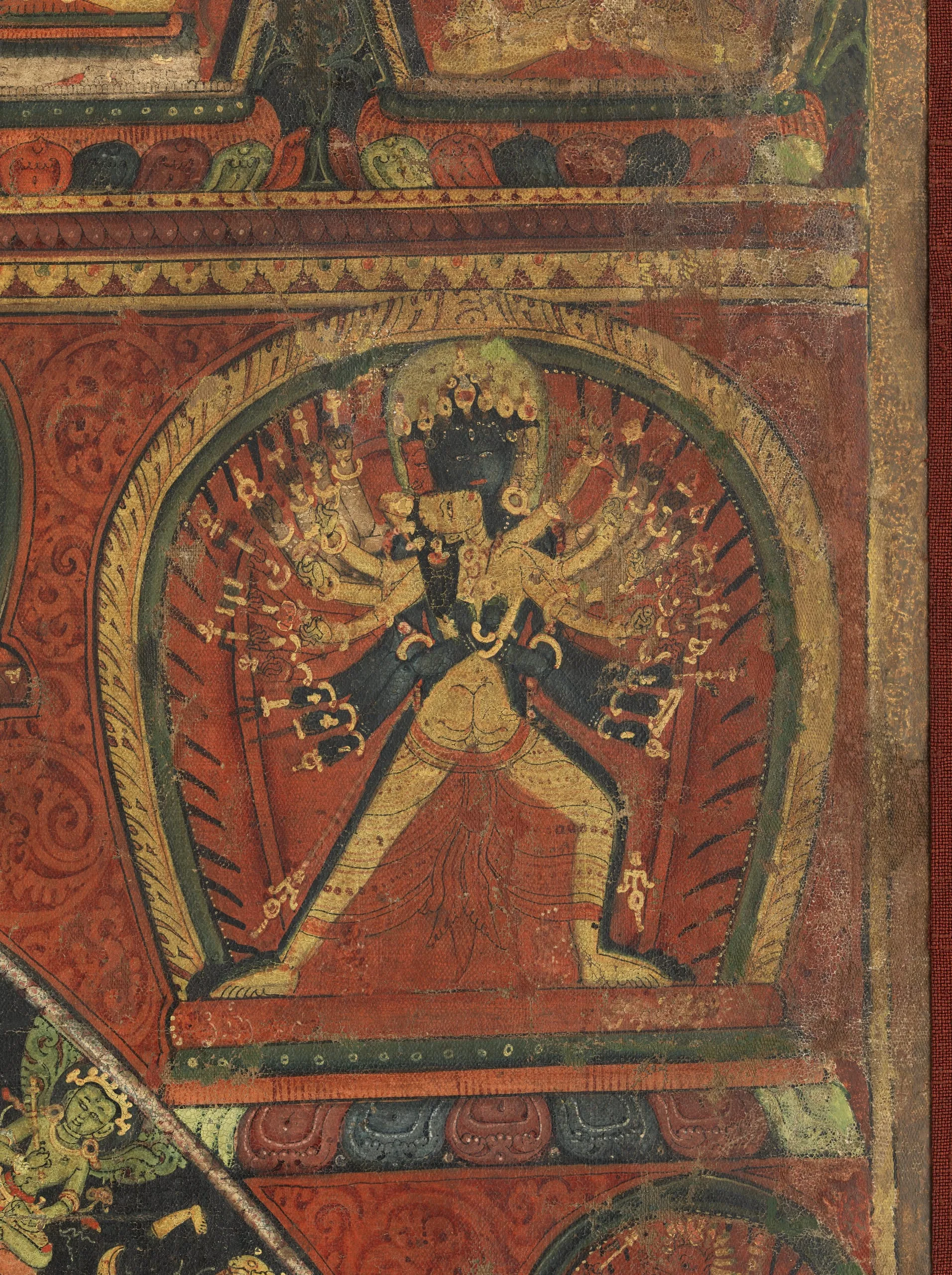
Detail of a Himalayan thangka painting depicting a multi-armed, multi-headed deity with dark blue skin, standing in a wide stance within an arched aureole, surrounded by radiating flames; gold, red, and black pigments with fine linear detailing.
Artist or Maker
Unknown
Title
Mandala of the Buddhist Deity Chakrasamvara
Place Made
Nepal
Date Made
Dated 1490
Medium
Mineral pigments on cotton cloth
Dimensions
46 x 34 5/8 in. (116.84 x 87.94 cm)
Credit Line
Museum Acquisition Fund
Accession Number
M.73.2.1
Classification
Paintings
Collecting Area
South and Southeast Asian Art
Curatorial Notes

The Chakrasamvara Mandala is the archetype of the Highest Yoga Tantra meditation cycles in Newar Buddhism. Chakrasamvara and Vajravarahi are the principle deities of secret shrines in Newar Buddhist institutions. The shrines and the rituals related, however, are accessible only to the initiated Buddhists, and images of Chakrasamvara are never displayed in public. Although Chakrasamvara’s significance is commonly known in Newar Buddhism, these practices are rarely openly discussed with the uninitiated.

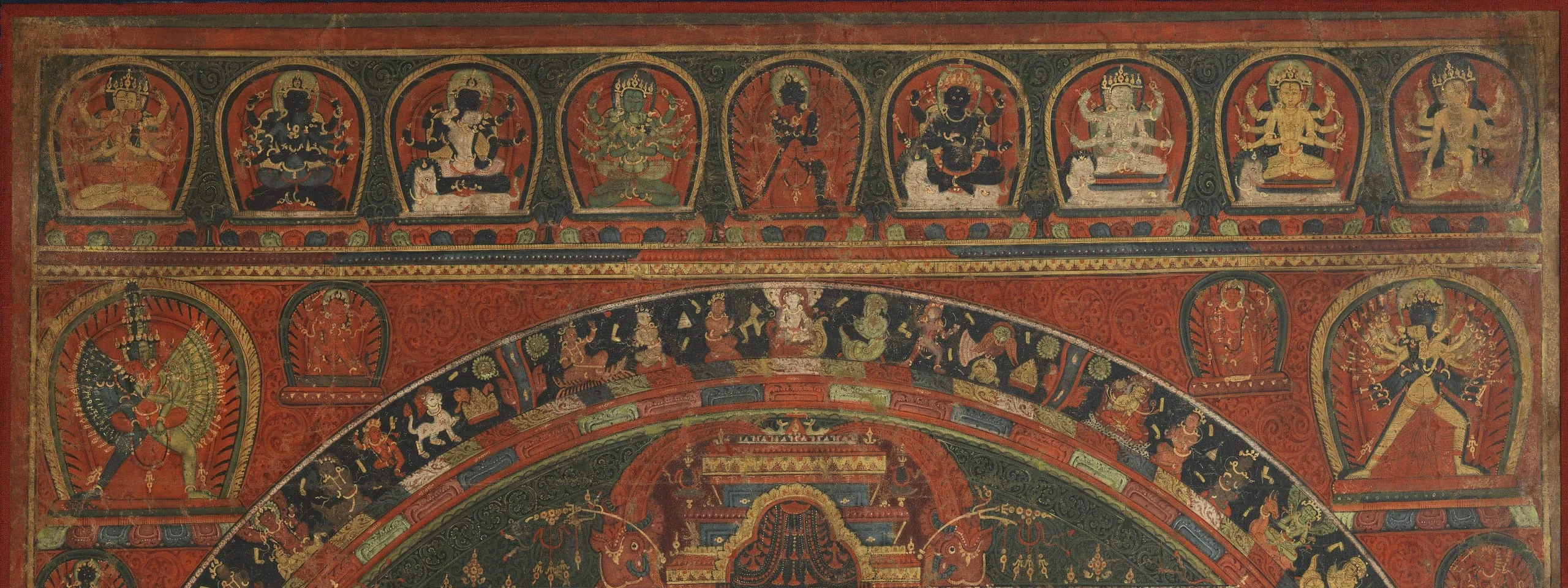
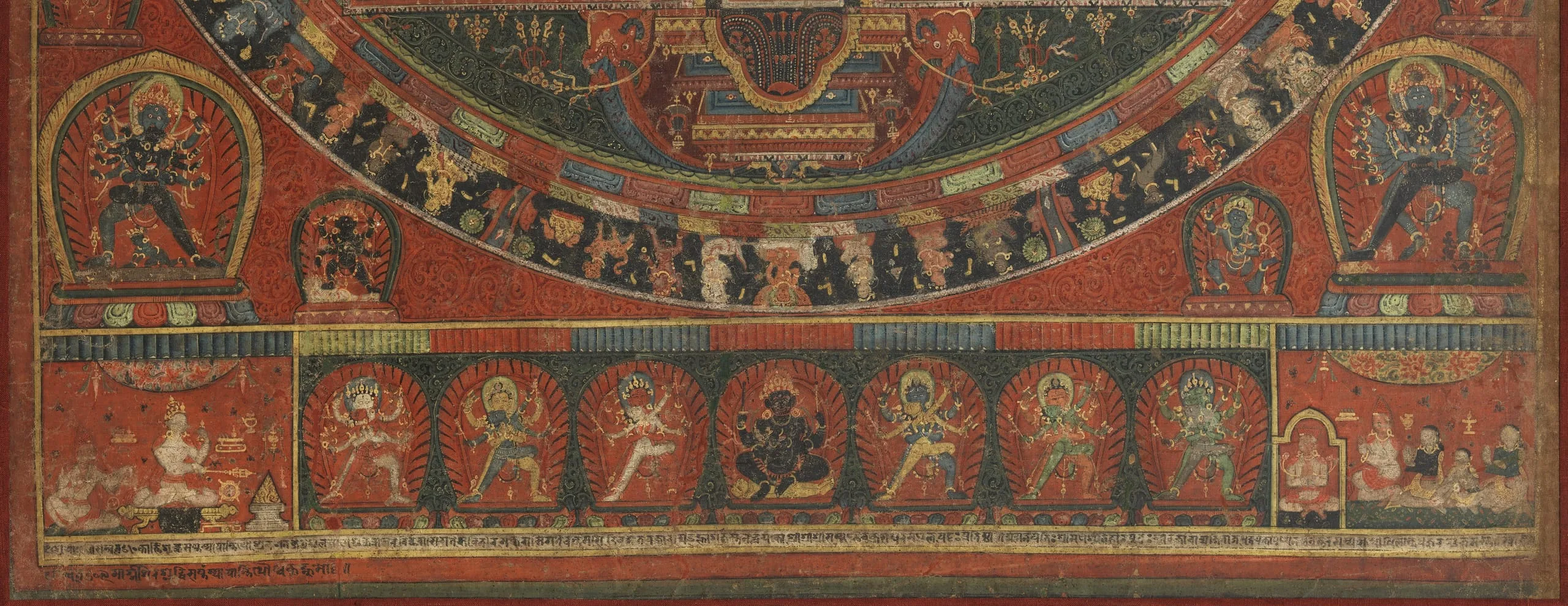
This painting provides a superb example of the fully detailed Chakrasamvara mandala iconography. Chakrasamvara and Vajravarahi are situated at the mandala’s core and a series of concentric circles, signifying the systematic purification of the practitioner’s body, radiates outward. The entire mandala is surrounded by the eight charnel fields, as an environment of renunciation of egoistic craving to prepare the practitioner for meditation.

According to the Newari inscription in the footer, the painting was consecrated in 1490 (N.S. 610) during the one-year death-rite ceremony at the request of the donor Vajracharya Jayaraja of Manasu Vihara (monastery) in memory of the death of his father, Vajracharya Uhlasa, who is depicted as a white-haired figure at the lower right. The accuracy with which the scene also represents the priests performing the fire-sacrifice rituals is remarkable, since even in the contemporary context, similar rituals with Vajracharya priests continue to be performed with the same dynamism and vitality of the donors. The second inscription in the lower border states that Uhlasa died in the month of Mansir (December – January) in 1489 (N.S. 609).
Selected Bibliography
  • Little, Stephen, Tushara Bindu Gude, Karina Romero Blanco, Silvia Seligson, Marco Antonio Karam. Las Huellas de Buda. Ciudad de México : Instituto Nacional de Antropología e Historia, 2018.
  • Little, Stephen, and Tushara Bindu Gude. Realms of the Dharma: Buddhist Art across Asia. Los Angeles: Los Angeles County Museum of Art, 2025.