LACMA

ShopMembershipMyLACMATickets
LACMA
Los Angeles County Museum of Art
5905 Wilshire Blvd.
Los Angeles, CA 90036
info@lacma.org
(323) 857-6000
Sign up to receive emails
Subscribe
© Museum Associates 2025

Museum Hours

Monday

11 am–6 pm

Tuesday

11 am–6 pm

Wednesday

Closed

Thursday

11 am–6 pm

Friday

11 am–8 pm

Saturday

10 am–7 pm

Sunday

10 am–7 pm


  • About LACMA
  • Jobs
  • Building LACMA
  • Host An Event
  • Unframed
  • Press
  • FAQs
  • Log in to MyLACMA
  • Privacy Policy
© Museum Associates 2025
Collections

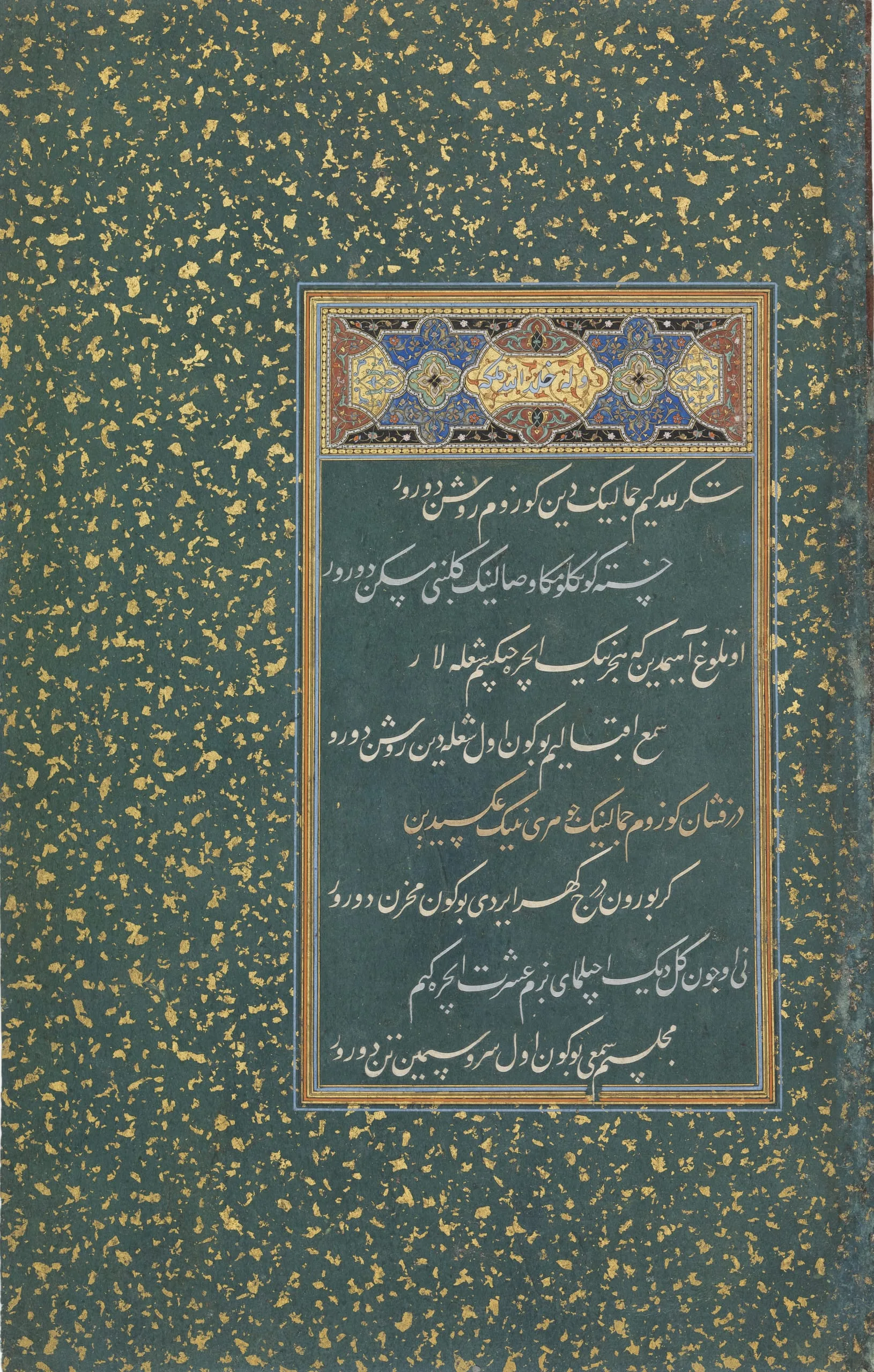
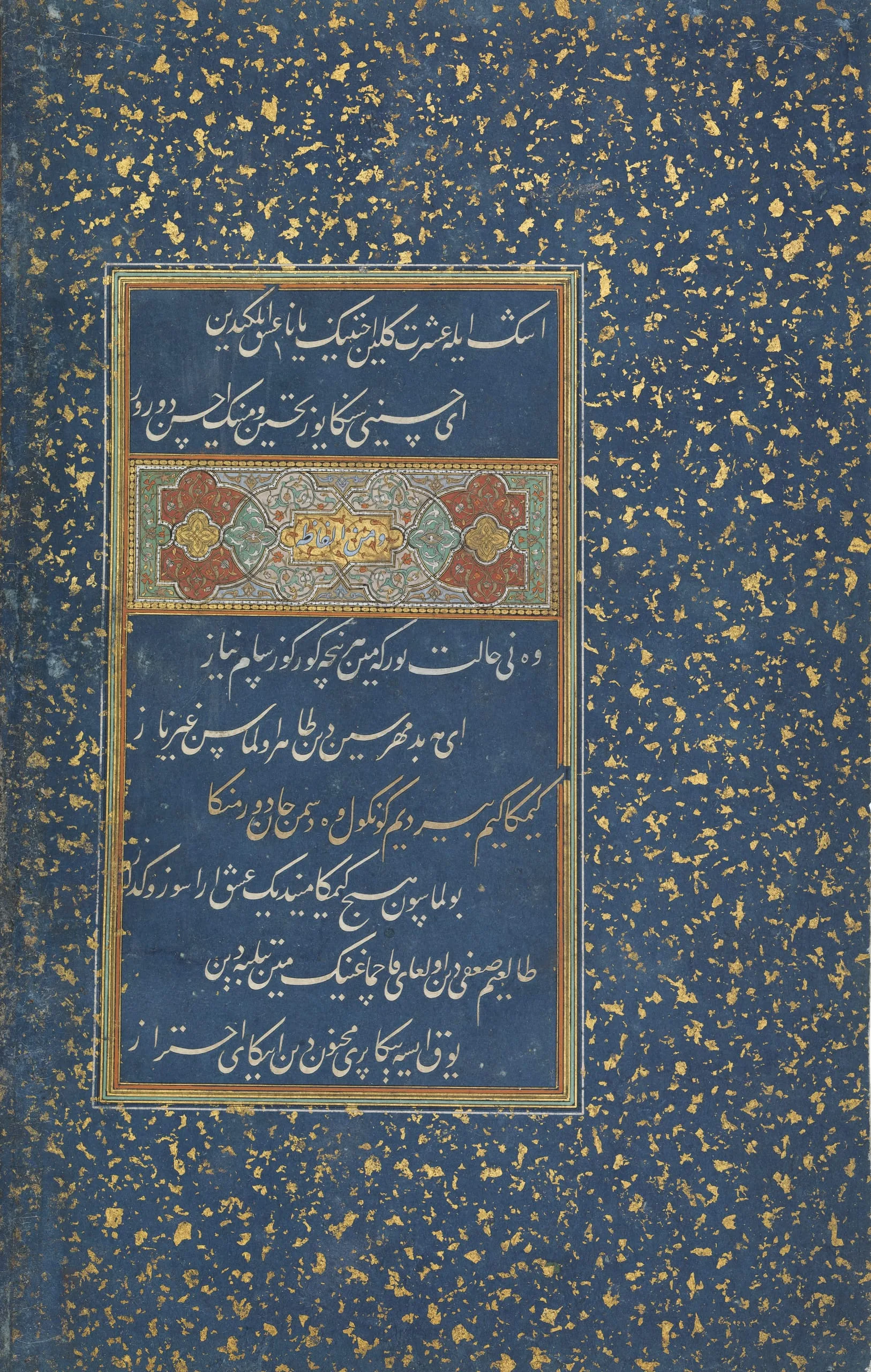
Page from the Diwan (Collected Works) of Sultan Husayn Mirzacirca 1490

Not on view
Illuminated manuscript page with Nasta'liq script in white on teal ground, gold-flecked marbled border, and ornate geometric header in blue and gold
Illuminated manuscript page with deep blue ground sprinkled with gold flecks. Central text panel contains lines of Nastaliq script in gold ink, interrupted by a horizontal decorative band with interlaced floral arabesque in red, green, and gold on a white ground. Ruled borders in gold and red frame the text block.
Title
Page from the Diwan (Collected Works) of Sultan Husayn Mirza
Place Made
Afghanistan, Herat
Date Made
circa 1490
Period
Timurid (1370-1506)
Medium
Opaque watercolor and gold on paper, with découpage and gold-flecked border
Dimensions
9 × 5 3/4 in. (22.86 × 14.61 cm)
Credit Line
The Nasli M. Heeramaneck Collection, gift of Joan Palevsky
Accession Number
M.73.5.599a-b
Classification
Manuscripts
Collecting Area
Art of the Middle East: Islamic
Curatorial Notes

See also: https://collections.lacma.org/node/2261916">M.73.5.599c-d>, https://collections.lacma.org/node/2261913">M.73.5.599e-f>, and https://collections.lacma.org/node/240330">M.73.56>


The last great Timurid ruler, Sultan Husayn Bayqara, whose court at Herat in the late fifteenth century was the preeminent Persian cultural center of its day, also wrote poetry in his Turkic mother tongue; these poems were collected and copied in a now-dispersed manuscript, several pages of which are in LACMA’s collection. The exquisite nasta‘liq calligraphy was not written with a pen but was cut from sheets of colored paper and meticulously pasted onto the page, which has gold-flecked borders. This remarkable type of calligraphic paper cutout, or découpage, is known as qit‘a.

Selected Bibliography
  • Bloom, Jonathan and Sheila Blair, eds. And Diverse Are Their Hues: Color in Islamic Art and Culture. New Haven: Yale University Press, 2011.