- Title
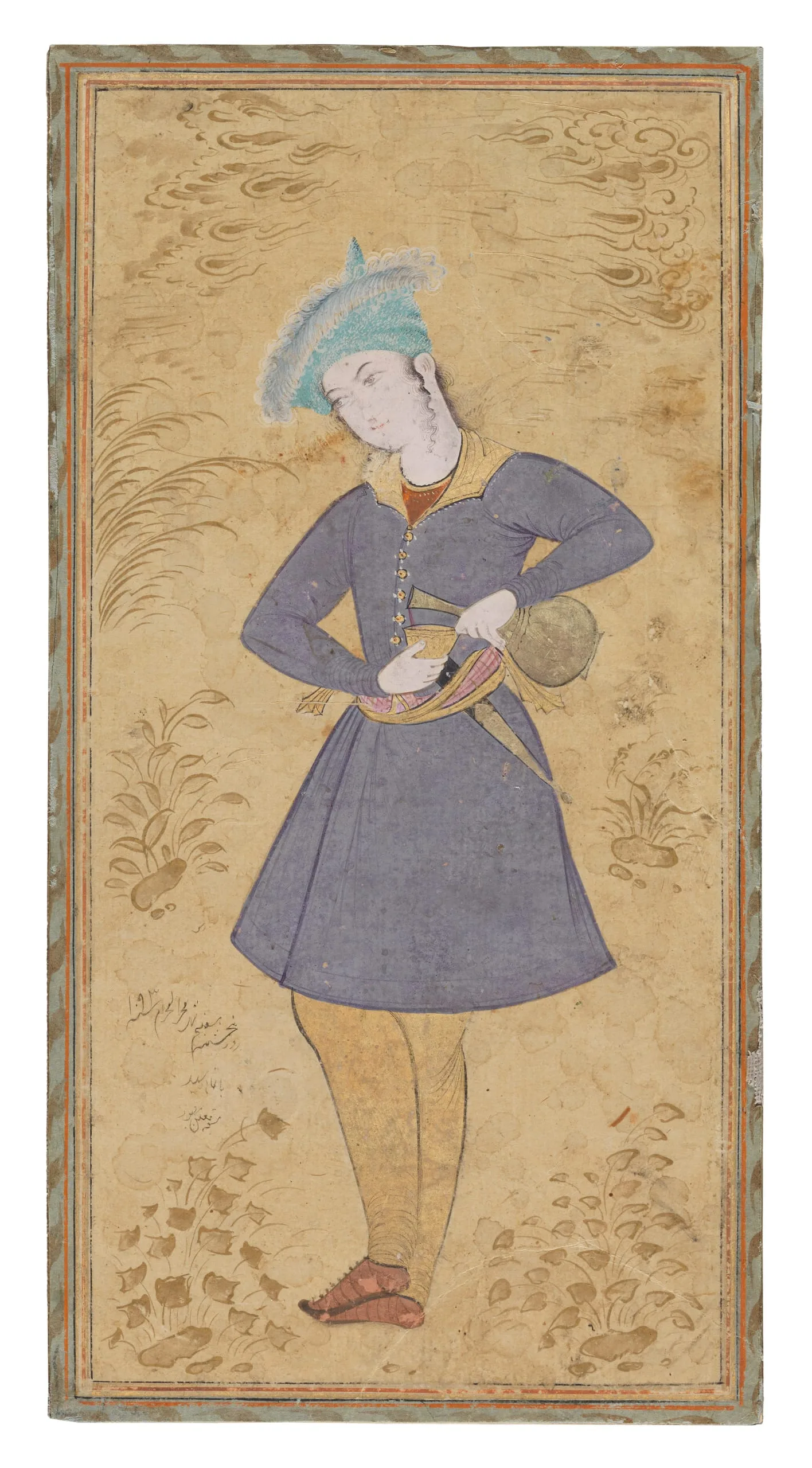
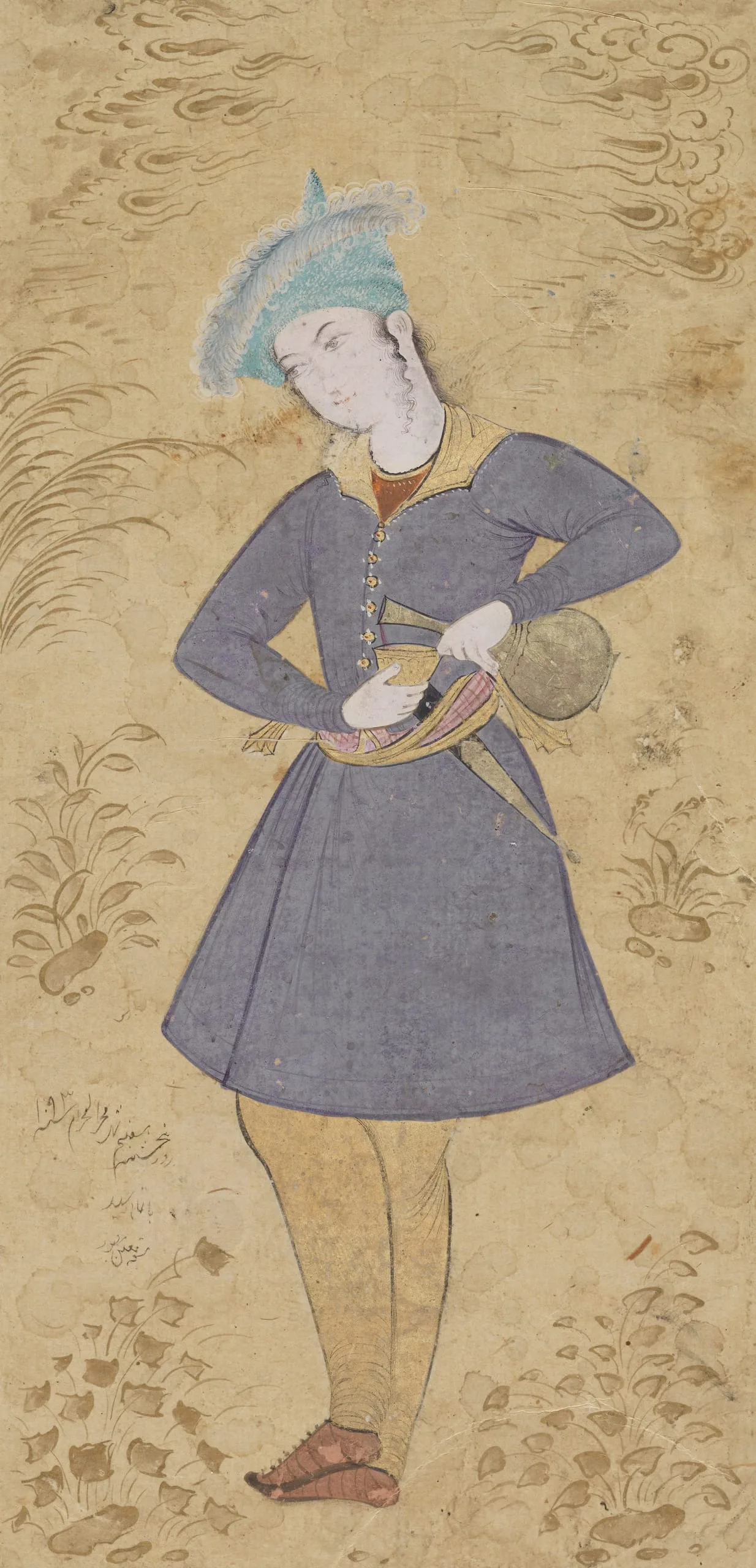
- A Standing Youth Pouring Wine, Page from an Album
- Date Made
- AH 7 Muharram 1093/January 16, 1682
- Medium
- Ink, opaque watercolor, and gold on paper
- Dimensions
- 7 7/8 x 4 in. (20.0 x 10.16 cm)
- Accession Number
- M.73.5.570
- Curatorial Notes
By the early seventeenth century, a new form of painting emerged in Iran that favored individual folio paintings unconnected to a manuscript illustration or narrative, as had been the prior tradition. Such single-page compositions reached their peak in popularity in Isfahan, the capital of the Safavid dynasty, a hub of commerce and social change. No longer confined by court patronage, some artists found a willing market among the cultured social elite, producing popular themes such as portraits of idle youths. These paintings were often enjoyed individually or more often gathered in an album known as a muraqq‘a.
Inscribed with the name Mu‘in Musavvir, the celebrated student of Riza-yi ‘Abbasi (see M.73.5.471 and M.73.5.474), this painting exemplifies one of the most cherished contemporary subjects: the saqi, or cupbearer. The saqi is a frequent subject in Persian poetry, where admiration for the figure, either male or female (M.73.5.14), often equated them with the Beloved—in Sufism, God. It is also likely that there was a literal or sexualized interpretation of the depiction. Mu‘in’s meticulous attention to detail here highlights the youth’s stylishness and refinement, with the young man posing in a fashionable, rakishly placed hat, casually balancing his weight on one leg while elegantly pouring wine. (See M.73.5.12 and M.73.5.26 for other works by this artist.)
- Selected Bibliography
- Pal, Pratapaditya, ed. Islamic Art: The Nasli M. Heeramaneck Collection. Los Angeles: Museum Associates, 1973.
- Williams, Sandra S. "A Queer Palimpsest: Historical Layers in Salman Toor's The Bar on East 13th Street." In Iranian Art from the Sasanians to the Islamic Republic: Essays in Honour of Linda Komaroff, edited by Sheila S. Blair, Jonathan M. Bloom and Sandra S. Williams. Edinburgh University Press, 2024.