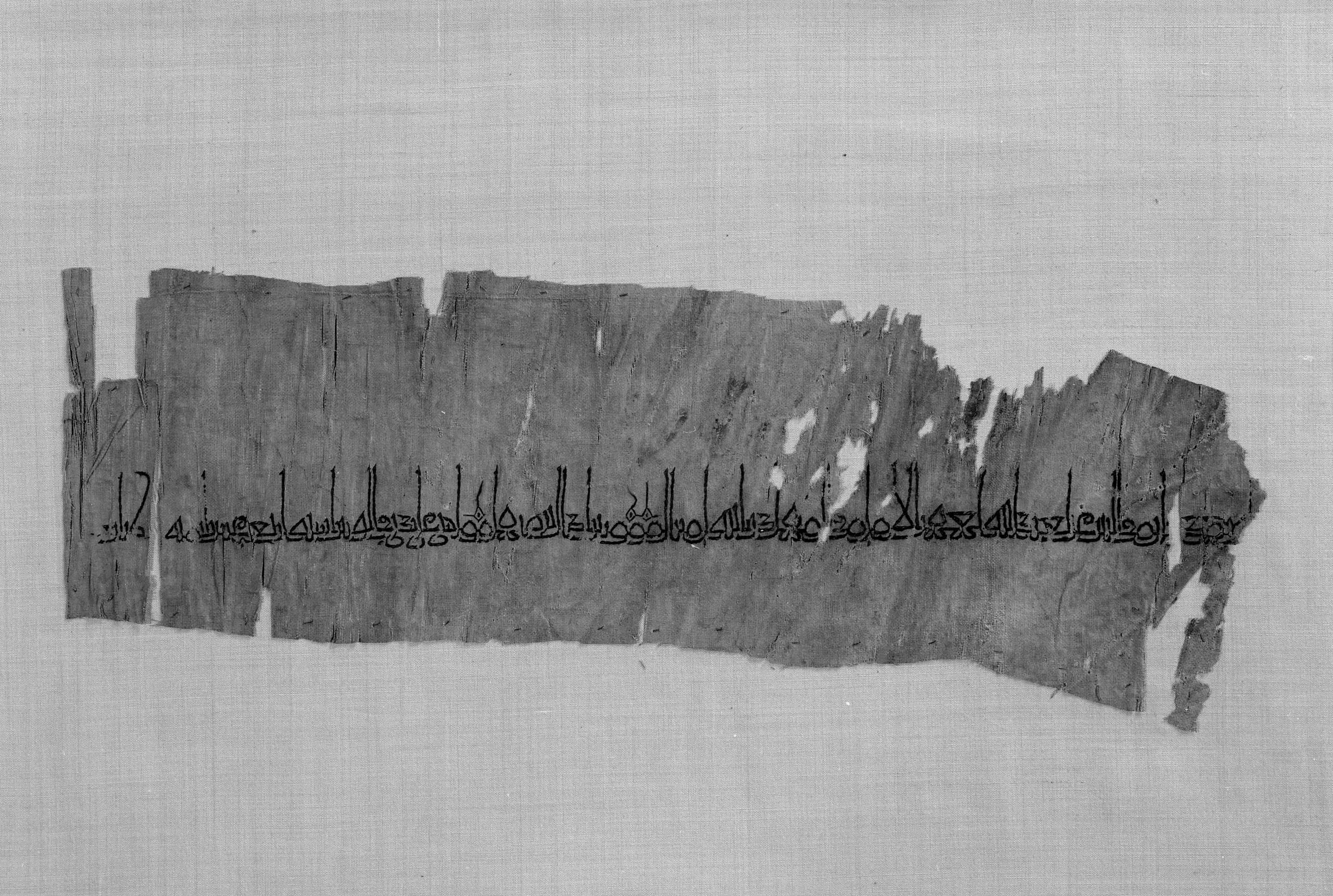
Textiles from the first centuries of the Islamic era survive mainly in the form of fragments, including tiraz, with their characteristic embroidered or woven inscriptions supplying the name and titles of the ruler. Tiraz textiles were produced in factories, both private and public, and were the exclusive preserve of the caliph. The reigning monarch would gift such cloths, or more often robes of honor bearing Arabic inscriptions on the sleeves, to members of his court.
Due to the fragmentary state of this tiraz, the inscription is incomplete but fortunately preserves key historical information such as the name of the caliph and the date it was made: “[Muhammad, s]eal of the Prophet. Glory to the servant of God, Ja‘far, the imam al-Muqtadir billah, Commander of the Faithful, . . . may God preserve his existence. What was cared for under the direction of the vizier. Year four and ten and three hundred . . . tiraz [factory] . . .”
The ruler named is the ‘Abbasid caliph al-Muqtadir (r. 908−32). Among the missing text is the location of the factory where the tiraz was made, perhaps Baghdad, where several other related fragments in this caliph’s name were produced.
2024