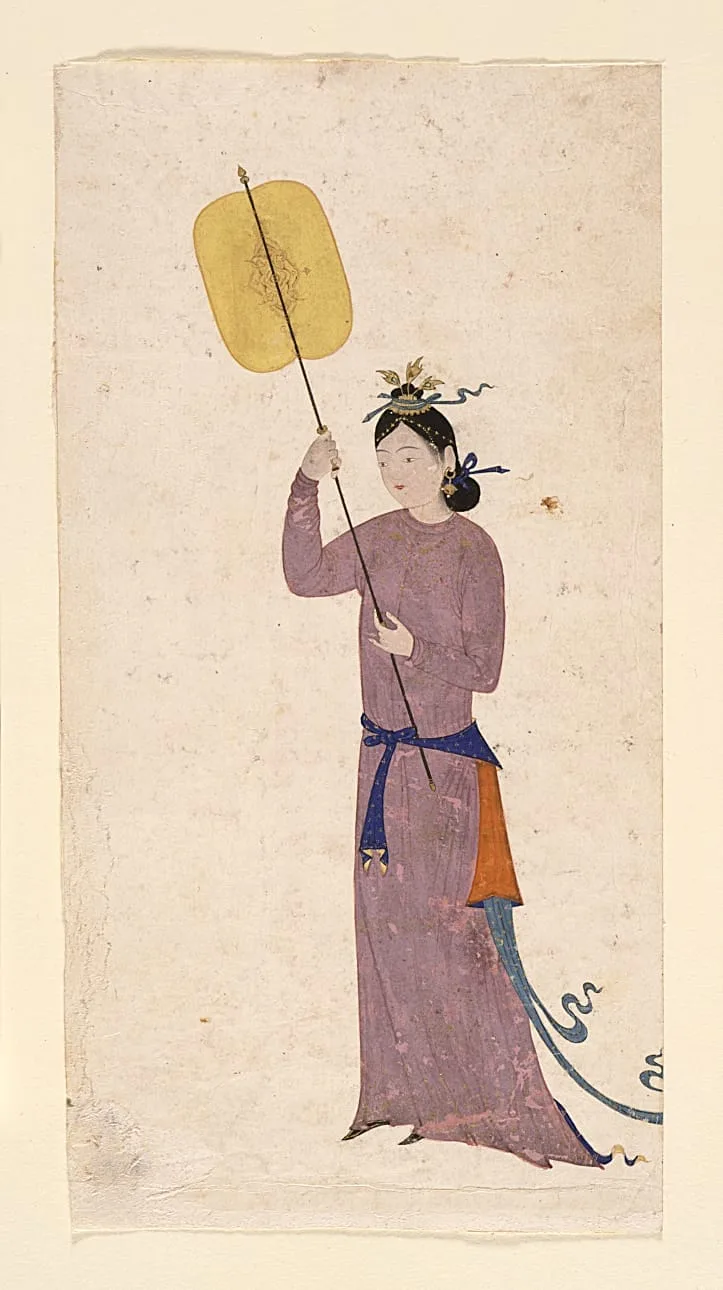
The distant Chinese imperial courts and their princesses captivated the Iranian imagination, becoming symbols of beauty, mystery, and cultural allure that permeated both art and literature. Iranian artists, likely exposed to depictions of Chinese courtly life through imported textiles and perhaps scroll paintings, infused their works with the sophistication of this unseen realm, while Persian poets romanticized Chinese princesses as figures of unparalleled grace. These princesses appear in medieval literary masterpieces such as Firdawsi’s Shahnama, Nizami’s Haft Paykar, and Khwaju Kirmani’s Humay and Humayun, embodying both romantic intrigue and the creative exchange between the two civilizations. Poets used terms like nigar-i Chin (Chinese beloved) and bot-i Chin (Chinese idol) to evoke an idealized vision of Chinese beauty, reflecting a lasting cross-cultural admiration that shaped Persian artistic identity for centuries.
This painting of a Chinese lady holding a long-handled fan is likely not an individual portrait but rather a representation of a court attendant serving the elite. Her poised yet static posture, along with the way she holds the fan as if cooling someone else, suggests she was originally part of a larger composition, possibly of a courtly gathering. Similar depictions appear in the Ya‘qub Beg Album, named after the Aq Quyunlu ruler Ya‘qub Beg (r. 1478–90). Compiled in Tabriz during the Timurid-Turkmen period, this album brings together paintings, calligraphy, and other artistic elements from various sources. Later known as the Fatih Album after entering the Ottoman imperial collections, it features both original Chinese paintings on silk and Persian reinterpretations, showcasing a rich fusion of Persian, Chinese, and Central Asian artistic traditions. The refined style of LACMA’s illustration reflects the aesthetic cultivated in the ateliers of Tabriz, where Timurid and Jalayirid artists achieved a delicate balance of form and color, distinguished by fluid lines, soft pastel hues, and an intimate lyricism that favored elegance over epic grandeur.
2025