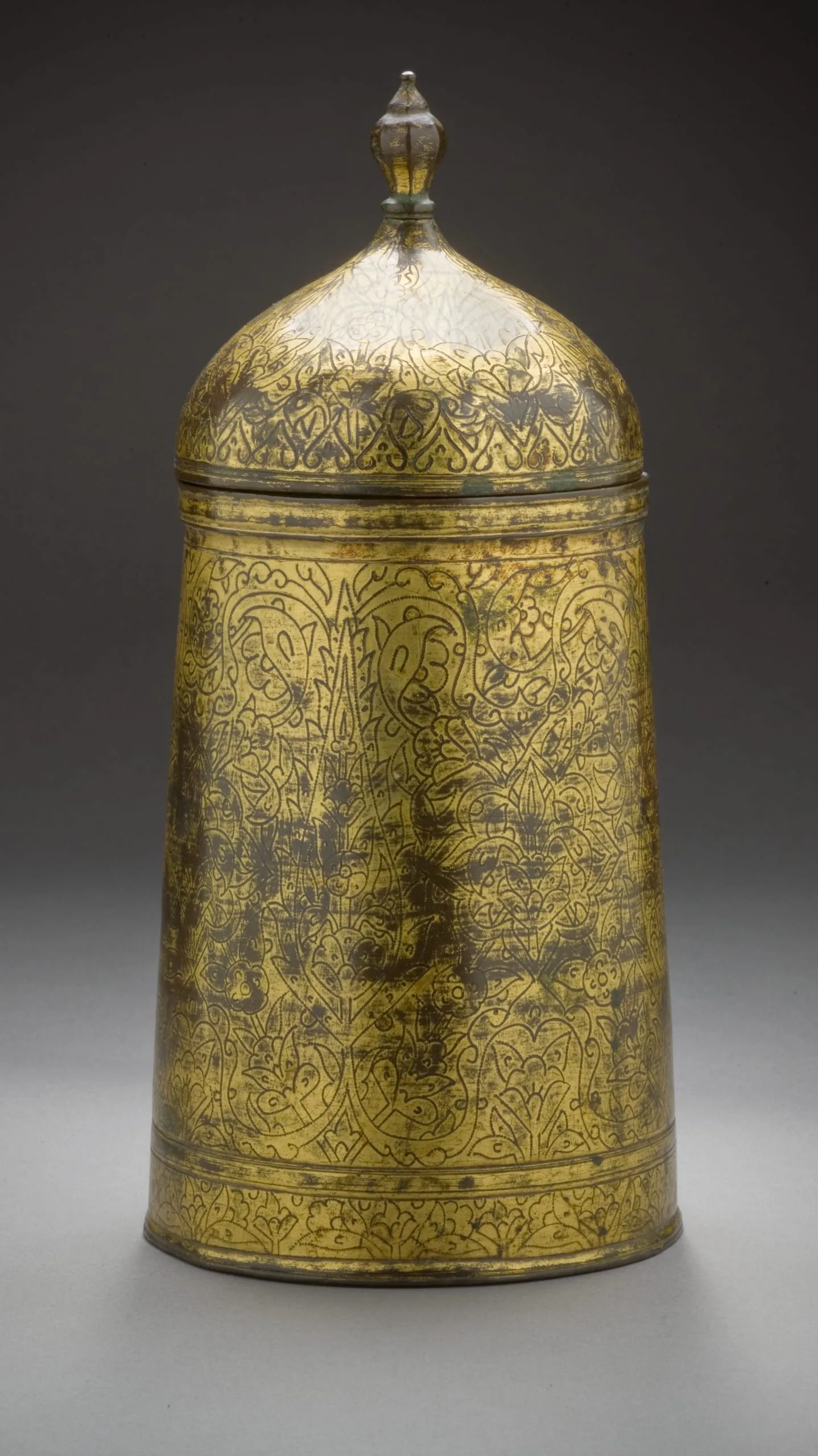
This handsome cylindrical tankard, which is missing its handle while preserving its domical lid, represents a familiar form of drinking vessel found in both northern Europe and the Ottoman Empire from the early sixteenth century onward. Though it is fabricated from gilt copper (tombak), giving it the hue of more costly gold, other surviving Ottoman examples are made of leather, glazed ceramic, and often jewel-encrusted jade and rock crystal. The dense decoration on the tankard’s surface features an array of cypress trees and floral patterns, of a type that emerged in the second half of the sixteenth century. These designs belonged to a cohesive Ottoman aesthetic evident across all courtly media, including luxury textiles, Iznik ceramics, and the metalware seen here.
Unlike in Europe, where such vessels were used to drink hopped beer, it is more likely that the Ottoman drinkware was for consuming boza, a milky beverage made of fermented millet or other cereals. Like wine and coffee, boza was served in public houses. Two types of boza abounded in Ottoman lands: the sweet nonalcoholic variety and the fermented alcoholic version, which was permissible under Ottoman law, if not drunk to excess. It was also subject to occasional bans and the shuttering of taverns and boza-houses due to religious prohibitions around alcohol.