- Title
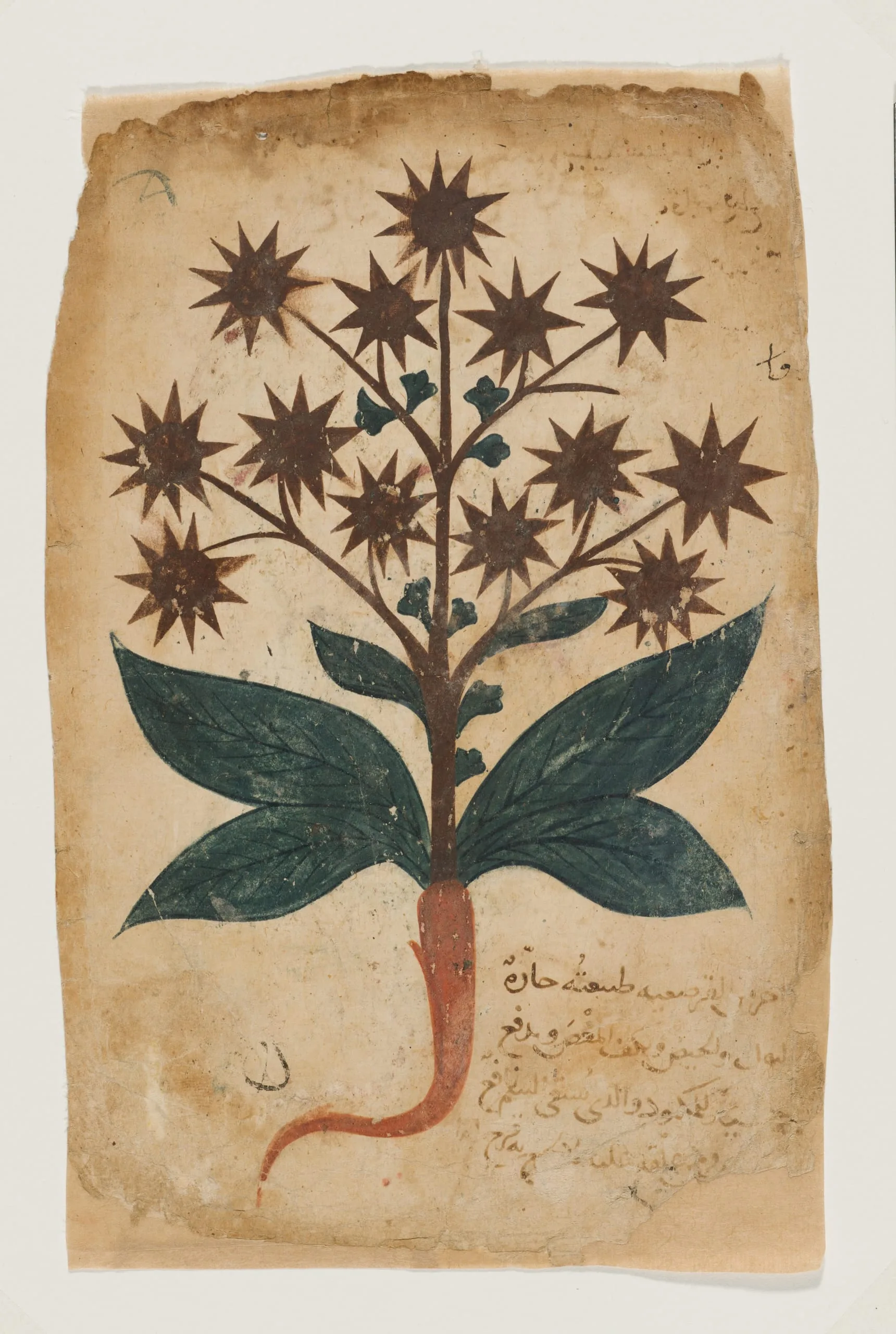
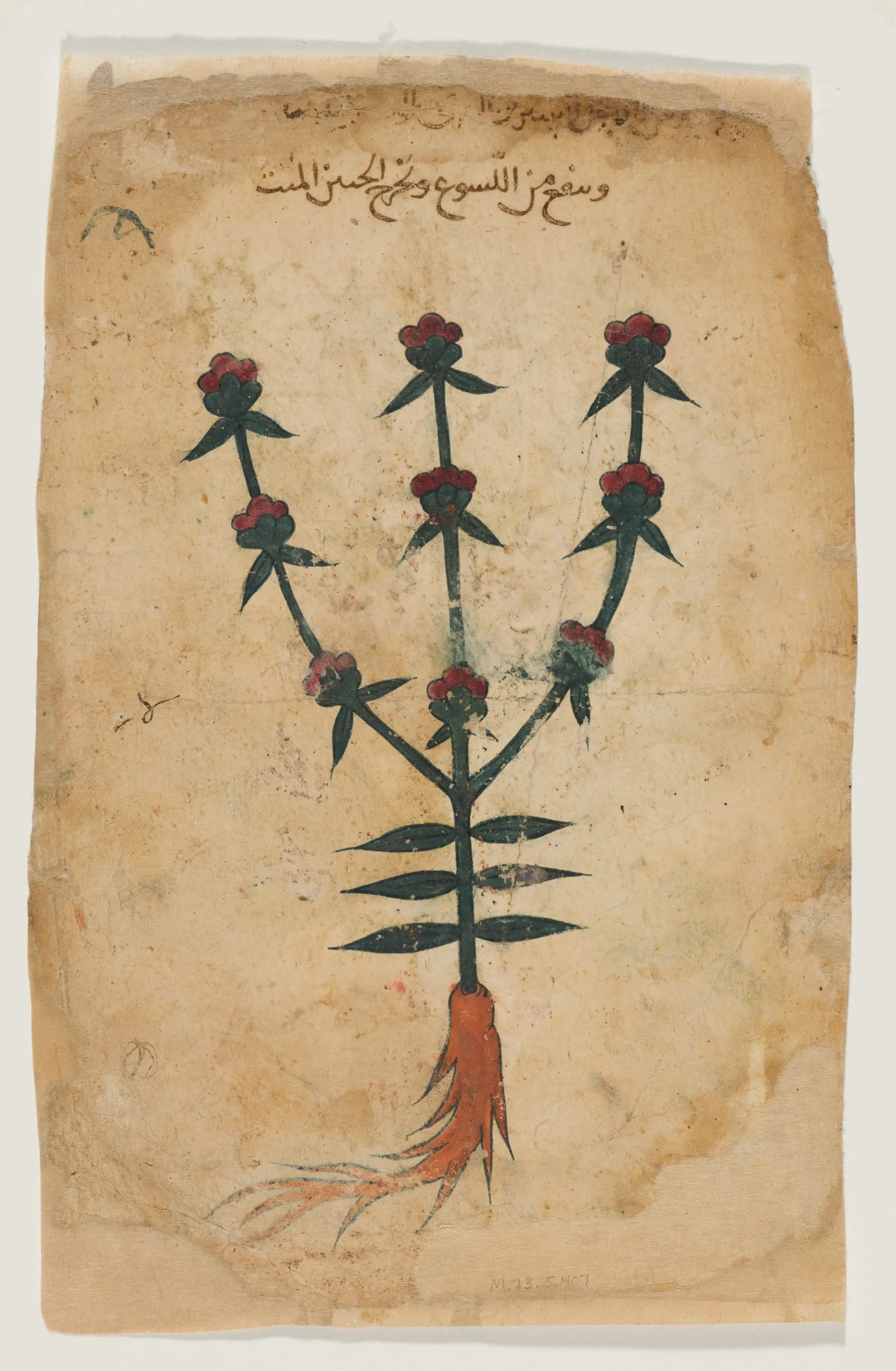
- Page from an Herbal Manuscript
- Date Made
- 13th century
- Medium
- Ink and opaque watercolor on paper
- Dimensions
- 9 3/4 × 6 in. (24.77 × 15.24 cm)
Frame: 20 × 15 × 1 1/2 in. (50.8 × 38.1 × 3.81 cm)
- Accession Number
- M.73.5.407a-b
- Curatorial Notes
Beginning in the ninth century and under the direction of the ‘Abbasid caliph, scribes began translating, updating, and expanding ancient Greek scientific and philosophical manuscripts. Among the translated texts was Dioscorides’s De materia medica, a guide to medicinal plants and the inspiration for later herbal manuscripts, from which this thirteenth-century page derives (also see M.73.5.408a-b). Physicians and pharmacists may have relied on nonillustrated versions of the text in their practice, but illustrated versions such as this one, which often have more limited textual information, were likely commissioned for their visual appeal. This illustration of a plant with star-shaped flowers is accompanied by a description of its use: to treat the urinary tract, menstruation, stomach cramps, and liver problems.
- Selected Bibliography
- Pal, Pratapaditya, ed. Islamic Art: The Nasli M. Heeramaneck Collection. Los Angeles: Museum Associates, 1973.
Lo Terrenal y lo Divino: Arte Islámico siglos VII al XIX Colección del Museo de Arte del Condado de Los Ángeles. Santiago: Centro Cultural La Moneda, 2015.
Pal, Pratapaditya, Thomas W. Lentz, Sheila R. Canby, Edwin Binney, 3rd, Walter B. Denny, and Stephen Markel. "Arts from Islamic Cultures: Los Angeles County Museum of Art." Arts of Asia 17, no. 6 (November/December 1987): 73-130.