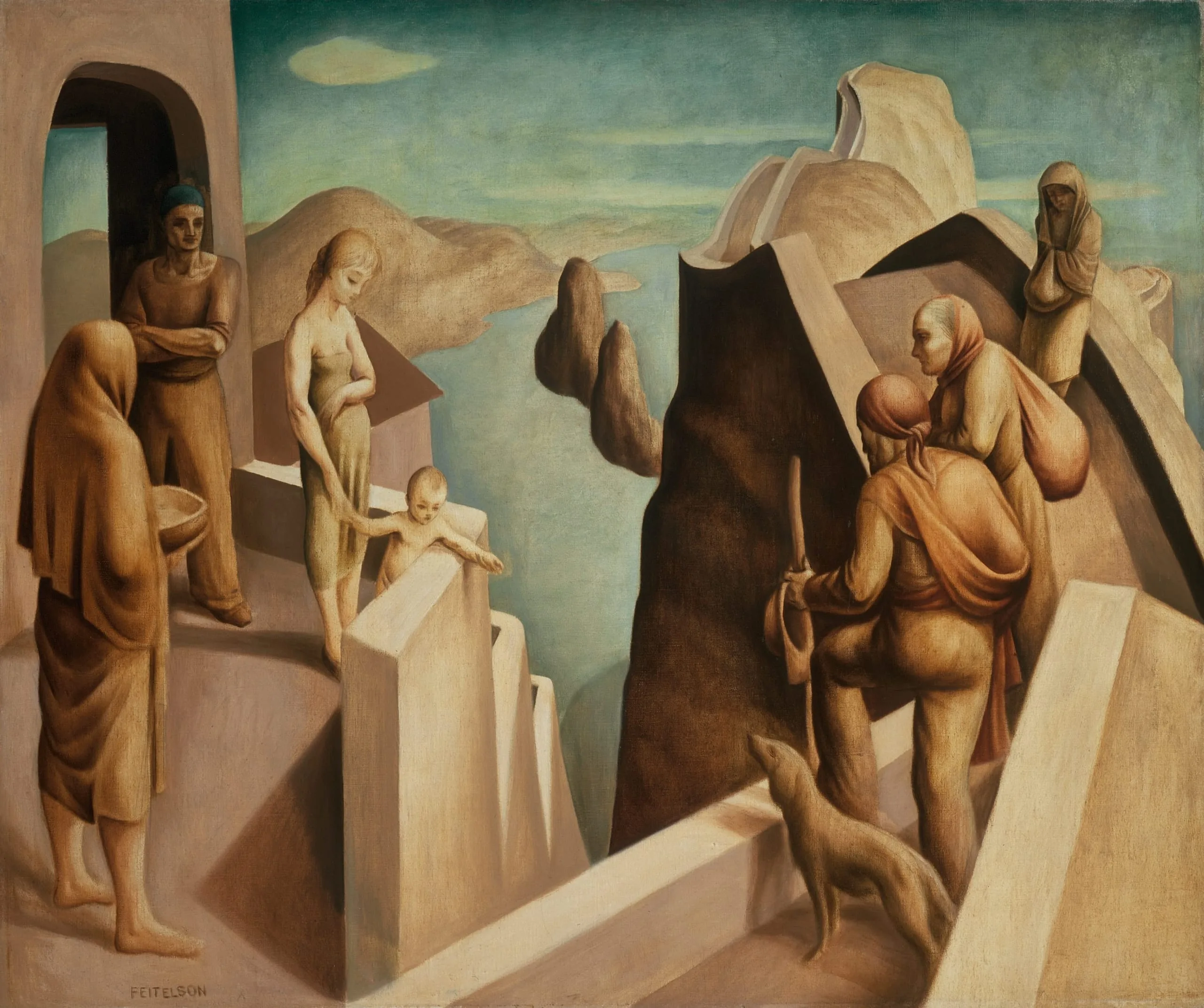
Maternity was Feitelson’s last peasant painting and served as a link between his classical paintings of the 1920s and works based on his postsurreal concepts of the mid-1930s.
Landscape became a major component in Feitelson’s art for the first time in this canvas. The craggy mountains of Corsica are the basis of the setting. The deep chasm in the center forms a physical and psychological barrier between the two figure groupings, the young people on the left and the elderly on the right. The two strongly vertical elements of the composition are unified by what Feitelson termed "the dynamics of directional suggestion," that is, by the figures’ gazing across the chasm at one another and thereby uniting the two sides by the directions of their gazes. According to the art historian Diane Moran, this was a major discovery for Feitelson and marked a turning point in his development of a classical art structured by subjective means. This new compositional device was so important to him that when he first exhibited Maternity in San Francisco in 1932-in his most important exhibition to date-and then at the Los Angeles Museum the next year, a diagram of his analysis of the composition’s directional rhythms was hung next to the painting.
While Maternity was in the Los Angeles Museum’s Fourteenth Annual Exhibition of Painters and Sculptors in 1933, it was singled out in a dispute over modernism. A conservative group of protesting artists headed by Karl Yens (1868-1945) referred to it as a conglomeration of mere daubings and criticized its incorrect perspective. In defense of his art Feitelson offered to debate publicly in support of the modernist cause, stating in an article for the Los Angeles Times that he strove for a neoclassic painting that would be a "deathless art, achieved in a new manner... but worthy to live as long as art shall live".