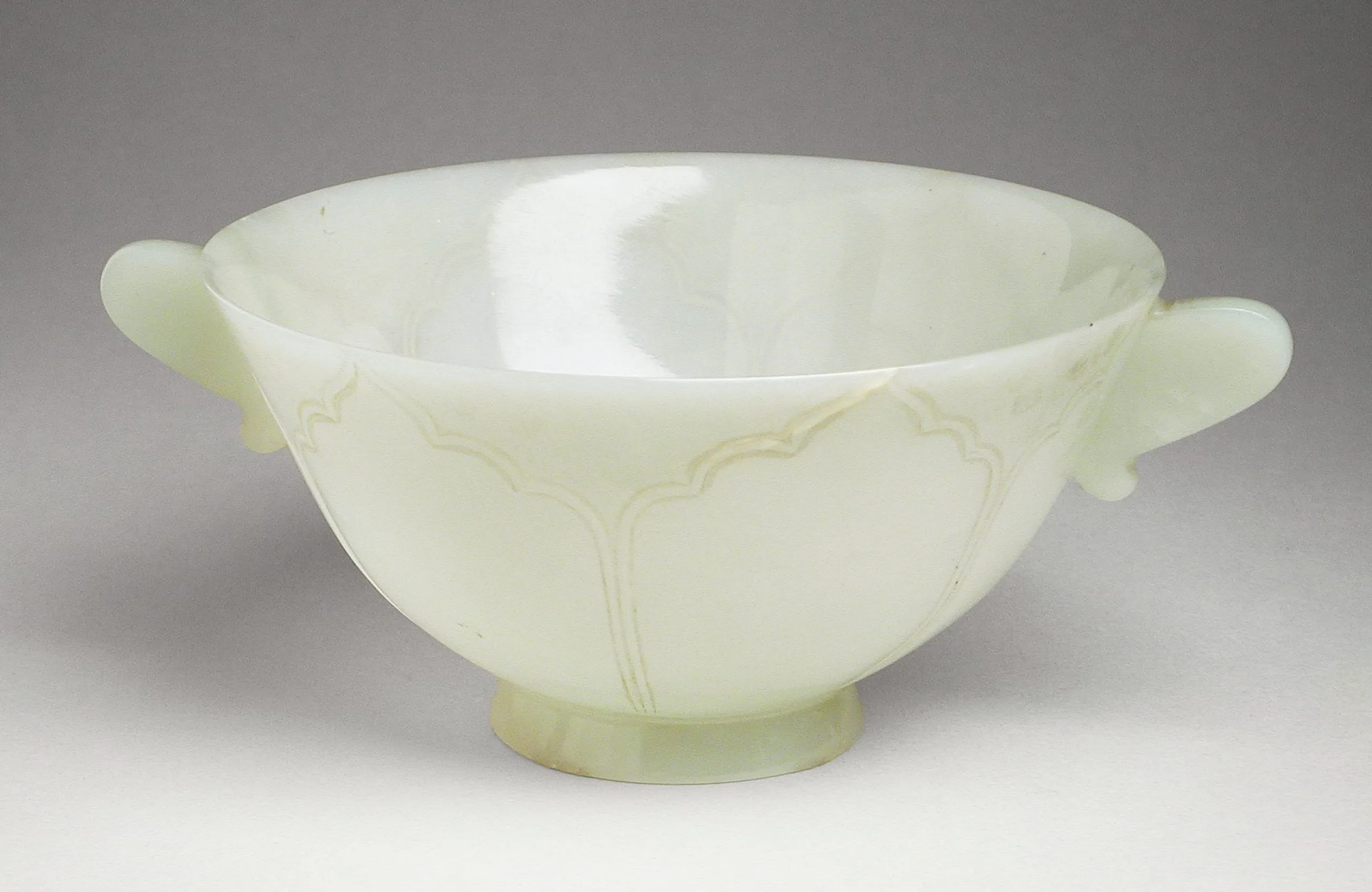
Made of white nephrite jade, the round deep bowl has a ring foot and solid lateral handles. Engraved around the exterior wall of the vessel body are six hexa-lobed pointed arches reminiscent of the architectural arches and mihrabs (prayer niches) of Islamic and Indo-Islamic monuments and textiles.
Flat handles — solid or openwork, vertical or horizontal — are a hallmark of Turkish jades made in the late 17th through 19th centuries, as well as being a characteristic feature of derivative Turkish-style Chinese and Indian jades. The vertical handles are generally S-shaped or ear-shaped. Such handles are stylized descendants from the dragon-headed handles of earlier Timurid jade prototypes. They relate to the similarly shaped curvilinear floral handles with bud terminals often found on contemporaneous Mughal jades.
Although the bowl’s primary decoration of a series of arches used as a geometric design is atypical for Mughal jades, repetitive arches are found in Mughal architecture and on South Asian metal or glass vessels. Bowls with the related design program of a series of upright petals, both straight or lobed, are known from Turkey or Turkestan, but their stylistic and technical rendition differs significantly from the incised arches here.
The bowl appears intended to emulate Turkish jades. It was likely produced at a non-Mughal South Asian jade working center, probably in the Deccan, which maintained strong cultural and artistic ties with Turkey’s Ottoman Empire.