LACMA

ShopMembershipMyLACMATickets
LACMA
Los Angeles County Museum of Art
5905 Wilshire Blvd.
Los Angeles, CA 90036
info@lacma.org
(323) 857-6000
Sign up to receive emails
Subscribe
© Museum Associates 2025

Museum Hours

Monday

11 am–6 pm

Tuesday

11 am–6 pm

Wednesday

Closed

Thursday

11 am–6 pm

Friday

11 am–8 pm

Saturday

10 am–7 pm

Sunday

10 am–7 pm


  • About LACMA
  • Jobs
  • Building LACMA
  • Host An Event
  • Unframed
  • Press
  • FAQs
  • Log in to MyLACMA
  • Privacy Policy
© Museum Associates 2025
Collections

Unknown
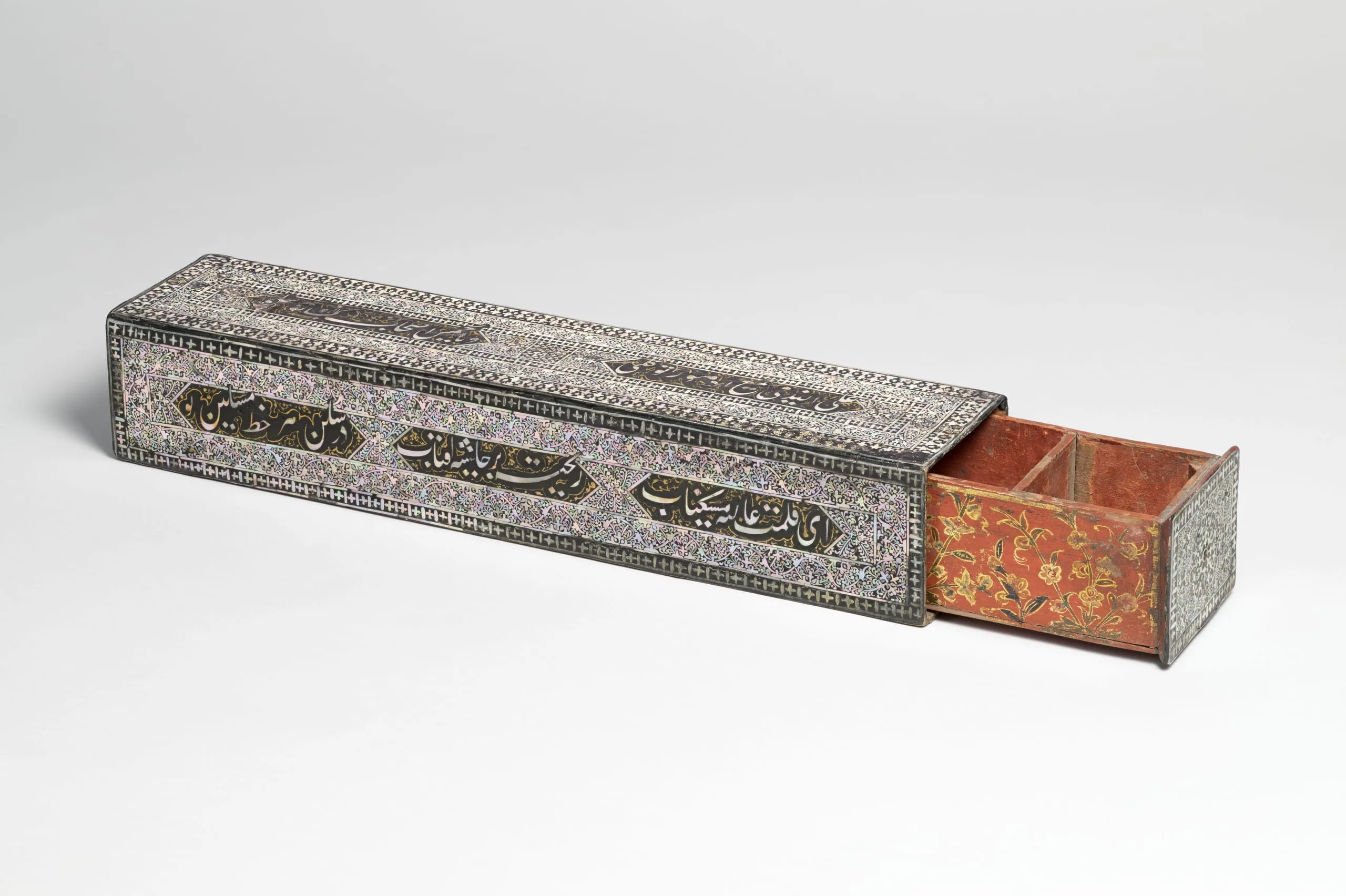
Pen Box (Qalamdan)circa 1575-1625

Not on view
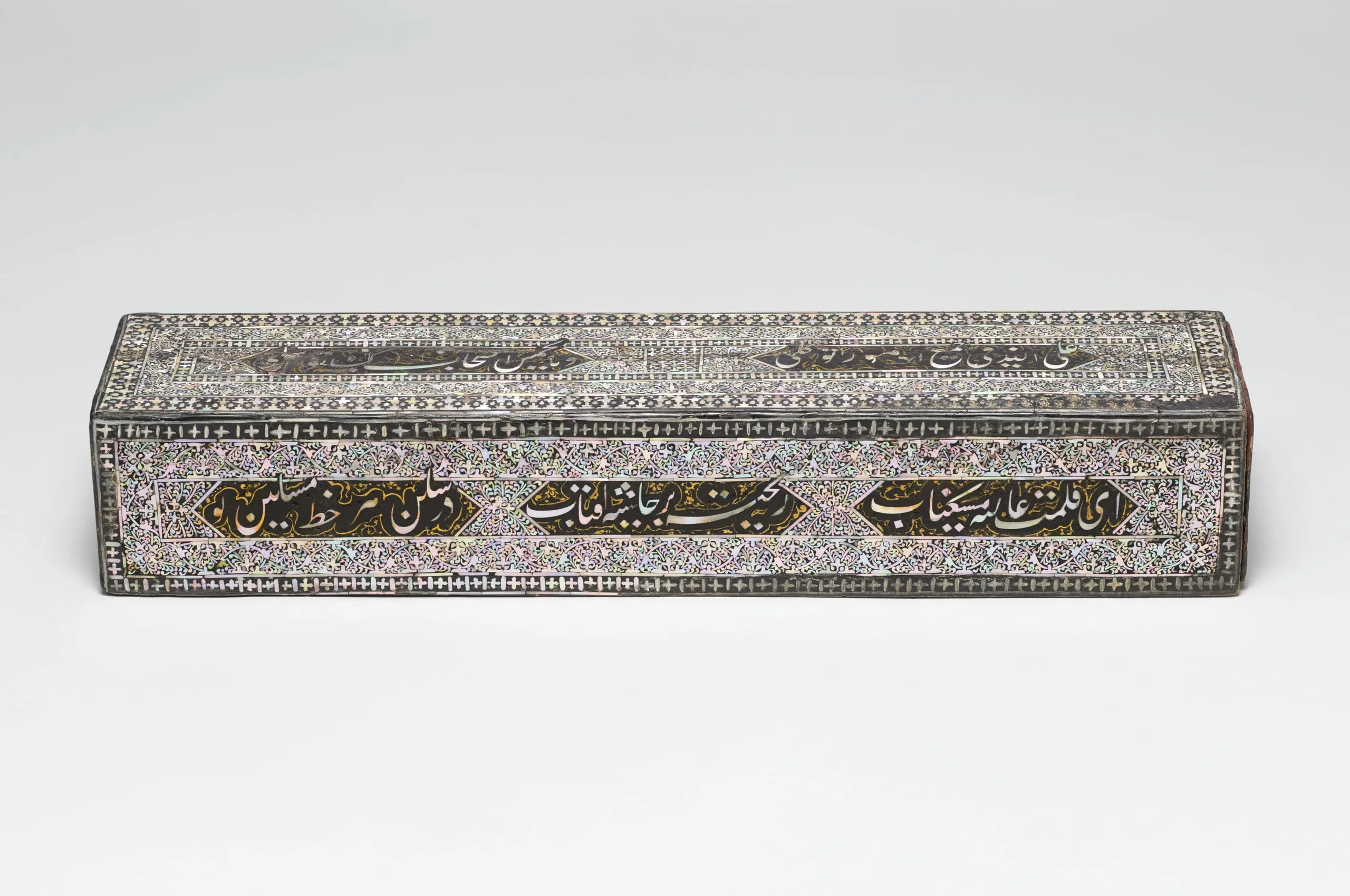
Long rectangular pen box with dense white, blue, and gold inlaid geometric patterning, brass calligraphic cartouches in Arabic script, and a sliding red floral-painted interior tray
Rectangular pen box with dense inlaid mosaic decoration in multicolored micro-geometric patterns covering the surface; cartouches containing Perso-Arabic script in gold and white on dark ground along the sides and lid, framed by geometric border bands.
Artist or Maker
Unknown
Title
Pen Box (Qalamdan)
Place Made
India, Gujarat, Ahmedabad region
Date Made
circa 1575-1625
Period
16th century
Medium
Wood overlaid with mother-of-pearl in lac; Drawer: wood with red, gold, and black paint
Dimensions
2 1/2 × 13 5/8 × 3 in. (6.35 × 34.61 × 7.62 cm)
Credit Line
The Nasli M. Heeramaneck Collection, gift of Joan Palevsky
Accession Number
M.73.5.340
Classification
Furnishings
Collecting Area
South and Southeast Asian Art
Curatorial Notes

This rectangular pen box with an inner side drawer is likely made of sisham wood (dalbergia sissoo). It is adorned with small overlaid pieces of iridescent mother-of-pearl or nacre, the shiny secreted coating found on pearls and some mollusk shells, which are adhered with lac or mastic, a lacquerlike resinous ground. The scintillating mother-of-pearl fragments are arranged in concentric registers in a dense foliated arabesque featuring a scrolling vine accentuated with split palmettes set against a background of comma-shaped leaves and geometric borders. The innermost register of the top and sides has horizontal hexagons with Persian poetry written in nasta’liq script. The verses are a religious invocation to Allah (on the top), and a celebration of the aesthetic flavor of the awe-inspiring calligraphy. (Translation by Shadi Shafiei.)

Mother-of-pearl ornamentation was used on a wide variety of sumptuous ceremonial and dining vessels; writing desks, pen boxes, cabinets, and other types of furniture; and ornate weapons. Principally produced in the modern Indian state of Gujarat in western India and in the Sindh region of present-day Pakistan, these distinctive luxury goods were made primarily as export ware for the international maritime market with Portugal, Ottoman Turkey, and the Middle East in the late 16th and 17th centuries. There were also prized as court presentation items in the Mughal Empire, and often praised in contemporaneous European travel accounts.

Calligraphy is the most distinctive and most exalted of all the fine arts associated with Islamic learning. Originally associated with the production of ornate manuscripts, particularly the sacred Qur’an, elegant calligraphy was also used widely in the cultural realm, being especially utilized to great artistic effect in stately and pious architecture and the decorative arts. Numerous major styles and regional variations of formal writing developed, ranging from stately, angular forms to lyrical, cursive ones.

Selected Bibliography
  • Pal, Pratapaditya, ed. Islamic Art: The Nasli M. Heeramaneck Collection. Los Angeles: Museum Associates, 1973.