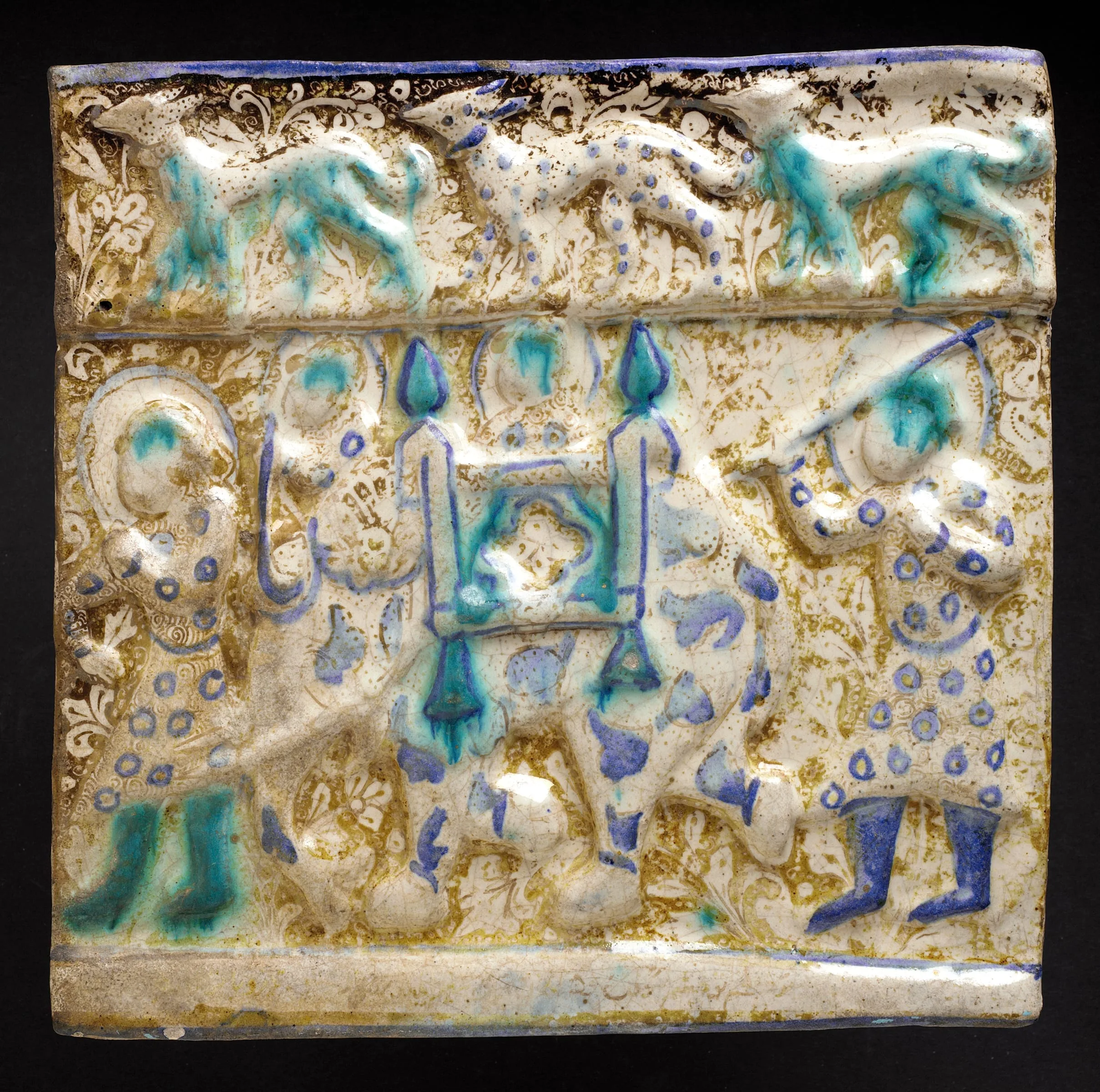
The Mongol invasions of Iran, beginning in 1220, and the subsequent period of Ilkhanid rule by the descendants of Genghis Khan (1256–1353) had an important impact on Persian art, architecture and architectural decoration. Like their Mongol predecessors, the Ilkhanids were migratory with seasonal camps and residences. Only one seasonal palace survives—Takht-i Sulaiman, in northwestern Iran—built ca. 1270 as a summer residence. Excavations at the site revealed extensive tile decoration. Based on the excavated tilework, this frieze tile, decorated in the costly overglaze luster technique, was likely produced for the interior of the palace.
Although its specific figural scene was not found at Takht-i Sulaiman, this tile is closely related in size and format to those excavated at the site. It similarly has molded relief decoration divided into three registers. In the top register is a row of spotted hounds while the bottom band has a badly abraded Persian inscription, which like other better-preserved examples may have quoted verses from the Shahnama (Book of Kings), the Iranian national epic. In the central field is an elephant mounted by a mahout, carrying a palanquin with a single passenger; an escort precedes and follows the procession. Like other such frieze tiles associated with the summer palace, this scene may illustrate a story from the Shahnama, perhaps from the tale of Bahram Gur who returned from India with a bride.