LACMA

ShopMembershipMyLACMATickets
LACMA
Los Angeles County Museum of Art
5905 Wilshire Blvd.
Los Angeles, CA 90036
info@lacma.org
(323) 857-6000
Sign up to receive emails
Subscribe
© Museum Associates 2026
  • About LACMA
  • Jobs
  • Building LACMA
  • Host An Event
  • Unframed
  • Press
  • FAQs
  • Log in to MyLACMA
  • Privacy Policy
© Museum Associates 2026
Collections

John Smibert
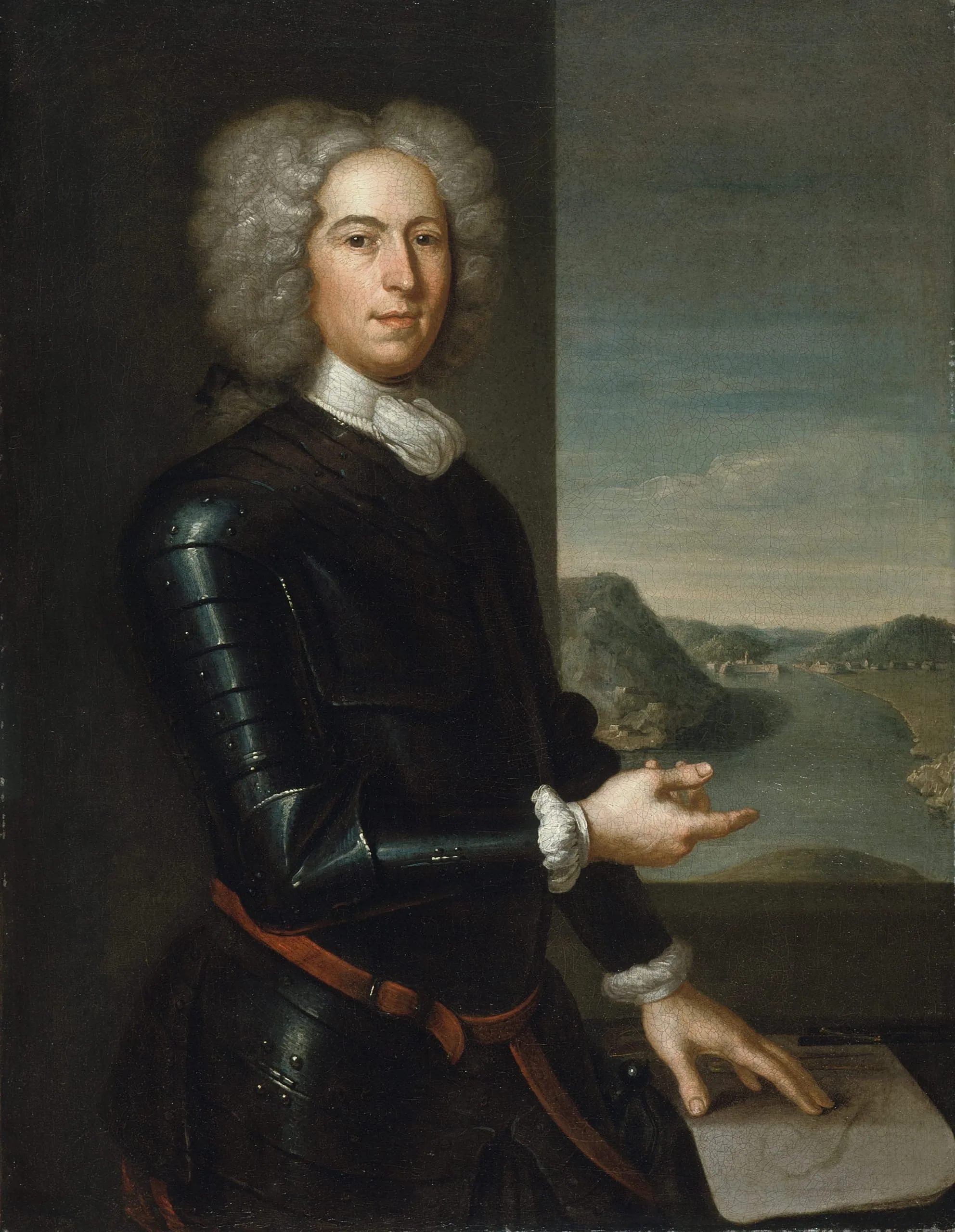
Portrait of Major General Paul Mascarene1729

On view:
Geffen Galleries
Oil painting portrait, three-quarter view of a man in dark plate armor and gray wig, one hand gesturing toward a river landscape visible through an opening behind him
Artist or Maker
John Smibert
Scotland, Edinburgh, active United States, 1688-1751
Title
Portrait of Major General Paul Mascarene
Place Made
United States
Date Made
1729
Medium
Oil on canvas
Dimensions
Canvas: 40 9/16 × 31 5/8 in. (103.03 × 80.33 cm) Frame: 47 1/16 × 38 × 3 in. (119.54 × 96.52 × 7.62 cm)
Credit Line
Museum purchase with funds provided by Mr. and Mrs. William Preston Harrison Collection, Charles H. Quinn Bequest, Eli Harvey, and other donors
Accession Number
78.8
Classification
Paintings
Collecting Area
American Art
Curatorial Notes

In his notebook, artist John Smibert recorded painting this portrait of Major Paul Mascarene in June 1729. Mascarene places his left hand on a map while gesturing with his right to a hilly scene in the window behind him—likely a modified view of the town of Annapolis Royal and Fort Anne in Nova Scotia. Smibert’s restrained palette, straightforward composition, and old-fashioned armor (which was already outdated when Mascarene posed for the portrait) belie the complex colonial circumstances depicted in the work.

Mascarene’s identity was multifaceted. Born in France, he grew up amid national religious conflicts that forced his Protestant Huguenot father to flee the country, while his mother converted to Catholicism. Mascarene landed in England, where he embarked on a military career that took him to North America to support British campaigns against the French in Canada. He spent the rest of his life in Boston and the British colony of Nova Scotia. There, he held government posts that placed him in the middle of contentious relations between British colonizers, French Catholics, and Indigenous communities.

In 1720, Mascarene authored a description of Nova Scotia that enumerated the natural resources available there, including grain, cattle, wood, mines, coal, stone, and fish, noting that, “It is easy from hence to infer of how much benefit it is to Great Britain that two such considerable branches of trade as the supplies for Naval Stores, and the Fishery may remain in her possession.” He also undertook a coastal survey of the area. The map and drafting instruments visible on the table in Smibert’s portrait allude to the colonial desire to record and control new territories.

Like Mascarene, Smibert was a product of British colonial ambitions. He emigrated to North America from Scotland to work as a professor of fine arts at a new university in Bermuda established by Anglican bishop George Berkeley. However, when that endeavor failed, Smibert stayed in Boston, where he operated a portrait studio, collected art, and sold supplies, helping to disseminate European artistic practices to aspiring artists in the British American colonies. His professional success was likely supported by enslaved labor, as evidenced by a 1737 newspaper notice in which Smibert attempted to find Cuffee, his enslaved Black servant, who was wearing “Leather Breeches stain’d with divers sorts of paints” (Van Horn, 35). Between artist and subject, Smibert’s portrait of Major Paul Mascarene is a visual embodiment of the varied and fraught journeys that often converged in colonial sites.

Selected Bibliography

Mascarene, Paul. “Description of Nova Scotia.” In Selections from the Public Documents of the Province of Nova Scotia, ed. Thomas B. Akins. C. Annand, 1869. https://archive.org/details/selectionsfromp00akingoog/page/38/mode/2up.

Saunders, Richard H. John Smibert: Colonial America’s First Portrait Painter. Yale University Press, 1995.

Stanwood, Owen. “A Refugee in the Service of Empire: The Life and Lessons of Paul Mascarene.” Diasporas 34 (2019): 31−45. https://doi.org/10.4000/diasporas.4097.

Smibert, John. The Notebook of John Smibert; with Essays by Sir David Evans, John Kerslake, and Andrew Oliver. Massachusetts Historical Society, 1969.

Van Horn, Jennifer. Portraits of Resistance: Activating Art during Slavery. Yale University Press, 2022.

Selected Exhibition History

Studio of the artist, Boston, January 1730, no cat. traced.

The Smibert Tradition, Yale University Art Gallery, New Haven, 1949 (cat. published as Bulletin of the Associates in Fine Arts, Yale University, 17, nos. 2−3 [1949], no. 20).
Provenance

Paul Mascarene, Boston and Canada § John Mascarene (by descent), Boston, 175?-79 § Margaret Holyoke Mascarene (by descent), Boston, 1779-92 § Foster Hutchinson, Jr. (by descent), Halifax, Nova Scotia, Canada, 1793 § Abigail Hutchinson (by descent), Halifax, as of 1838 § W. J. Stirling (by descent), Halifax; Wiesbaden, Germany; and London, as of 1869 to 1910 (sale of W. J. Stirling effects, London, 1910 [?], as by Sir Peter Lely) § With A. Ellis, London, from 1910 § London (?), auction, about 1915 § With Alfred M. Lever, London, as of 1925 or 1926 § Paul Mascarene Hamlen, Boston, 1926 § Mrs. E. R. Warren (by descent), Boston, 1928 § Mrs. Paul Mascarene Hamlen (by descent), Wayland, Mass., as of 1950 § Mr. and Mrs. Nathaniel Hamlen (by descent), Way, land § Estate of Nathaniel Hamlen, as of 1973 § With Hirschl & Adler Galleries, New York, 1975-78.

Commissioned by Jean-Paul (Paul) Mascarene (c. 1684–1760), Boston and Canada, given 1750s to his son; John Mascarene (1772–1779), Boston, to his wife; Margaret Mascarene (1726–1792, née Holyoke), Boston, by descent in 1793 to her husband’s nephew; Foster Hutchinson, Jr. (1761–1815) Halifax, Nova Scotia. Abigail Merchant (née Hutchinson 1776–1843), Halifax, by 1838, by descent by 1869 to; W. J. Stirling, Halifax, Wiesbaden, and London (sale of W. J. Stirling effects, London, 1910 [?], as by Sir Peter Lely). [A. Ellis, London, from 1910. London auction (?), sold c. 1915, to; [Alfred M. Lever, London, sold 1925 or 1926 to]; Paul Mascarene Hamlen (1874–1939), Boston, given 1928 to his sister; Miriam Peabody Warren (née Hamlen, 1871–1957), Boston, to her sister-in-law; Dorothy Bristow Hamlen (née Draper, widow of Paul Mascarene Hamlen, formerly Mrs. Thomas Brattle Gannett, 1890–1970), Wayland, Massachusetts, as of 1950 to; Nathaniel Hamlen (son of Paul Mascarene Hamlen 1905–1967) and his wife, Evelyn Livingston Hamlen (1911–1982, née Hollingsworth), Wayland, transferred 1973 to; estate of Nathaniel Hamlen, sold 1975 to; [Hirschl & Adler Galleries, New York, sold 1978 to]; LACMA.
Selected Bibliography
  • Fort, Ilene Susan and Michael Quick. American Art: a Catalogue of the Los Angeles County Museum of Art Collection. Los Angeles: Los Angeles County Museum of Art, 1991.
  • Price, Lorna. Masterpieces from the Los Angeles County Museum of Art. Los Angeles: Los Angeles County Museum of Art, 1988.
  • Quick, Michael et. al. American Portraiture in the Grand Manner: 1720-1920. Los Angeles: Los Angeles County Museum of Art, 1981.
  • LACMA: Obras Maestras 1750-1950: Pintura Estadounidense Del Museo De Arte Del Condado De Los Angeles. Mexico, D.F.: Museo Nacional de Arte, 2006.