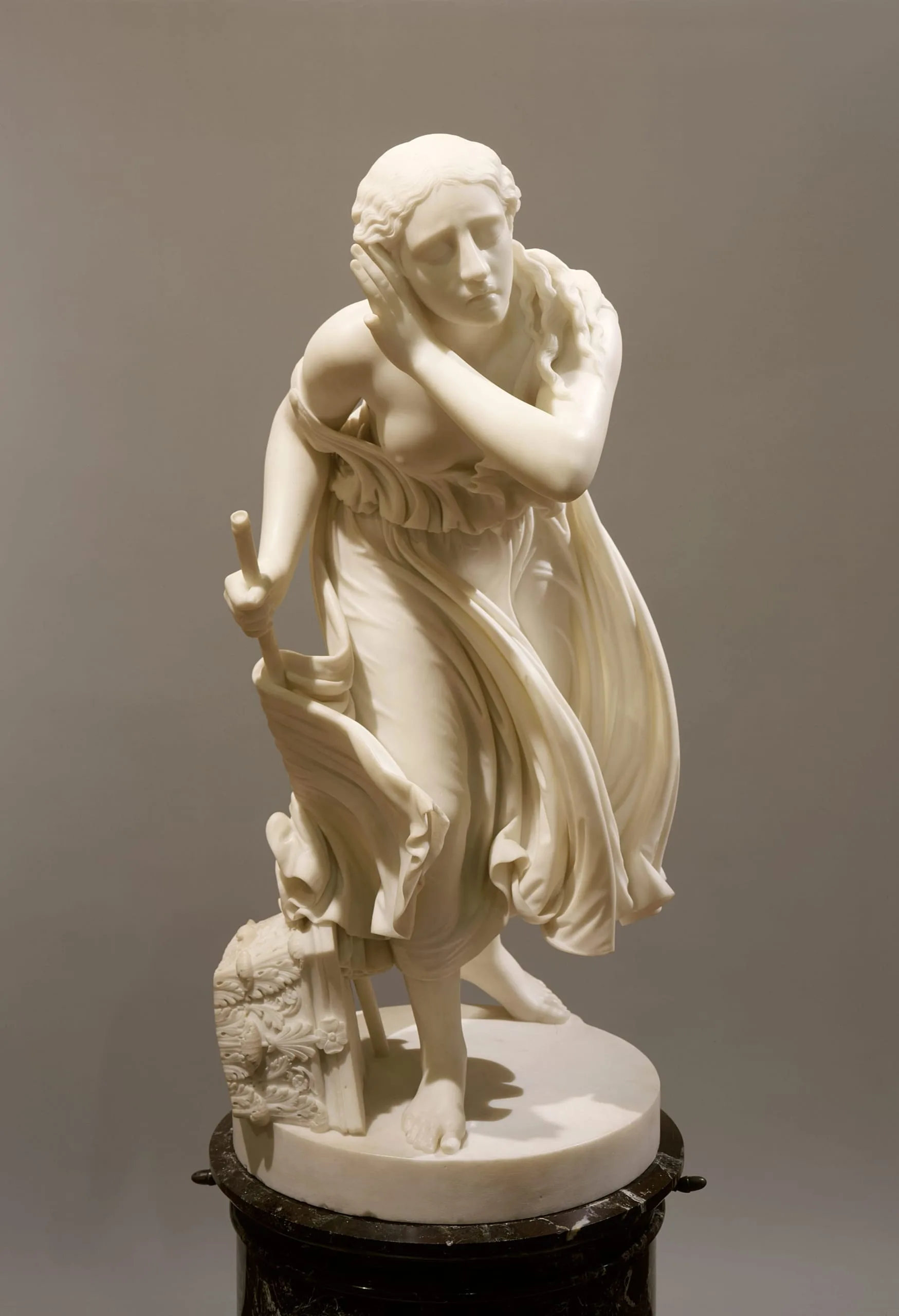
Inspired by British author Edward Bulwer-Lytton’s enormously popular novel The Last Days of Pompeii (1834), Randolph Rogers depicts the blind and enslaved flower girl Nydia striding dramatically forward as she tries to escape Pompeii during the eruption of Mount Vesuvius (79 CE). With one hand at her ear and another holding a cane, her eyes are closed to convey her blindness. In the darkness that followed the volcanic eruption, her highly developed sense of hearing was an advantage in trying to navigate and escape the doomed city. The sculpture re-creates a moment in the story when Nydia became separated from her two companions, Glaucous and Ione, as she was attempting to lead them to safety.
Rogers grew up in Ann Arbor, Michigan, but spent most of his professional career in Rome. Nydia became his most famous sculpture, reflecting a heightened interest in the eruption of Vesuvius arising from the excavations of Pompeii and Herculaneum that began in the eighteenth century. With Nydia, Rogers references a classical past as interpreted through nineteenth-century literature. While Nydia’s smooth, idealized facial features and the inclusion of the capital fragment at her feet are consistent with Neoclassical aesthetics, the folds of drapery, which suggest dramatic movement, are more aligned with ancient Hellenistic sculpture and Baroque traditions. Her dress, which falls off one shoulder to reveal her breast, may also be a reference to classical depictions of the Amazons, female warriors who were similarly lauded for their strength and bravery.
Selected Bibliography
Fort, Ilene Susan, and Michael Quick. American Art: A Catalogue of the Los Angeles County Museum of Art Collection. Los Angeles County Museum of Art, 1991.
Mattusch, Carol C., Stefano De Caro, and Kenneth Lapatin, et al. Pompeii and the Roman Villa: Art and Culture around the Bay of Naples. National Gallery of Art and Thames & Hudson, 2008.
Seydl, Jon L. “Experiencing the Last Days of Pompeii in Late Nineteenth-Century Philadelphia.” In Pompeii in the Public Imagination from Its Rediscovery to Today, ed. Shelley Hales and Joanna Paul. Oxford University Press, 2011.
Selected Exhibition History
Pompeii and the Roman Villa: Art and Culture Around the Bay of Naples, LACMA, May 3−October 4, 2009.