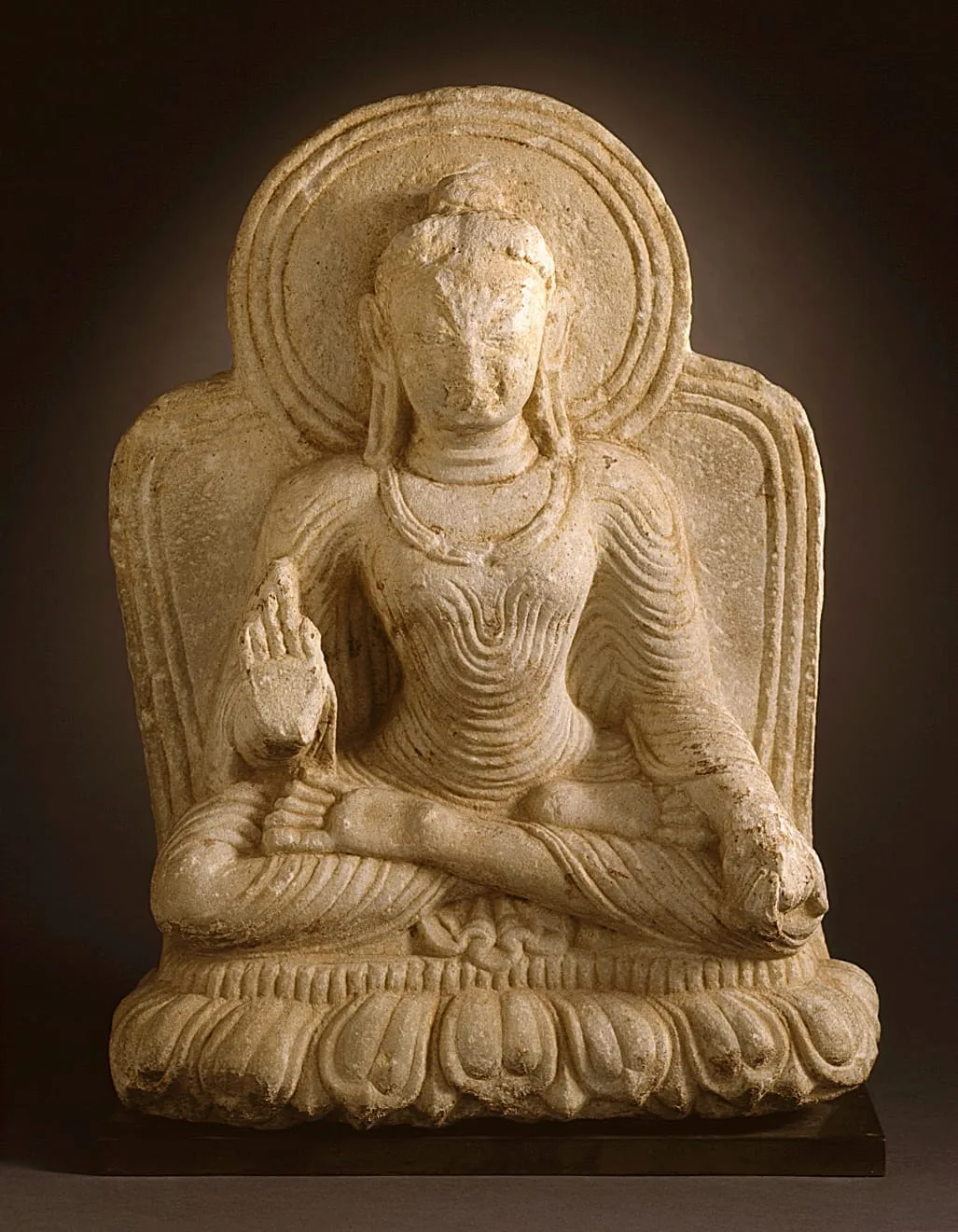
Iconographically, this Buddha displays the standard physical features. It has snail-curl hair, the cranial protuberance (ushnisha) emblematic of his omniscience, elongated earlobes symbolizing his renunciation of the material world, and heavily-lidded pensive eyes conveying his compassion for all sentient beings. Unfortunately, the forehead is damaged and it is impossible to tell if there was originally a sacred forehead marking (urna). The Buddha is seated on a lotus base in the meditation posture (padma asana), although the left leg is unusually placed over the right leg instead of the more customary vice versa. His right hand is held in the gesture of reassurance (abhaya mudra). His left hand rests on his left knee and holds the end of his robe. He wears a pleated robe over both shoulders.
Stylistically, however, this representation of the Buddha incorporates elements from Afghanistan, Kashmir, and China. This is apparent in the triple borders of the aureole and nimbus, and particularly in the treatment of the robe with its distinctive undulating pendant drapery folds on the chest, which may derive from Chinese artistic traditions. For example, see a well-known Chinese gilt bronze image dated 486 of Maitreya, the Buddha of the Future, in the Metropolitan Museum of Art, New York (26.123).