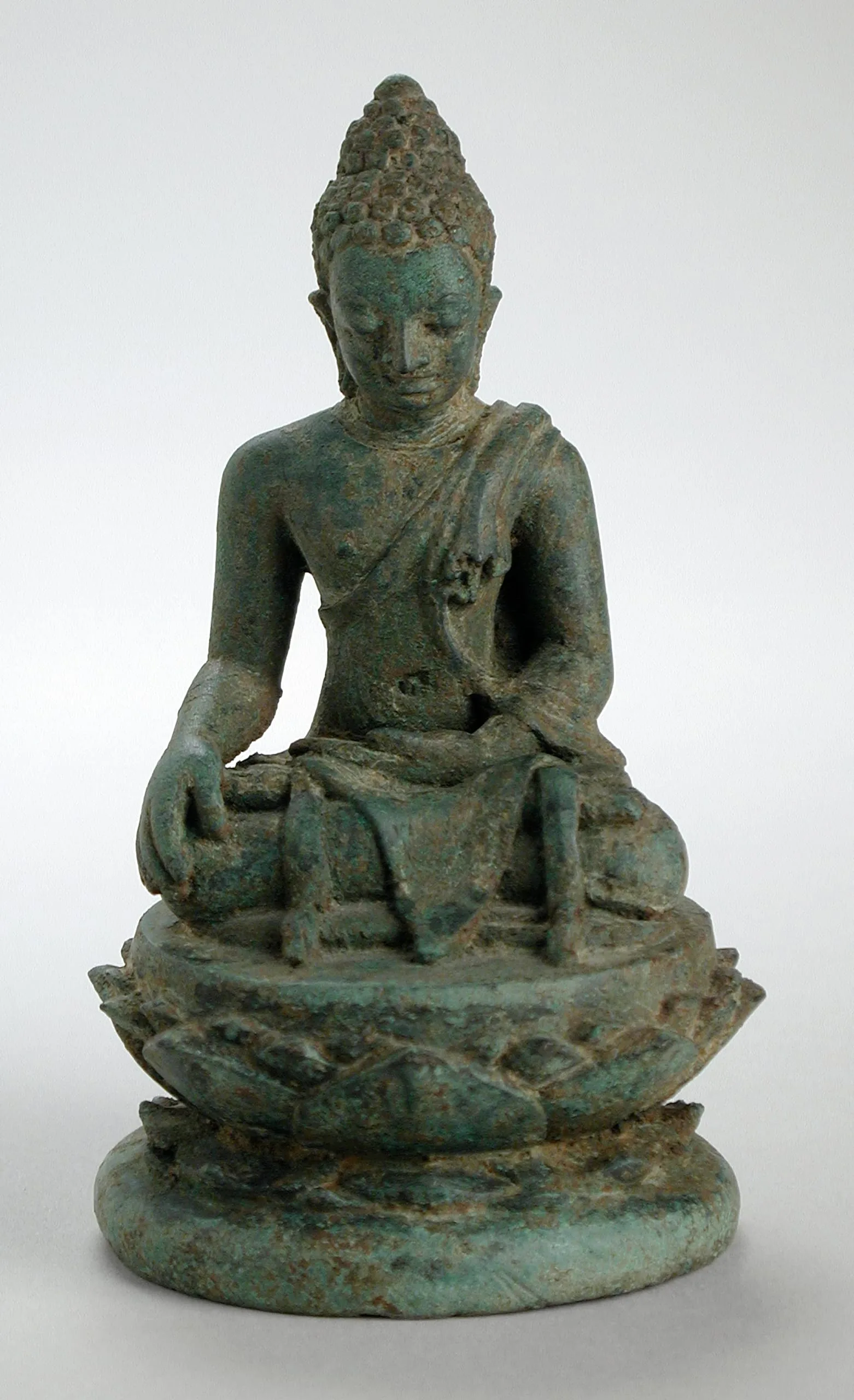
This classic Central Javanese copper alloy sculpture of a Buddha probably represents the historical Buddha Shakyamuni (traditionally dated to 563–483 BCE), although it is alternatively possible that it portrays the transcendental Jina Buddha Akshobhya (Unshakable One). Akshobhya, who presides over the Abhirati eastern heaven and whose symbolic color is blue, is one of the five Jina (Victor) Buddhas demonstrating the state and qualities of Buddhahood. In addition to Akshobya, they are Vairochana, Ratnasambhava, Amitabha, and Amoghasiddhi.
The Buddha is seated in the meditation posture (padma asana) on a lotus base. He wears a monastic robe covering his left shoulder. His right hand is held in the gesture of calling the earth to witness his accumulated merit by touching the ground with his right hand (bhumisparsha mudra), which is shared by Shakyamuni and Akshobhya. He does not hold the thunderbolt (vajra) attribute of Akshobhya in his left hand resting in his lap, nor is one shown on the base. Hence, it is more likely the image depicts Shakyamuni than Akshobhya.
A comparable Central Javanese copper alloy image of Shakyamuni or Akshobhya is in the Linden-Museum, Stuttgart (SA 35 235 L). See J. E. van Lohuizen-de Leeuw, Indo-Javanese Metalwork (Stuttgart: Linden-Museum, 1984), p. 47, no. 11. See also M.80.50.