LACMA

ShopMembershipMyLACMATickets
LACMA
Los Angeles County Museum of Art
5905 Wilshire Blvd.
Los Angeles, CA 90036
info@lacma.org
(323) 857-6000
Sign up to receive emails
Subscribe
© Museum Associates 2025

Museum Hours

Monday

11 am–6 pm

Tuesday

11 am–6 pm

Wednesday

Closed

Thursday

11 am–6 pm

Friday

11 am–8 pm

Saturday

10 am–7 pm

Sunday

10 am–7 pm


  • About LACMA
  • Jobs
  • Building LACMA
  • Host An Event
  • Unframed
  • Press
  • FAQs
  • Log in to MyLACMA
  • Privacy Policy
© Museum Associates 2025
Collections

Unknown
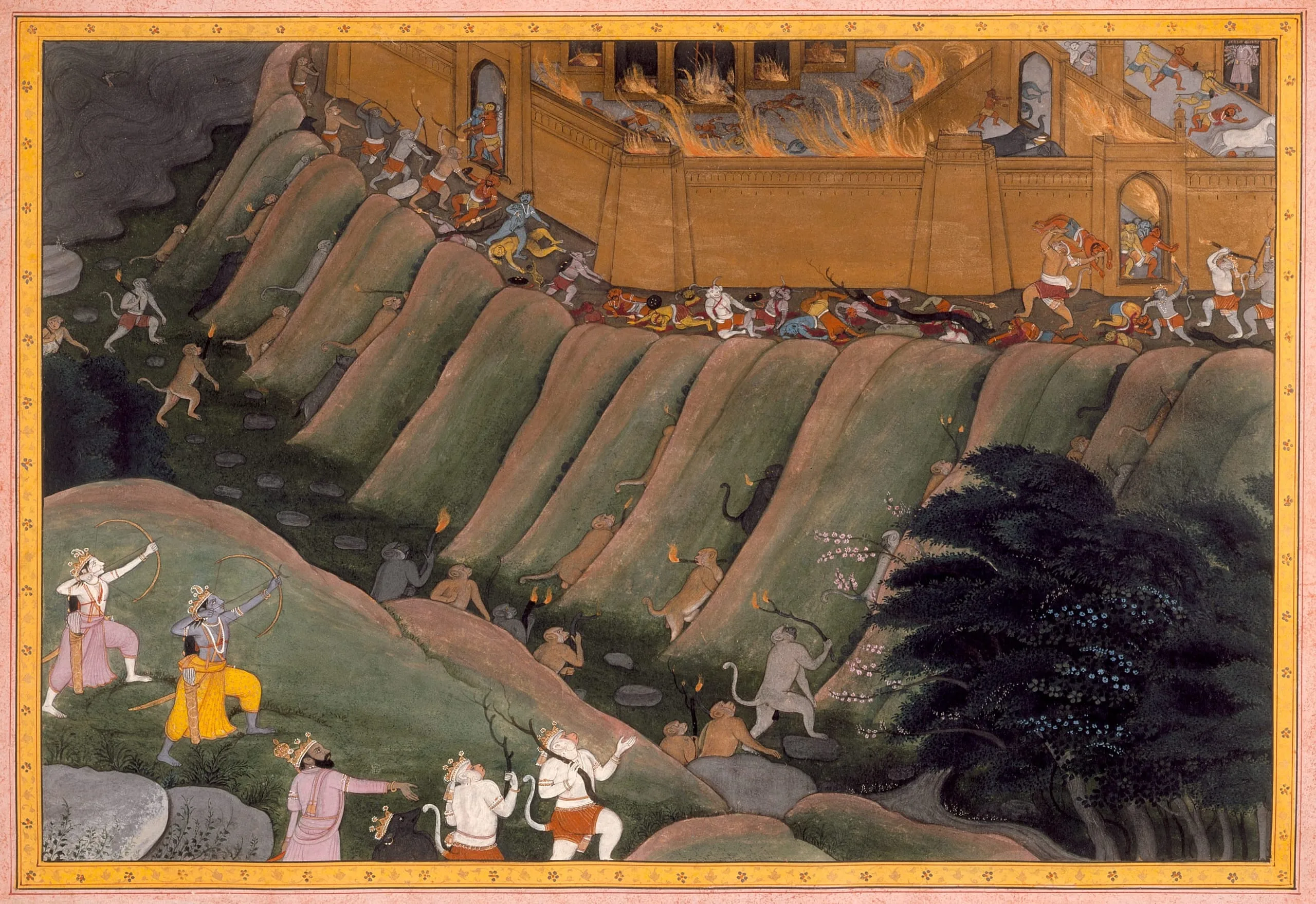
The Siege of Lanka, Folio from a Ramayana (Adventures of Rama)circa 1800

Not on view
Mughal or Rajput painting of a battle scene with monkey figures storming a burning golden fortress across terraced green hills, with commanding figures in the lower left
Artist or Maker
Unknown
Title
The Siege of Lanka, Folio from a Ramayana (Adventures of Rama)
Place Made
India, Himachal Pradesh, Kangra
Date Made
circa 1800
Medium
Opaque watercolor, gold, and silver on paper
Dimensions
Image: 8 x 12 in. (20.32 x 30.48 cm); Sheet: 9 3/4 x 13 7/8 in. (24.77 x 35.24 cm)
Credit Line
Indian Art Special Purpose Fund
Accession Number
M.78.31
Classification
Drawings
Collecting Area
South and Southeast Asian Art
Curatorial Notes

The Ramayana narrates the epic saga of the valiant Prince Rama and his dutiful wife, Princess Sita, who was abducted by Ravana, the arrogant ten-headed King of Lanka (probably modern Sri Lanka), during Rama's unjust fourteen-year forest exile from his capital of Ayodhya, Uttar Pradesh. To rescue Sita, Rama and his faithful brother Lakshmana assembled a great army of monkeys and bears led by the Monkey-King Sugriva and his Monkey-General Hanuman. After several magical battles, the princess was freed, and the happy couple triumphantly returned home to rule their kingdom. Rama and Sita epitomize the ideal ruler and the paragon of fidelity in Hindu culture.

This illustration is from Book 6 (Yuddha kanda). It depicts the ferocious siege of the Lanka fortress before Indrajit, the elder son of Ravana who had been given a boon of invisibility by Brahma, struck down Rama and Lakshmana with magical arrows in the form of great serpents (Ramayana 6:31-34).

In the foreground, Rama and Lakshmana shoot barrages of arrows at the demonic defenders of the impregnable fort. Sugriva, Hanuman, the Bear-King Jambavan and their simian and bruin forces are directed where to attack by Vibishana, the younger brother of Ravana who defected to Rama’s side and provided strategic advice during the assault. In the upper right corner, the enraged Ravana watches helplessly as his citadel goes up in flames. Monkeys cross the moat and scale the hillside to join the fierce fighting at the base of the ramparts.
Selected Bibliography
  • Pal, Pratapaditya. "Ramayana Pictures from the Hills in the Los Angeles County Museum of Art." In Ramayana: Pahari Paintings, edited by Roy C. Craven, 87-106. Bombay: Marg Publications, 1990.
  • Meller, Susan. Labels of Empire: Textile Trademarks: Windows into India in the Time of the Raj. Novato, CA: Goff Books, 2023.