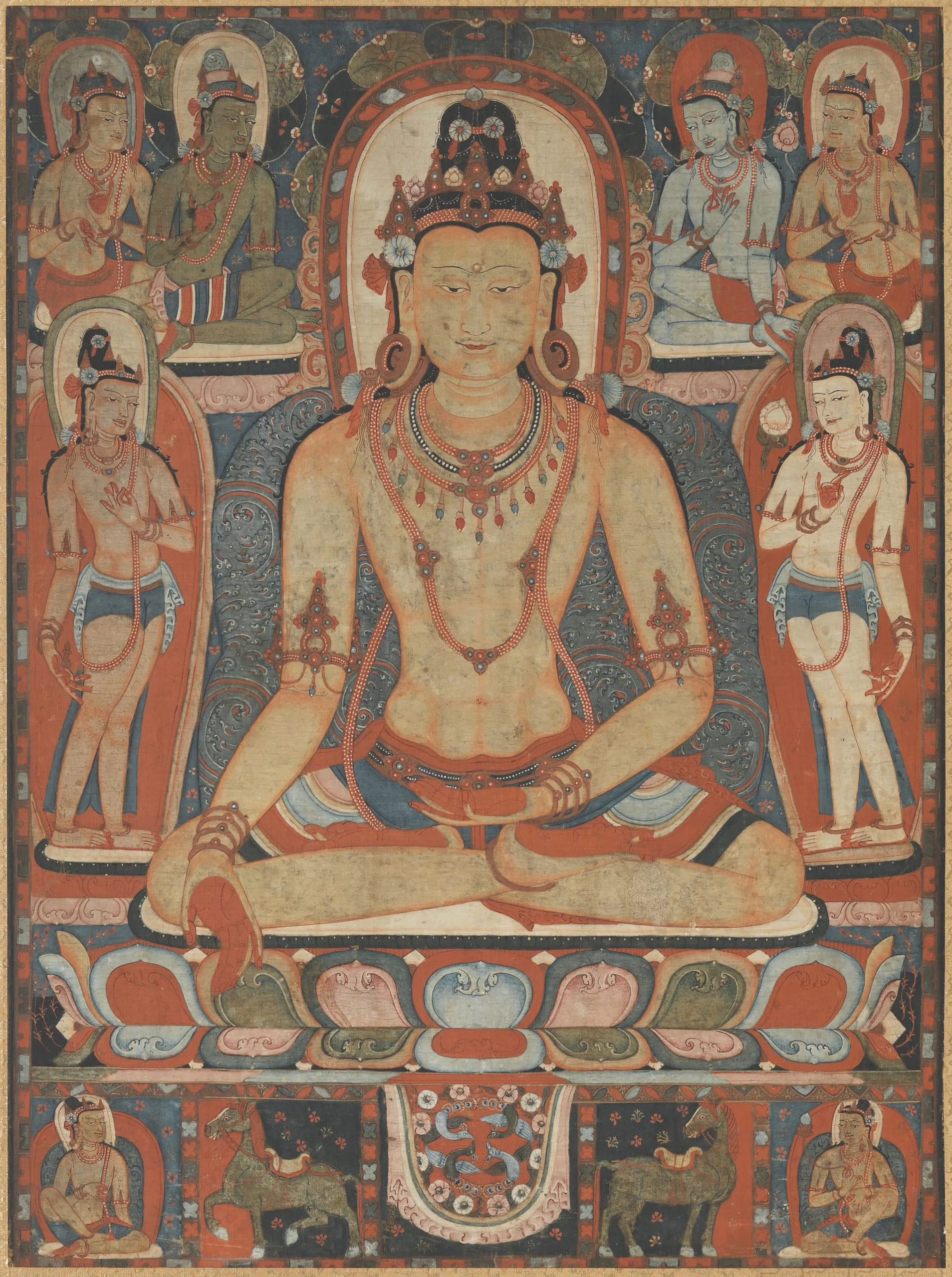
This painting of Ratnasambhava was once part of a set of five Jina (Meditation) Buddhas associated with Saravid (Universal Knowledge [of incantations and mantras] Vairochana (see AC1994.121.1). Each one of these Buddhas is associated with a color, direction, hand gesture, and vehicle. Ratnasambhava, who symbolizes the "primordial wisdom of equality," is yellow, presides over the southern quadrant, makes the gesture of charity (varada mudra), and has a horse mount (shown here in the bottom register). Ratnasambhava is enthroned on a lotus base in the center of the painting. He is flanked by the Bodhisattvas Vajra Ratna on his right and Vajra Hasa on his left. The green and blue Bodhisattvas flanking Ratnasambhava’s head are Vajra Tejas and Vajra Ketu respectively. In the four corners are yellow Bodhisattvas displaying the gesture of discourse (vitarka mudra).
The painting was produced at a Kadampa monastery in Central Tibet. The founding monastery of the Kadampa sect was established in Reting in 1056 by Dromton (1008-64), a disciple of the Indian teacher Atisha (982-1054). The Kadampas (bound by command) practiced a rigorous form of Buddhism derived from Indic monastic traditions that requiring abstaining from marriage, intoxicants, travel, and possession of money.
In this early Tibetan painting of Ratnasambhava ("Jewel Born"), the artist has consciously emulated eastern Indian painting in the style in which the figures are modeled, the symmetrical composition, and in the manner in which the further eye protrudes beyond the faces drawn in three-quarter profile. The sparkling surface, once believed to be caused by the presence of mica flakes (Pal (1983) 1990, 135), has been determined by a technical analysis to be a deterioration resulting from arsenic crystallization (Huntington and Bangdel 2003, 512-513, Appendix 3A).