- Artist or Maker
- Possibly by Mir Ali
(Herat or Bukhara, active late 15th to first half of 16th century) - Title
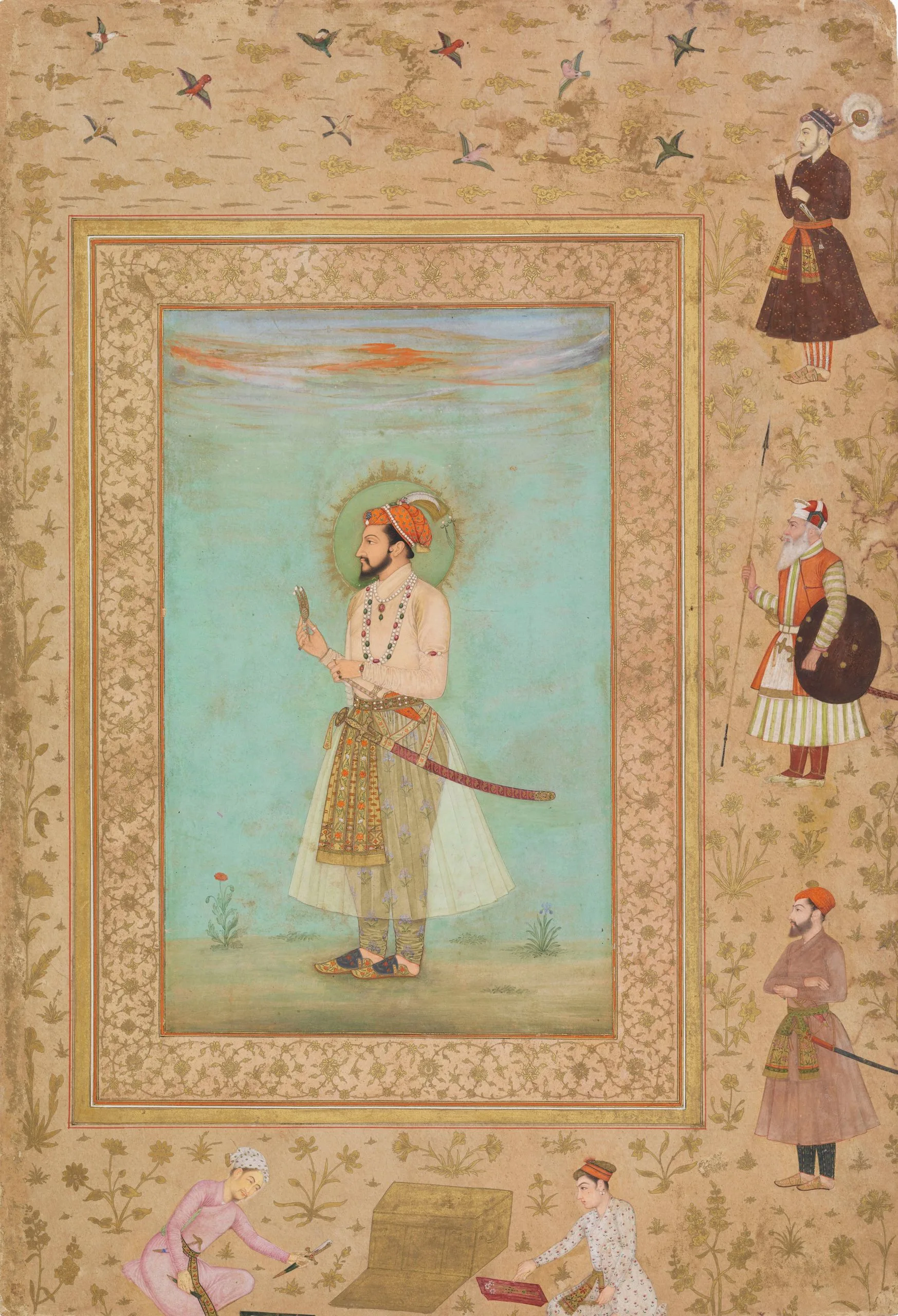
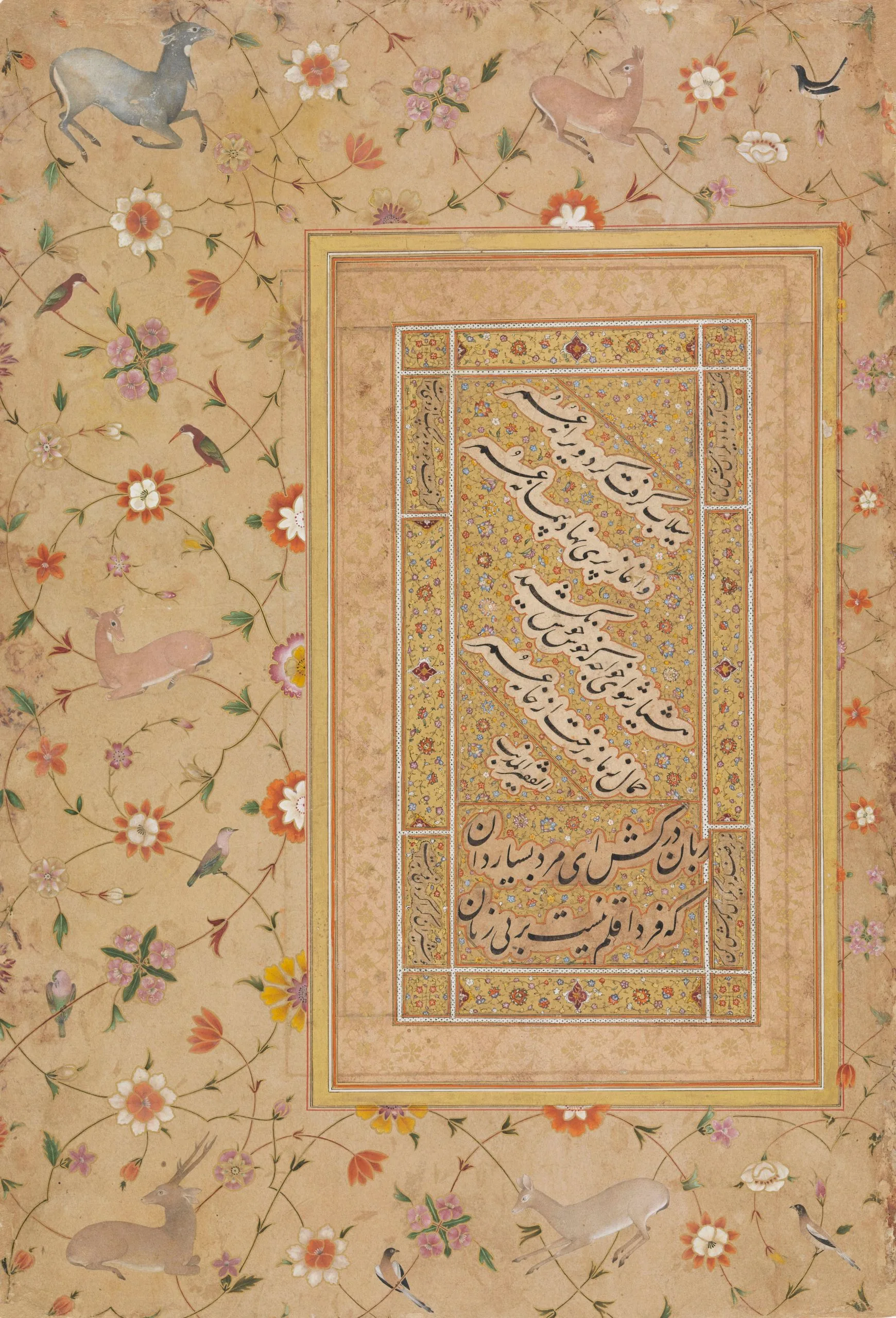
- Emperor Shah Jahan (r. 1628-1658) (verso), Calligraphy (recto), Folio from the Late Shah Jahan Album
- Date Made
- circa 1635 (border: circa 1650) (verso); Iran, circa 1505-1545 (border: India, Mughal Empire, circa 1650) (recto)
- Medium
- Opaque watercolor, gold, and ink on paper
- Dimensions
- Sheet: 14 1/2 x 10 in. (36.83 x 25.4 cm); Image (recto): 7 3/4 x 4 in. (19.69 x 10.16 cm); Image (verso): 8 x 4 7/8 in. (20.32 x 12.38 cm)
- Accession Number
- M.78.9.15
- Curatorial Notes
This painting once belonged to a now dispersed album (muraqq‘a) known as the Late Shah Jahan Album (for another folio, see M.83.1.3). The muraqq‘a, which flourished from the fifteenth to the seventeenth century in Iranian lands, was adopted in Mughal India by the early seventeenth century. Many of these albums, which were typically composed of alternating facing pages of paintings and calligraphy, were later disassembled and their folios disseminated on the art market, as was the case with the Late Shah Jahan Album. At least 100 folios from this album survive and are spread across collections worldwide; they have been determined to be related to one another through their border decorations.
While some muraqq‘a focused on collecting and displaying masterpieces of calligraphy and painting, this album had a strong historical focus, gathering together painted portraits of important members of the Mughal court. This painting portrays the emperor Shah Jahan (r. 1628−58), for whom the album is believed to have been made. The ruler is elegantly dressed and bedecked in exquisite pearl and gem-encrusted jewelry, with a green halo radiating gold rays around his head, a symbol of his imperial authority. The figures in the surrounding border are courtiers and attendants, who may have once been recognizable as specific individuals but their identities are now unknown. The recto of the folio features a calligraphic work likely by the Timurid calligrapher Mir ‘Ali, who was active in Bukhara and Herat in the preceding century, and whose work was highly prized by the Mughals and appears frequently in this album.
2025
- Selected Bibliography
- Melwani, L. "Looking for the Perfect Ganesha." Arts and Antiques (October 2000).
- Heeramaneck, Alice N. Masterpieces of Indian Painting : From the Former Collections of Nasli M. Heeramaneck. New York: A.N. Heeramaneck, 1984.
- Anderson, D. The Aesthetics of Calligraphy. Los Angeles: University of Southern California, 1977.
- Pal, Pratapaditya, Janice Leoshko, Joseph M. Dye, III, Stephen Markel. Romance of the Taj Mahal. Los Angeles: Los Angeles County Museum of Art, 1989.
- Rosenfield, John. The Arts of India and Nepal: The Nasli and Alice Heeramaneck Collection. Boston: Museum of Fine Arts, Boston, 1966.
- Pal, Pratapaditya. Indian Painting, vol.1. Los Angeles: Los Angeles County Museum of Art, 1993.
- Komaroff, Linda. Beauty and Identity: Islamic Art from the Los Angeles County Museum of Art. Los Angeles: Los Angeles County Museum of Art, 2016.
- Asher, Catherine B., and Thomas R. Metcalf, editors. Perceptions of South Asia's Visual Past. New Dehli: American Institute of Indian Studies, 1994.
- Markel, Stephen. Mughal and Early Modern Metalware from South Asia at LACMA: An Online Scholarly Catalogue. Los Angeles: Los Angeles County Museum of Art, 2020. https://archive.org/details/mughal-metalware (accessed September 7, 2021).