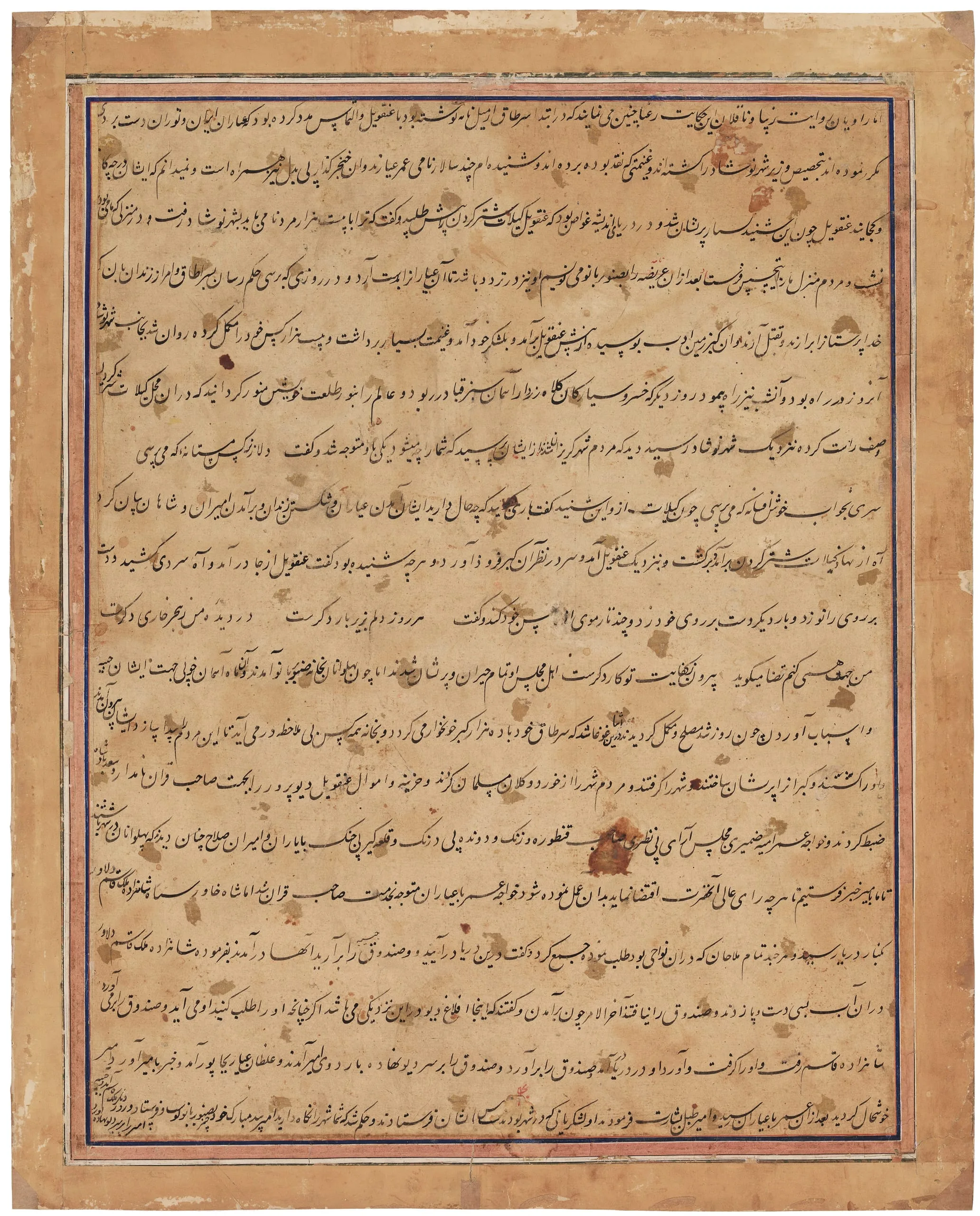
The Hamzanama is a Persian folk epic blending fantasy, romance, heroism, and religion, recounting the legendary exploits of Amir Hamza, the Prophet Muhammad’s uncle. Long rooted in oral tradition and popular across Iran and Mughal India, its charming tales of giants and epic battles were performed in public recitations. The young Emperor Akbar (r. 1556–1605) commissioned an illustrated manuscript early in his reign in 1562, recruiting Iranian and Indian artists under the supervision of the Persian masters Mir Sayyid ‘Ali and ‘Abd al-Samad. Originally comprising as many as fourteen volumes with an estimated 1,400 paintings, only a fraction survives today.
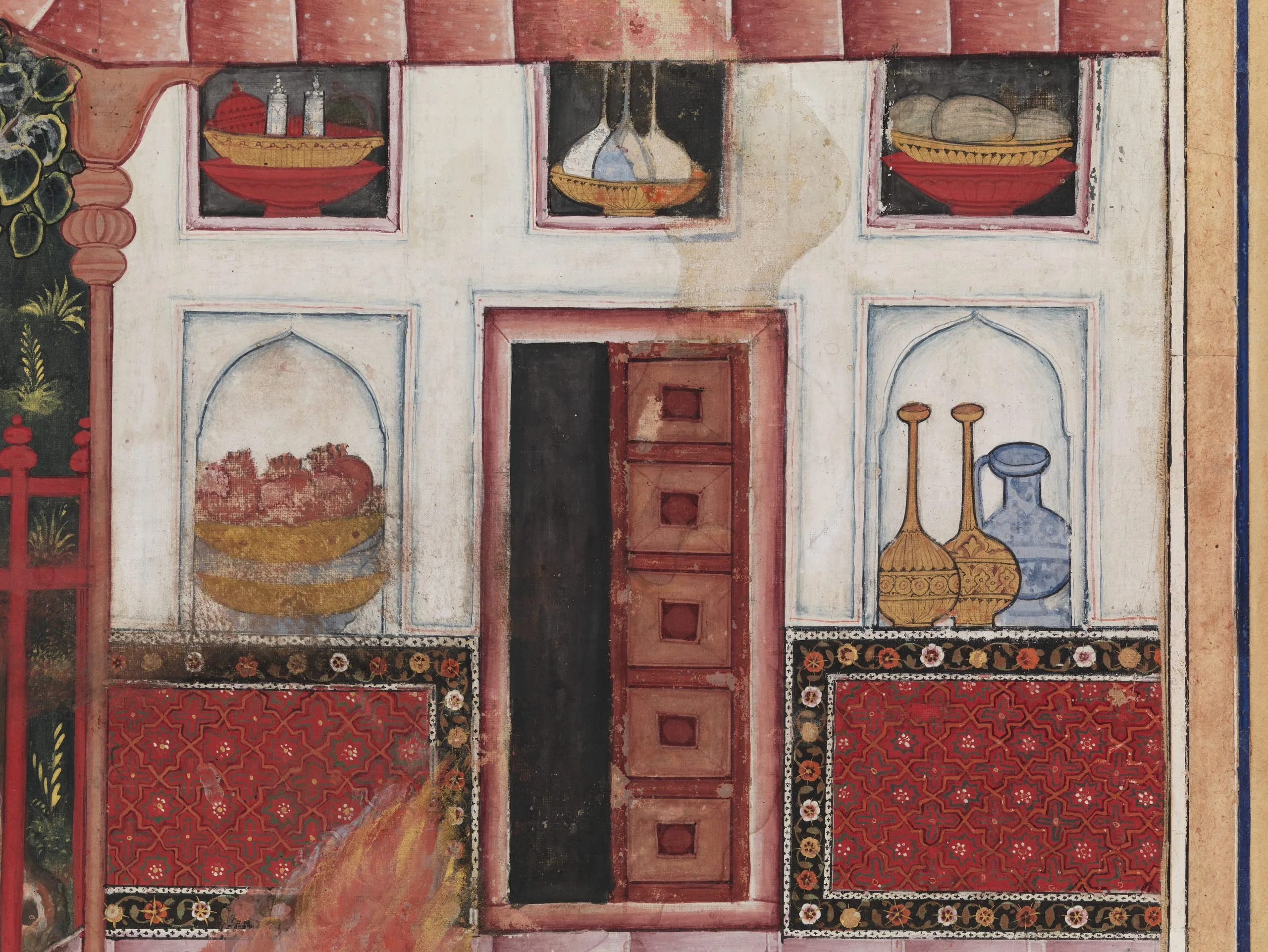
This folio depicts Sanawbar Banu welcoming Hamza’s warriors (ayyars) through an ornate gateway while a servant unrolls a red spread before them. The depiction of female figures in Indian attire reveals local influence, adapting the Islamic epic for Akbar’s diverse empire. As was customary, multiple artists collaborated on this painting. The architectural details are attributed to Shravana, while the expressive figures are believed to have been painted by Dashavanta. As seen in the present folio, Hamzanama illustrations were distinctive in both format and medium. Unlike conventional manuscript illustrations, they were larger in size and painted on cotton cloth with the text on the reverse. Their bold compositions, rich colors, and ornate details reflect a fusion of Persian and Indian artistic traditions, showcasing the early development of the distinctive Mughal style of painting, which later reached maturity in Akbar’s grand projects, such as the Baburnama (M.91.348.1 and M.81.8.7) and Akbarnama (M.78.9.6).
2025