- Title
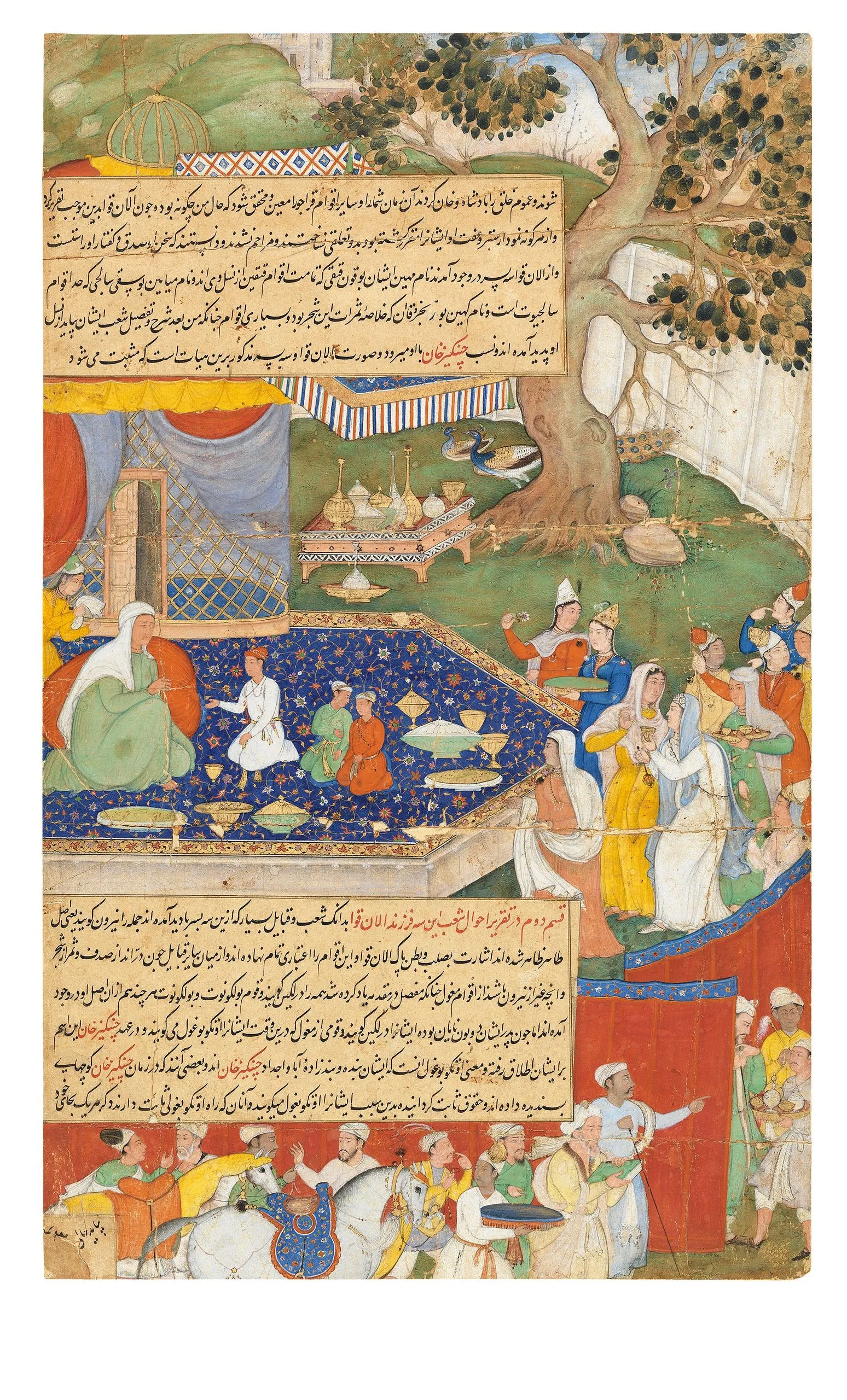
- Alanquva and Her Three Sons, Folio from a Chingiznama (History of Genghis Khan)
- Date Made
- 1596
- Medium
- Opaque watercolor, gold and ink on paper
- Dimensions
- 13 3/8 x 8 1/4 in. (33.97 x 20.32 cm)
- Accession Number
- M.78.9.9
- Curatorial Notes
The Chingiznama (History of Genghis Khan) is a section of the Jami al-Tawarikh (History of the World) written by the eminent Persian historian Rashid al-Din (1247-1318). Its first section, called the Tarikh-i Ghazani, describes the history of the Mongol and Turkish tribes, concentrating on the Mongol Emperor Genghis (or Chingiz) Khan (r. 1206-1227) and his successors until the death of Ghazan Khan (r. 1295-1304). This manuscript of the Chingiznama was completed in 1596. It is now held mainly in the Gulistan Palace Library, Tehran.
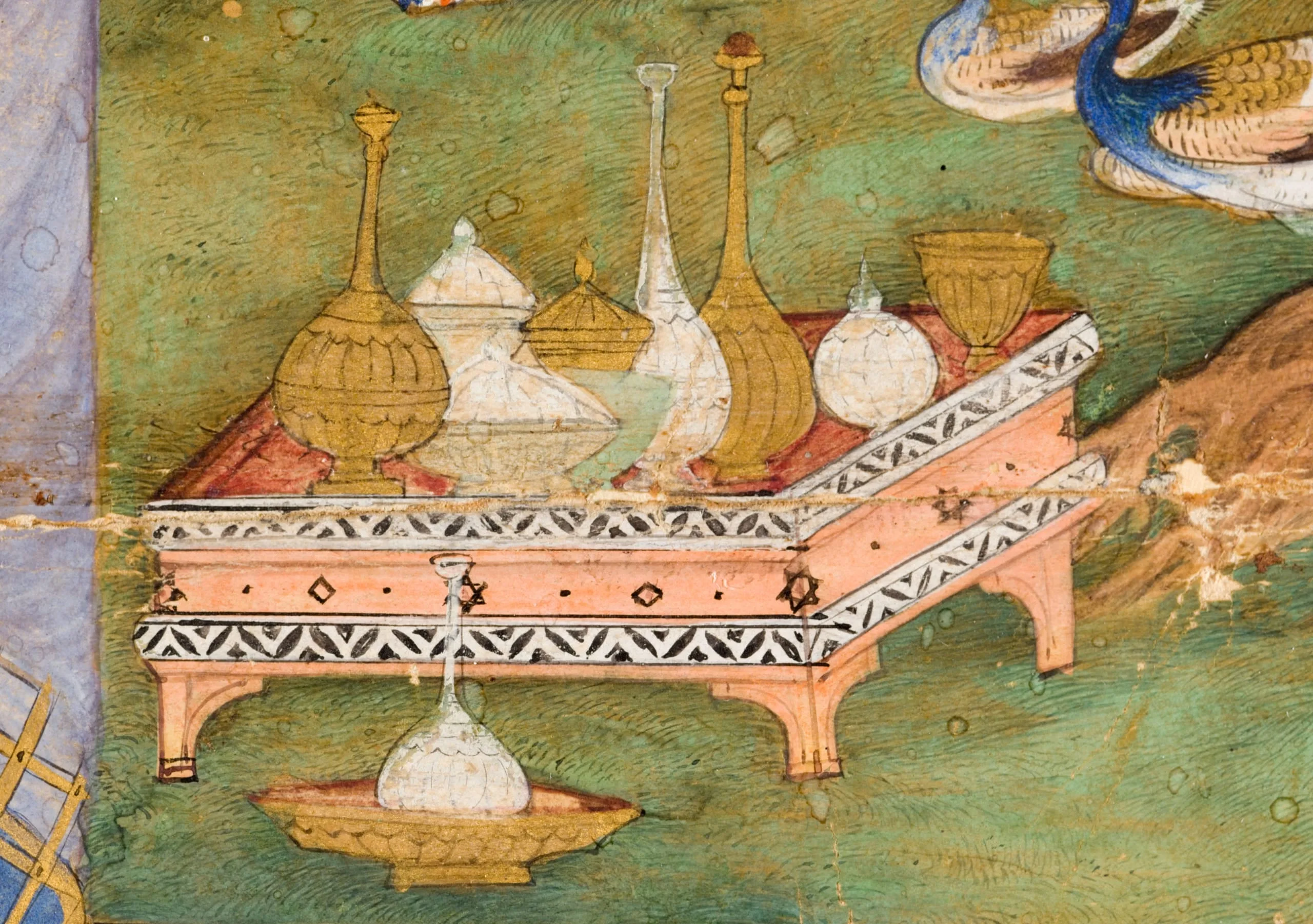
This folio portrays a mythical ancestor of the Mughals, Alanquva, and her three sons. She was believed to have been born miraculously after being impregnated by a divine light, which was inherited by the Mughal Emperor Akbar (r. 1556-1605). Here, Alanquva is seated on a carpeted platform with her three sons within a tent enclosure. Golden and ceramic dishes of delicacies are laid out for their enjoyment and a group of women bearing additional food and drink approaches them. In the foreground outside of the enclosure are the segregated men, some of them also bringing refreshments and a bound volume.
- Selected Bibliography
- Pal, Pratapaditya. Indian Painting, vol.1. Los Angeles: Los Angeles County Museum of Art, 1993.
- Heeramaneck, Alice N. Masterpieces of Indian Painting : From the Former Collections of Nasli M. Heeramaneck. New York: A.N. Heeramaneck, 1984.
- Pal, Pratapaditya, ed. Aspects of Indian Art: Papers Presented in a Symposium at the Los Angeles County Museum of Art. Leiden, The Netherlands: E.J. Brill, 1972.
- Rosenfield, John. The Arts of India and Nepal: The Nasli and Alice Heeramaneck Collection. Boston: Museum of Fine Arts, Boston, 1966.
- Komaroff, Linda, editor. Dining with the Sultan: The Fine Art of Feasting. Los Angeles: Los Angeles County Museum of Art; New York: DelMonico Books, 2023.