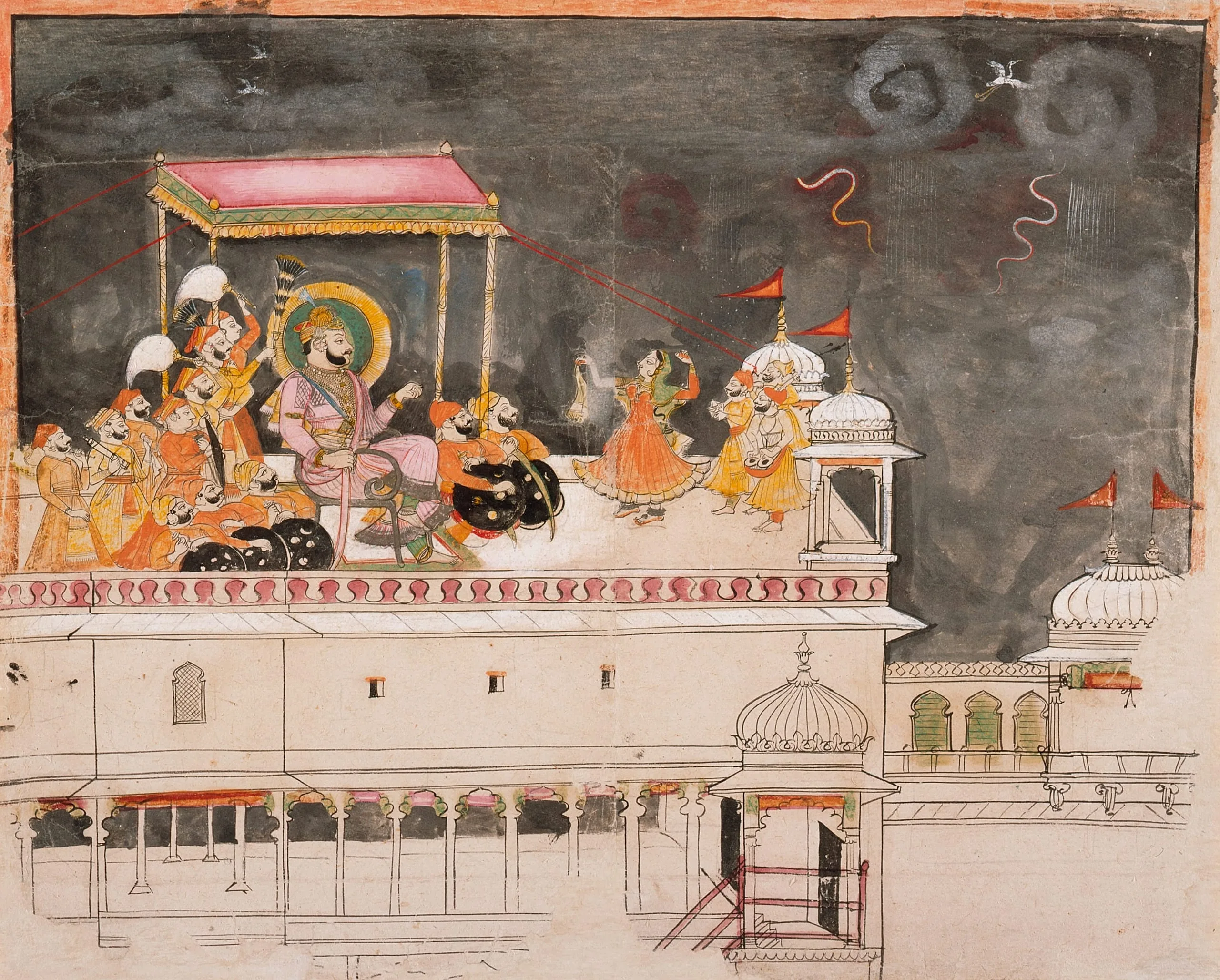
Maharao Ram Singh II of Kota (r. 1827-1866) was born in 1808, ascended the throne at age nineteen, and died in 1866. He is portrayed in numerous dated paintings engaged in a wide variety of activity ranging from his official duties (durbars, state meetings, royal processions, and festivals; see M.77.154.21) to his pastimes (hunting, entertainment, and erotic liaisons; see M.75.19). In his early portraits in the 1830s his side whiskers are short, but from around 1840 onward they are longer, which is a useful feature for corroborating the date of the painting. He wore a distinctive style of headgear of his own design: a flat turban with a peak in the front.
In this large unfinished composition, the nimbate Ram Singh II is seated in a throne chair under a canopy on a terrace roof watching a dance performance. He is accompanied by seated courtiers with black shields and swords. Behind him are bearers of honorific peacock feather fly whisks (morchal) and fly whisks made from the white tail-hairs of a yak (cauri or chowri), both signifying royalty. Ram Singh II wears his trademark turban, which is adorned with a feather plume in a gold feather brooch, a jigha (similar to an aigrette), and a sarpati (horizontal tripartite ornament). His long side whiskers suggest a date of circa 1840. He holds a sheathed sword with a curved blade (talwar) and has a dagger (peshkabz) tucked into his waist sash. His left hand is extended in what may be a gesture of appreciation for the performance.