- Title
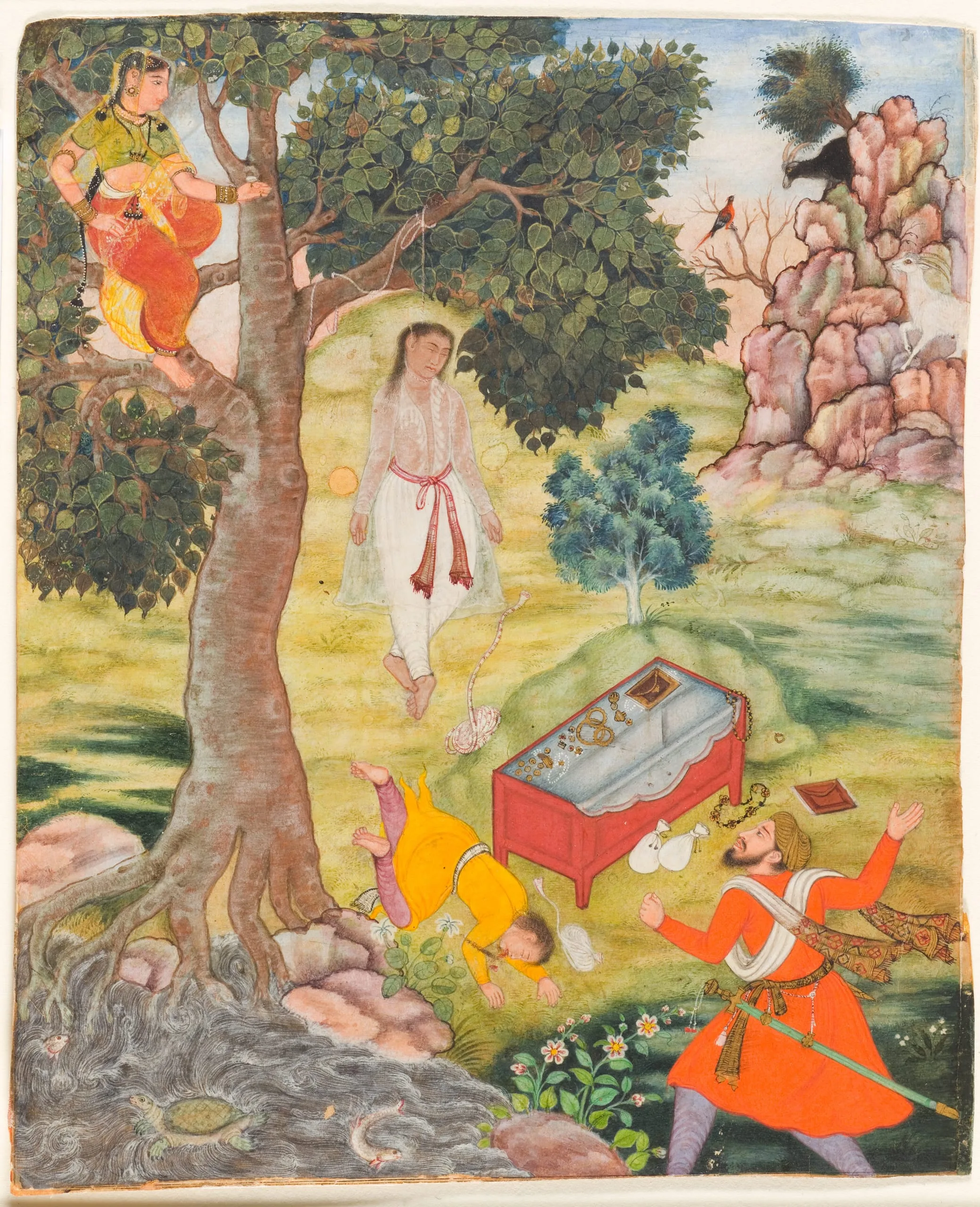
- Tale of the Cunning Siddhikari (recto), Calligraphy (verso), Folio from a Kathasaritsagara (Ocean of the Streams of Stories)
- Date Made
- circa 1590
- Medium
- Opaque watercolor, gold, and ink on paper
- Dimensions
- 6 1/2 x 5 1/4 in. (16.51 x 12.7 cm)
- Accession Number
- M.78.9.12
- Curatorial Notes
The Kathasaritsagara (Ocean of the Streams of Stories) is a vast anthology of hundreds of folk stories and fairy tales compiled in Sanskrit by the Kashmiri poet Somadeva in 1063–1081. Derived from earlier literary sources, the embellished tales were told by Somadeva for the diversion of Suryamati (or Suryavati), the queen of King Ananta of Kashmir (r. 1028–1063). The text was translated into Persian by Mustafa Khaliqdad ‘Abbasi for the Mughal Emperor Akbar (r. 1556–1605), but only about a dozen illustrated leaves are extant. See also M.78.9.13, M.78.9.7, two folios in the San Diego Museum of Art (1990.280 and 1990.281), and one folio in the Cleveland Museum of Art (I-2013-7592/31). The known leaves are cropped and have the Persian text on the reverse.
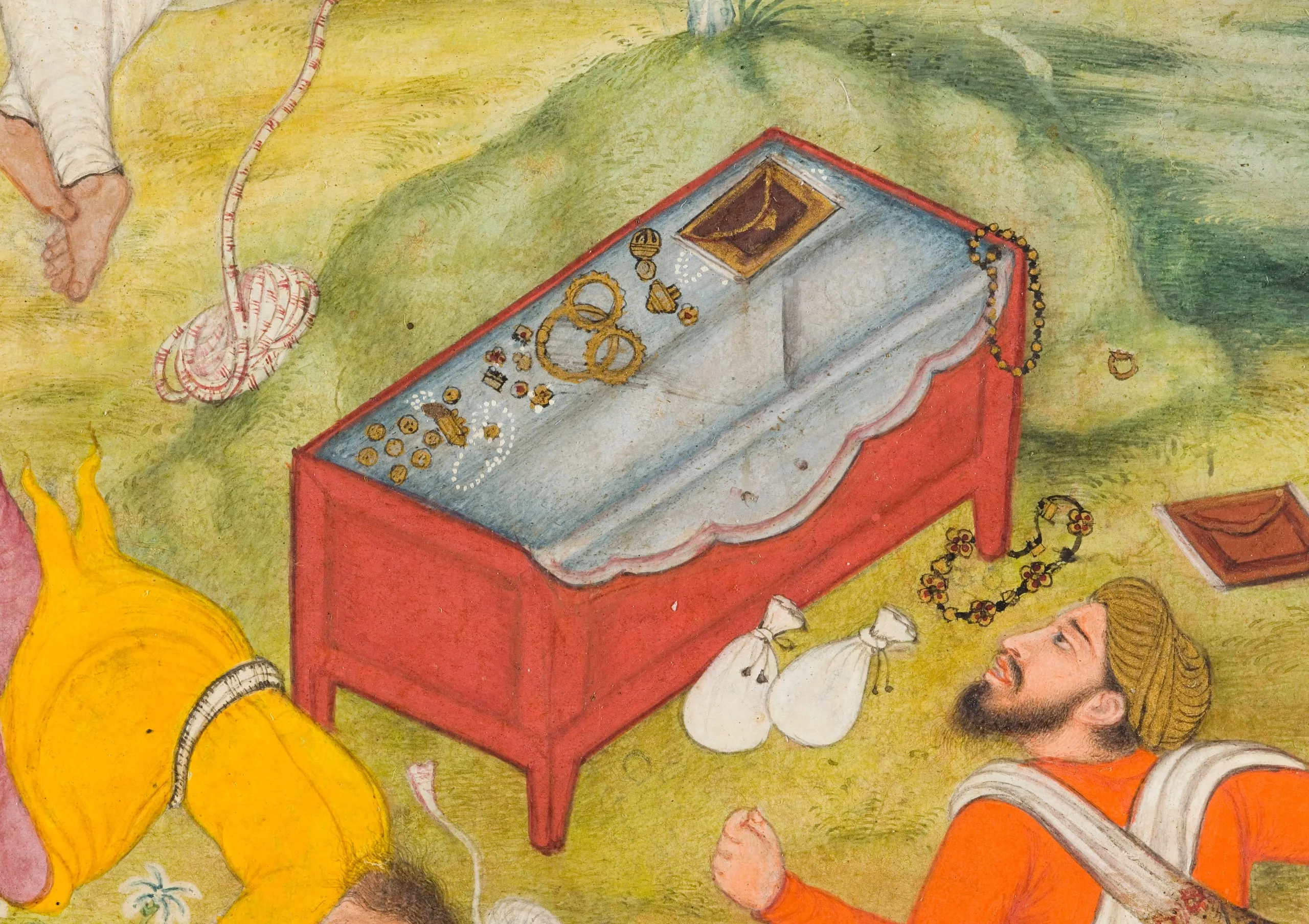
This folio depicts the story of the female ascetic disciple Siddhikari from “The Story of Devasmita” in Chapter 13 of the text. She enters the service of a merchant in the guise of a maid to steal his treasures. While fleeing, she meets a domba (a low caste man) who tries to rob her. Siddhikari pretends that she is running away from her husband and intends to commit suicide. She asks the domba how to hang herself, and as he shows her, she kicks away the (undepicted) drum on which he stands. While the man hangs from the tree, the merchant arrives with a servant. She climbs up in the tree, but the servant follows her. She pretends to kiss him and bites off his tongue. He falls from the tree before the dismayed merchant.
- Selected Bibliography
- Pal, Pratapaditya. Indian Painting, vol.1. Los Angeles: Los Angeles County Museum of Art, 1993.
- Heeramaneck, Alice N. Masterpieces of Indian Painting : From the Former Collections of Nasli M. Heeramaneck. New York: A.N. Heeramaneck, 1984.
- Pal, Pratapaditya, ed. Aspects of Indian Art: Papers Presented in a Symposium at the Los Angeles County Museum of Art. Leiden, The Netherlands: E.J. Brill, 1972.
- Rosenfield, John. The Arts of India and Nepal: The Nasli and Alice Heeramaneck Collection. Boston: Museum of Fine Arts, Boston, 1966.