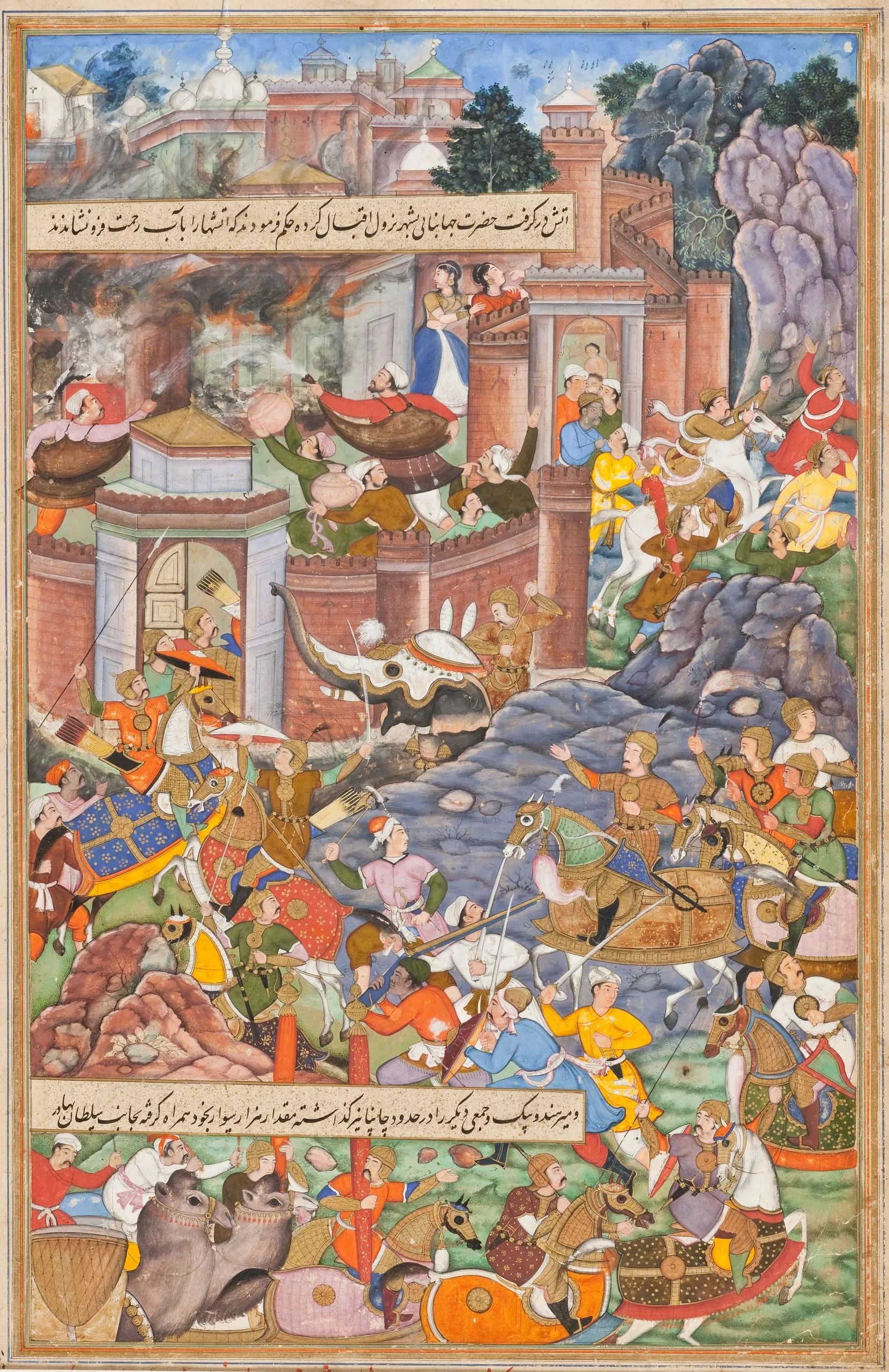
The Akbarnama, a biography of the third Mughal emperor Akbar (r. 1556–1605), was composed in Persian by Abul Fazl, an official in Akbar’s court and a close companion, between 1590 and 1596. It mainly chronicles the emperor’s lineage, administration, and military campaigns. As descendants of the Timurid dynasty, the Mughals upheld Persian as their literary language and patronized Iranian artistic traditions as symbols of prestige. Under Akbar, illustrated manuscripts flourished, blending the refinement of Persian painting with local Indian elements. Following Akbar’s two major earlier commissions, the richly illustrated Hamzanama (M.78.9.1) and Baburnama (M.91.348.1 and M.81.8.7), the Akbarnama exemplifies this Mughal artistic tradition, providing a rich visual record of battles, court ceremonies, and the emperor’s life.
Removed from the first imperial copy of the Akbarnama, most of which is housed in the Victoria and Albert Museum, London, LACMA’s folio, which is signed by Dharm Das, depicts Humayun’s 1535 conquest of the highly strategic Fort of Cambay. The composition masterfully integrates text and image, guiding the viewer through the unfolding drama. The lower text block announces Humayun’s entry into the city with 3,000 soldiers, mirrored in the bottom left by a disciplined row of warriors on camels and horses, marching to the rhythm of the drumbeat. On the right side, Humayun, identifiable by his feathered turban and golden chain-mail armor, leads the charge with composed authority. Above, the fortress erupts in flames, echoing the upper text that recounts the king’s merciful order to contain the fire, even as the defeated Bahadur Shah flees in terror, abandoning his subjects to fear and chaos. Believed to have been painted in 1586, before the Akbarnama’s commissioning, this work likely was later incorporated into the manuscript, capturing both historical grandeur and artistic mastery.
2025