- Title
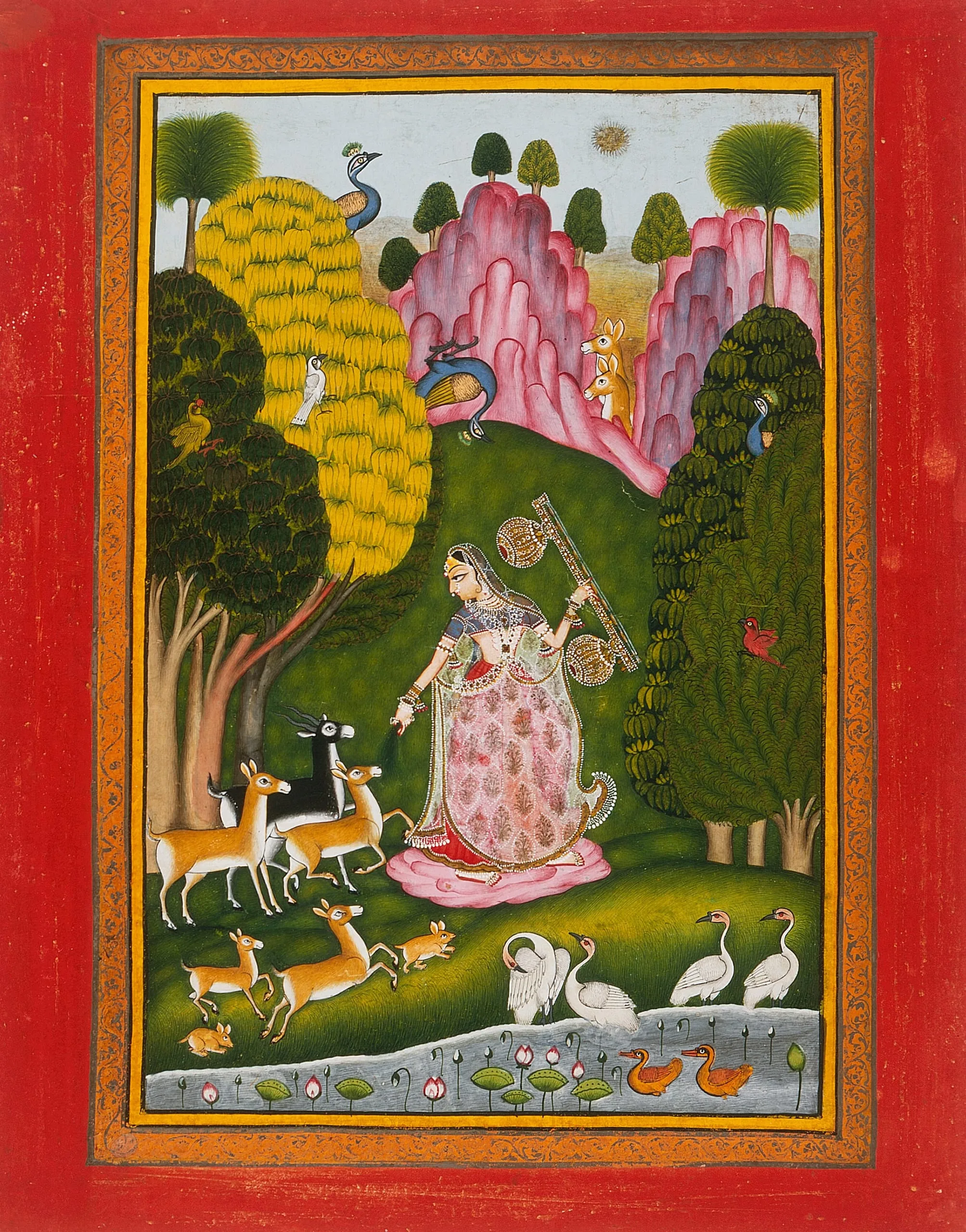
- Todi Ragini, Second Wife of Hindol Raga, Folio from a Ragamala (Garland of Melodies)
- Date Made
- circa 1775-1800
- Medium
- Opaque watercolor and gold on paper
- Dimensions
- Image: 9 7/8 x 6 1/2 in. (25.08 x 16.51 cm); Sheet: 12 1/8 x 9 1/2 in. (30.79 x 24.13 cm)
- Accession Number
- M.77.130.1
- Curatorial Notes
Todi Ragini is the second wife of Hindola Raga in the predominant ragamala (garland of melodies) classification system generally known as the Rajasthani system. It is a tender melody associated with the early morning and Winter (November–January). It may have originated as a tune sung by village girls to mesmerize foraging deer. Todi Ragini is described in ragamala poetry as a lovesick woman who walks alone through green groves and sings to the deer. It is usually personified as a woman carrying a vina and walking with deer and/or gazelles. Although she is usually shown as a solitary figure, she is occasionally shown accompanied by two female companions.
Here, Todi Ragini is envisioned as an ornately garbed woman carrying a rudra vina (a stick zither with two resonator gourds) in a lush mountainous forest with a stream running along the bottom. She is symbolically offering her music through her right hand held in the gift-giving gesture to a herd of blackbuck antelopes (Antilope cervicapra), which include a black-and-white male with corkscrew horns and several beige-and-white females and juveniles. Waterfowl, peacocks, and parrots are also captivated by the melody. The blazing sun and light blue sky indicate it is a daytime melody.
See also M.71.1.42, M.77.154.6, AC1999.127.11, and M.2004.180.
- Selected Bibliography
- Pal, Pratapaditya. The Flute and The Brush: Indian Paintings from the William Theo Brown and Paul Wonner Collection. Newport Beach, CA: Newport Harbor Art Museum, 1976.