- Title
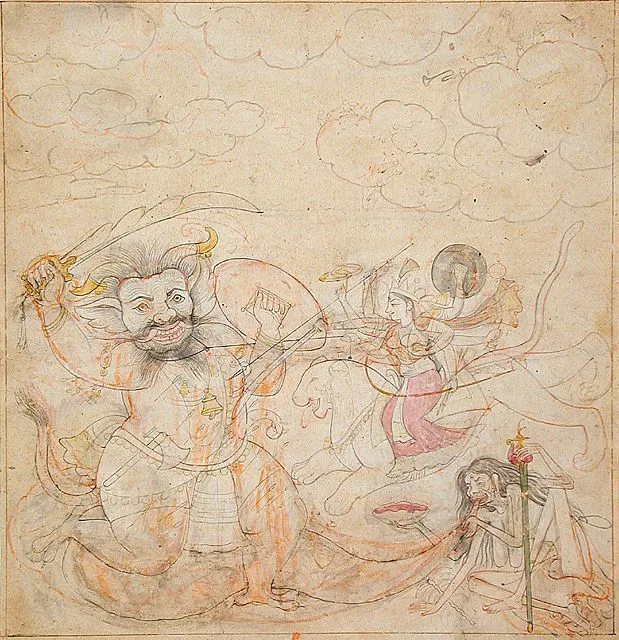
- Kali Drinking the Blood of Raktabija, Folio from a Devimahatmya (Glory of the Goddess)
- Date Made
- circa 1780
- Medium
- Ink and opaque watercolor on paper
- Dimensions
- Image: 8 3/4 x 8 1/2 in. (22.22 x 21.59 cm); Sheet: 9 3/8 x 9 in. (23.81 x 22.86 cm)
- Accession Number
- M.77.154.29
- Curatorial Notes
Dating from circa 550 CE, the Devimahatmya (Glory of the Goddess) is a devotional text of 700 Sanskrit verses that extol the Goddess (Devi) as the supreme power and creator of the universe. The verses were interpolations to the earlier Markandeya Purana dating from circa 250 CE and then extracted as a stand-alone text. The Devimahatmya describes the Goddess in her various aspects triumphing over the demons Madhu and Kaitabha, Mahishasura, Dhumralochana, Chanda and Munda, Raktabija, and Shumbha and Nishumbha.
This unfinished or preparatory drawing illustrates the climax of Chapter 8, “The Slaying of Raktabija.” The demon Raktabija had been granted a boon from the god Shiva that if a drop of blood from his body fell on the battlefield, an identical demon would arise from the blood and fight the enemies. Each time the Goddess and the Mother Goddesses wounded him, the resultant blood drops engendered another demon, thus causing hordes of demons to join the battle. The Goddess therefore called on the horrific goddess Kali to drink all his falling blood drops before they could hit the ground. The Goddess then slew Raktabija with her multiple weapons. Here, Kali is capturing the demon’s blood drops on her lolling tongue and drinking the blood from a skull cup. The Goddess riding her lion attacks the demon. Celestial divinities herald the auspicious event.
See also its series mate M.86.345.8.
- Selected Bibliography
- Pal, Pratapaditya and Catherine Glynn. The Sensuous Line: Indian Drawings from the Paul F. Walter Collection. Los Angeles: Los Angeles County Museum of Art, 1976.