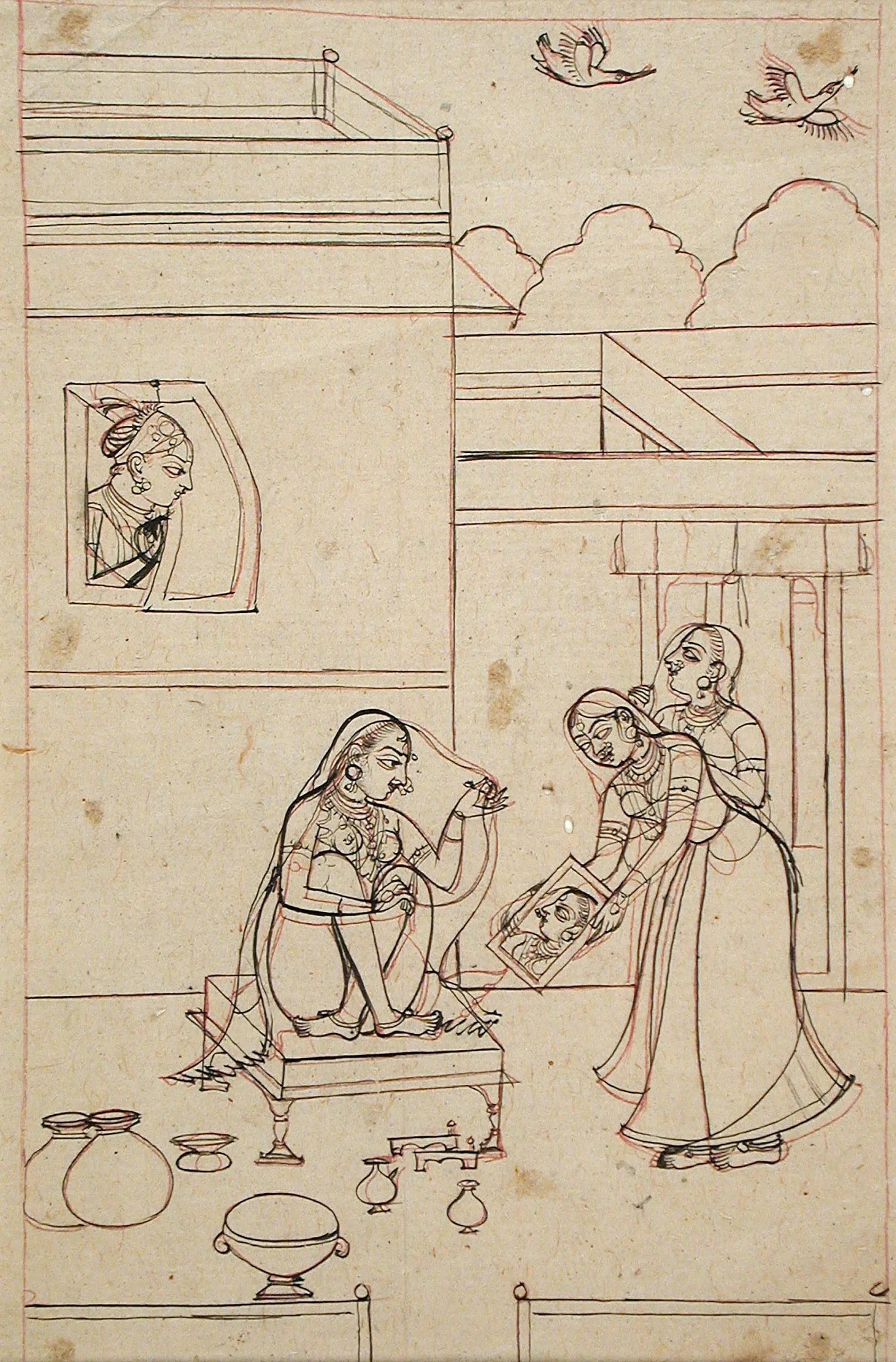
Palace genre scenes were a favored staple of Bundi and Kota artists. A wide range of mundane activities were portrayed, as well as subtle moments of suggestive intimacy that piqued the imagination of the viewers. Each new encounter was a fresh titillation to savor. The erotic sentiment (shringara rasa) was regarded as the ultimate emotion by poets and was long celebrated in Indian art and culture.
In this drawing executed in black ink with red underdrawing, a princess or nayika (heroine) sits on a stool with her knees drawn up and her feet crossed at the ankles. She has finished bathing, evidenced by the nearby water vessels, and has adorned herself with fine jewelry and gossamer garments. An attendant holds a mirror for the princess to inspect herself. A second attendant observes a prince who has pulled aside curtains and is peering out of a window at the bathing beauty. In similar representations, the face of the prince or nayaka (hero) is often visible in the mirror. The LACMA drawing depicts the instant before their glances converge in the mirror. This chance meeting of the eyes, known as the ‘prior passion’ (purva raga), is when two lovers first catch a glimpse of one another prior to any direct interaction. For a finished painting of such an incident that shares a closely similar composition as the LACMA drawing, see a Bundi painting attributed to circa 1750 in the San Diego Museum of Art (1990.686). See B. N. Goswamy and Caron Smith, Domains of Wonder: Selected Masterworks of Indian Painting (San Diego: San Diego Museum of Art, 2005), pp. 88-89, no. 29.
For related works featuring an observer in a palace window, see M.72.1.28, AC1994.59.1, and AC1994.59.4. For formal portraits of royalty or affluent Europeans presenting themselves in a balcony window (jharoka), see M.91.361 and M.84.224.2.