- Title
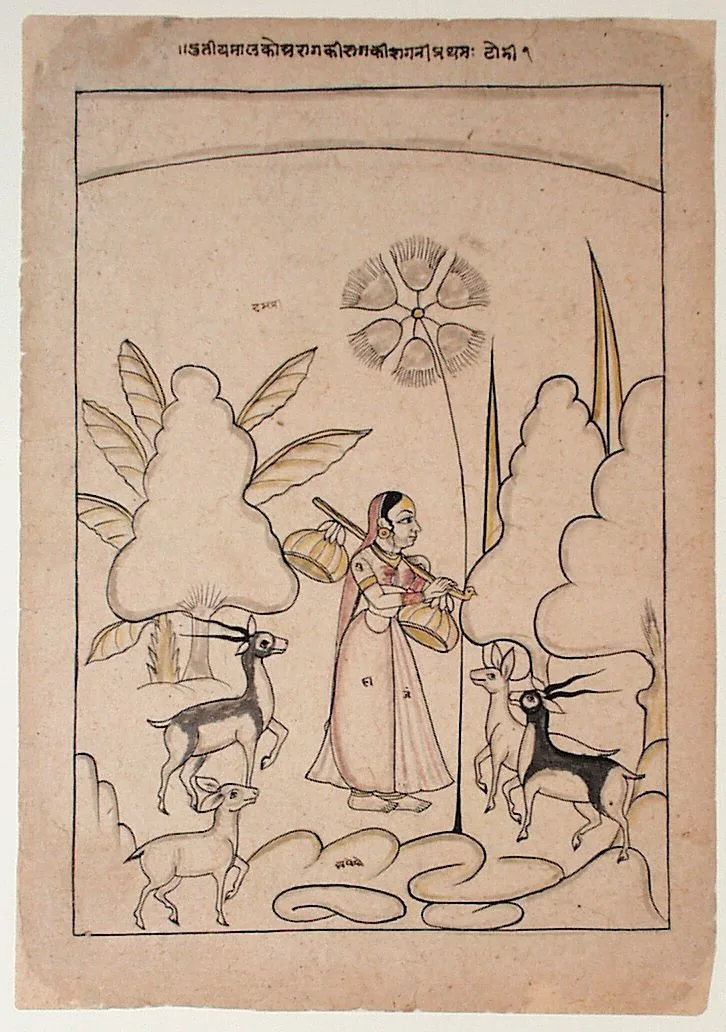
- Todi Ragini, First Wife of Malkos Raga, Folio from a Ragamala (Garland of Melodies)
- Date Made
- circa 1675-1700
- Medium
- Ink and opaque watercolor on paper
- Dimensions
- Image: 8 7/8 x 6 1/8 in. (22.54 x 15.55 cm); Sheet: 10 1/2 x 7 1/4 in. (26.67 x 18.41 cm)
- Accession Number
- M.77.154.6
- Curatorial Notes
The Hindi inscription in the upper border identifies the melody as Todi Ragini, the first wife of Malkos Raga. (Translation by Stephen Markel.) This indicates that the artist was following the variant ragamala garland of melodies classification system known as Hanuman’s system (developed by the ancient musical theorist Hanuman). In the more widespread Rajasthani system, Todi Ragini is the second wife of Hindola Raga. It is a tender melody associated with the early morning and Winter (November–January). It may have originated as a tune sung by village girls to mesmerize foraging deer. Todi Ragini is described in ragamala poetry as a lovesick woman who walks alone through green groves and sings to the deer. It is typically personified as a woman carrying a vina and walking with deer and/or gazelles. See also M.71.1.42, M.77.130.1, AC1999.127.11, and M.2004.180.
Here, Todi Ragini is envisioned as a woman playing a vina in a rock-strewn forest to a herd of enraptured blackbuck antelopes (Antilope cervicapra): two black-and-white males with corkscrew horns and two beige-and-white females. That this is a preparatory drawing is evident from the brief color key notations for the subsequent colorist: blouse, rose; skirt, green; pleats, gold, etc. The primary artist was responsible for the composition and figural outlines.
A comparable Sirohi preparatory drawing of a Khambhavati Ragini attributed to circa 1680 is in the Asian Art Museum, San Francisco (2016.120).
- Selected Bibliography
- Pal, Pratapaditya and Catherine Glynn. The Sensuous Line: Indian Drawings from the Paul F. Walter Collection. Los Angeles: Los Angeles County Museum of Art, 1976.