- Title
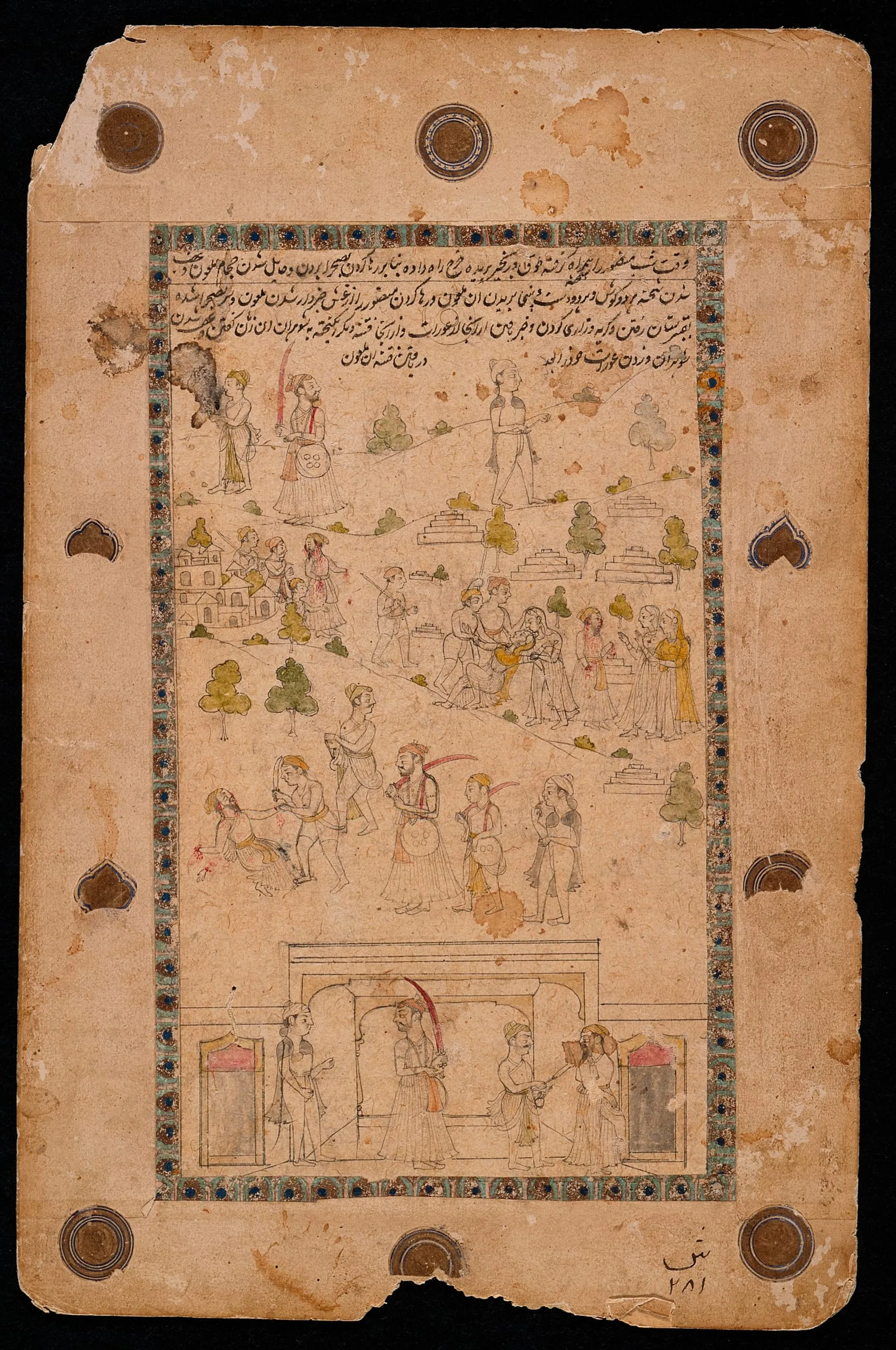
- Illustration of an Islamic Story
- Date Made
- circa 1775
- Medium
- Ink and opaque watercolor on paper
- Dimensions
- Sheet: 12 3/8 x 8 in. (31.43 x 20.32 cm); Image: 8 7/8 x 5 in. (22.54 x 12.7 cm)
- Accession Number
- M.77.154.1
- Curatorial Notes
According to the inscription (translation by Robert Skelton), this nim qalam (half-pen) lightly tinted drawing illustrates an episode in the life of someone named Mansur. In the desert he encounters a man whose nose and hands are being cut off by a barber (?). The men travel together to a cemetery, where the wife of the unfortunate man faints with the shock of seeing him (Pal and Glynn, The Sensuous Line (1976), p. 15, no. 6).
Stories from Persian and Indian literature, especially tragic romances, were popular subjects of Lucknow painting. They were often illustrated in composite compositions with multiple stories presented, such as M.83.105.22 in which the lovers Khusrau and Shirin are represented in the foreground and the lovers Layla and Majnun are in the middle ground. Another pair of ill-fated lovers depicted more often in individual paintings were Sohni and Mahinwal (see M.72.2.1). Besides the tales of famous lovers introduced through Persian poetry and prose, South Asia has an extensive indigenous literary tradition of ideal loving couples. Female lovers (nayikas) and male lovers (nayakas) are classified into two general categories— ecstatic lovers in union and forlorn lovers in separation—each of which has many subcategories. These classifications were indexed by situation and corresponding emotional charge in popular texts such as Ragamalas (Garland of Melodies), the Barahmasa (The Twelve Months), and the Amaru Shataka (Hundred Stanzas of Amaru).
- Selected Bibliography
- Pal, Pratapaditya and Catherine Glynn. The Sensuous Line: Indian Drawings from the Paul F. Walter Collection. Los Angeles: Los Angeles County Museum of Art, 1976.