LACMA

ShopMembershipMyLACMATickets
LACMA
Los Angeles County Museum of Art
5905 Wilshire Blvd.
Los Angeles, CA 90036
info@lacma.org
(323) 857-6000
Sign up to receive emails
Subscribe
© Museum Associates 2026
  • About LACMA
  • Jobs
  • Host An Event
  • Unframed
  • Press
  • FAQs
  • Log in to MyLACMA
  • Privacy Policy
© Museum Associates 2026
Collections

Unknown
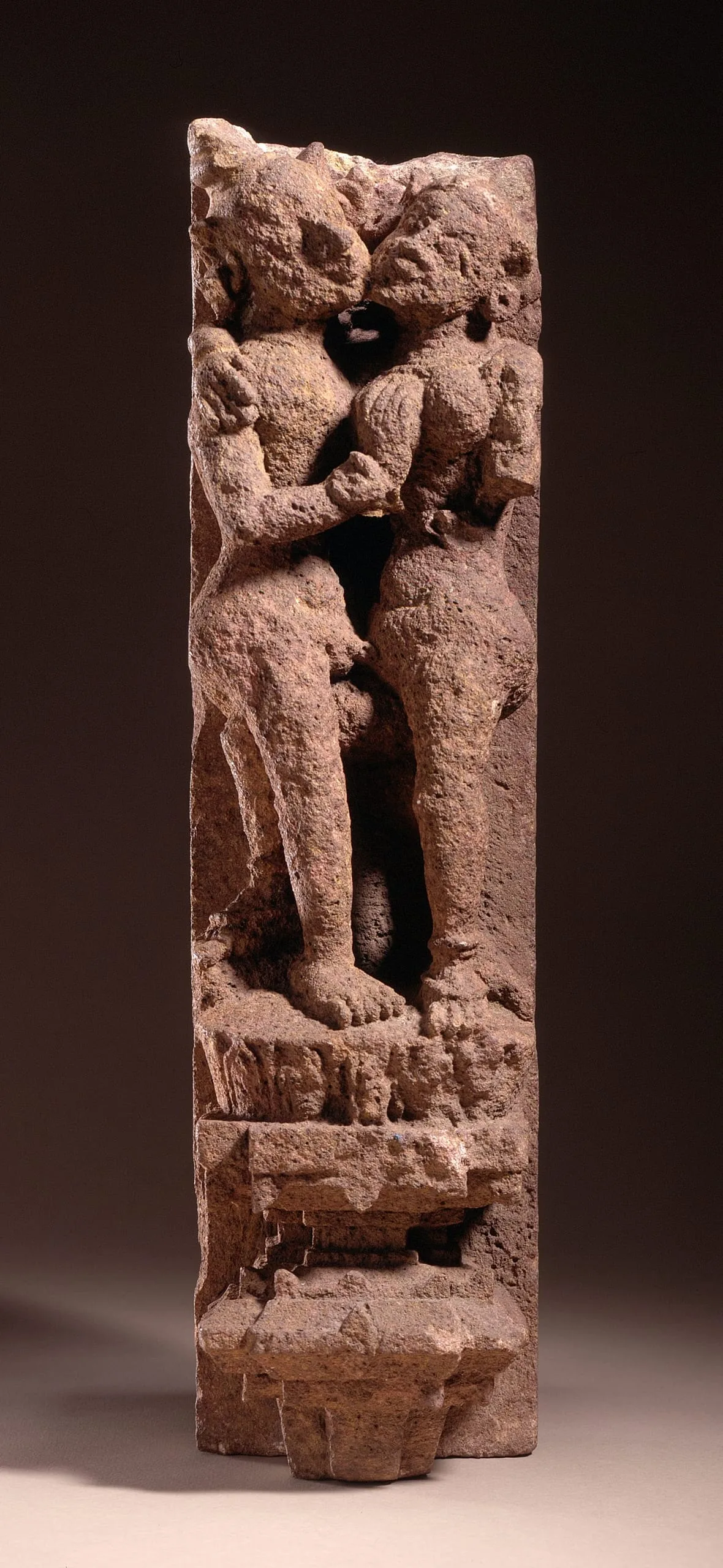
Celestial Lovers13th century

Not on view
Tall sandstone relief sculpture of two upright lion-like figures embracing, carved on a narrow rectangular slab with a stepped base

Unknown, Celestial Lovers, 13th century, Los Angeles County Museum of Art, Gift of Eivor and Dr. Alston Callahan, Birmingham, Alabama, photo © Museum Associates/LACMA

Artist or Maker
Unknown
Title
Celestial Lovers
Place Made
India, Odisha (Orissa)
Date Made
13th century
Medium
Gneissic rock
Dimensions
19 x 4 3/4 x 4 3/4 in. (48.26 x 12.07 x 12.07 cm)
Credit Line
Gift of Eivor and Dr. Alston Callahan, Birmingham, Alabama
Accession Number
M.77.150
Classification
Sculpture
Collecting Area
South and Southeast Asian Art
Curatorial Notes

The exterior surfaces of early and medieval Odia (Orissan) Hindu temples are replete with amorous and/or erotic imagery. The representations include both the mithuna motif of voluptuous couples as well as the explicit maithuna motif depicting various tantric ritual acts of sexual union. The sensuous sculptures are believed to serve both propitious and apotropaic functions. See also M.76.48.2. See Thomas Donaldson, "Propitious-Apotropaic Eroticism in the Art of Orissa," Artibus Asiae 37:1/2 (1975): 75–100.

In this illustration of an amorous couple, the celestial lovers are facing each other and having sexual intercourse in a standing position (sthitarata). The male is leaning in to kiss his partner, who is embracing him with her right arm. His right hand is cupping her breast. The Kamasutra (2nd–3rd century CE) identifies their specific physical interaction as the "tripod" or "three-legged" position (tripadam) in which one of the female’s legs is lifted off the ground and wrapped around the male’s thigh or waist. This creates the so-named three points of support (the man's two feet and the woman's one foot).
Selected Bibliography
  • Pal, Pratapaditya. Indian Sculpture, vol.2. Los Angeles: Los Angeles County Museum of Art; University of California Press, 1988.