- Title
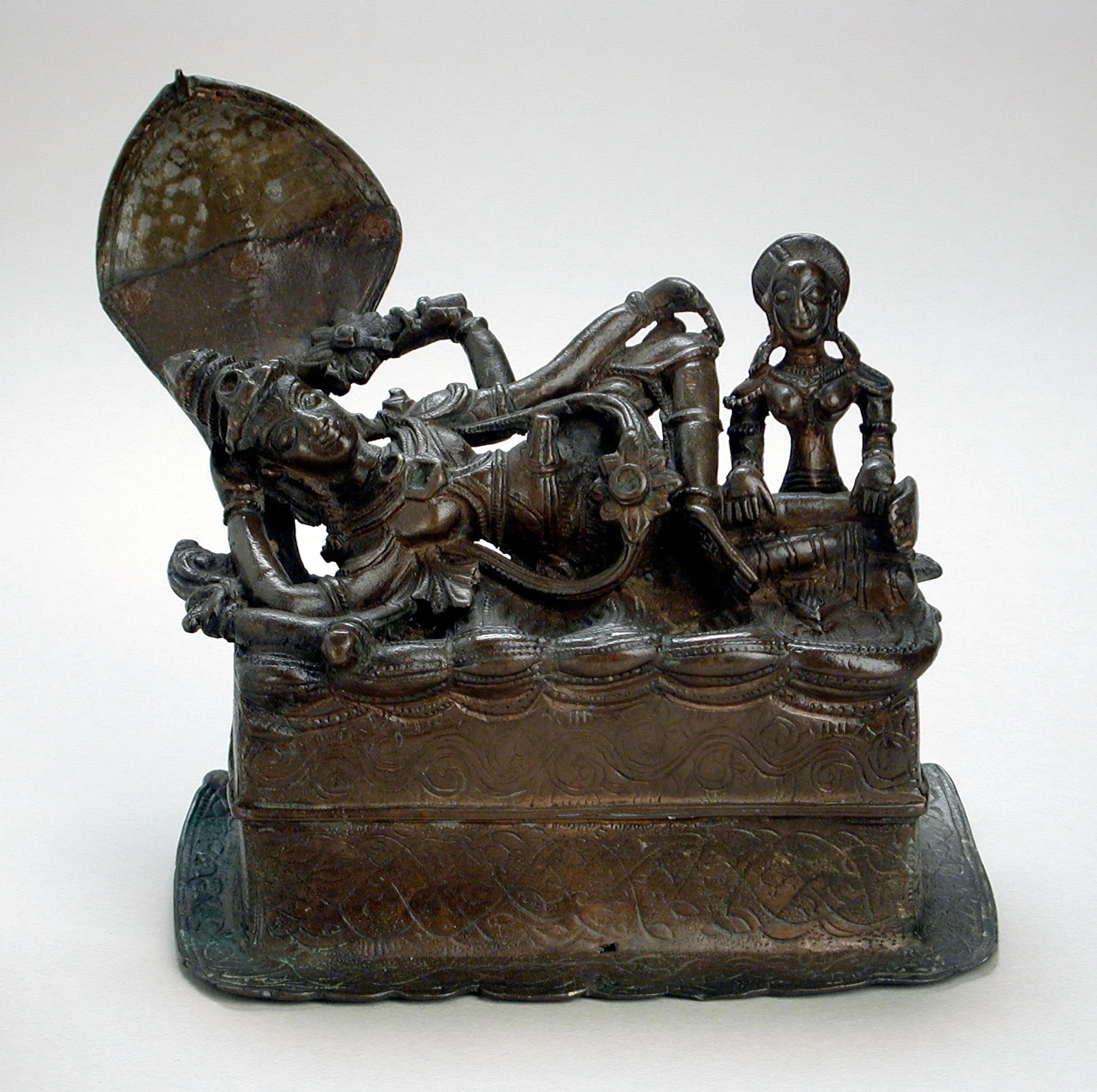
- Vishnu in His Cosmic Sleep
- Date Made
- 13th century
- Medium
- Copper alloy
- Dimensions
- 4 5/8 x 4 3/8 x 2 7/8 in. (11.74 x 11.11 x 7.3 cm)
- Accession Number
- M.76.147.3
- Curatorial Notes
Vishnu, the Hindu God of Preservation, is reclining on the primordial serpent, Ananta (Eternity) or Shesha (Remainder), whose undulating coils form cushions for the god to float on the primordial ocean of milk. His wife Lakshmi is massaging his foot, thereby stimulating him to dream the history of the universe during each cosmic age (kalpa). Vishnu wears a conical crown (kirita mukuta) and has four arms. His upper right hand supports his head. His lower right hand holds his conch (shankha). His mace (gada) lies beneath his lower right arm. His upper left hand holds his spoked discus (chakra). His upper lower left hand is extended along his side and rests on his crossed left knee. The upper half of Ananta’s serpent hood is a later replacement. Brahma, the God of Creation, who rises on a lotus out of Vishnu’s naval was likely originally attached to the now-broken lotus stem. The unusual tall duplex pedestal has incised aquatic decoration. The upper section supporting the coils of Ananta features thick rolling wave forms reminiscent of ocean waves on the surface. The lower section has fine crisscrossing waves that create an underwater environment with abstracted fish and tortoise. See also M.79.111. Comparable bronze images of Vishnu on Ananta, albeit attributed to Tamil Nadu, circa 1800, are in the Norton Simon Museum, Pasadena (P.1996.3.4) and the Victoria and Albert Museum, London (IM.159-1929).
- Selected Bibliography
- Pal, Pratapaditya. Indian Sculpture, vol.2. Los Angeles: Los Angeles County Museum of Art; University of California Press, 1988.