LACMA

ShopMembershipMyLACMATickets
LACMA
Los Angeles County Museum of Art
5905 Wilshire Blvd.
Los Angeles, CA 90036
info@lacma.org
(323) 857-6000
Sign up to receive emails
Subscribe
© Museum Associates 2025

Museum Hours

Monday

11 am–6 pm

Tuesday

11 am–6 pm

Wednesday

Closed

Thursday

11 am–6 pm

Friday

11 am–8 pm

Saturday

10 am–7 pm

Sunday

10 am–7 pm


  • About LACMA
  • Jobs
  • Building LACMA
  • Host An Event
  • Unframed
  • Press
  • FAQs
  • Log in to MyLACMA
  • Privacy Policy
© Museum Associates 2025
Collections

Unknown
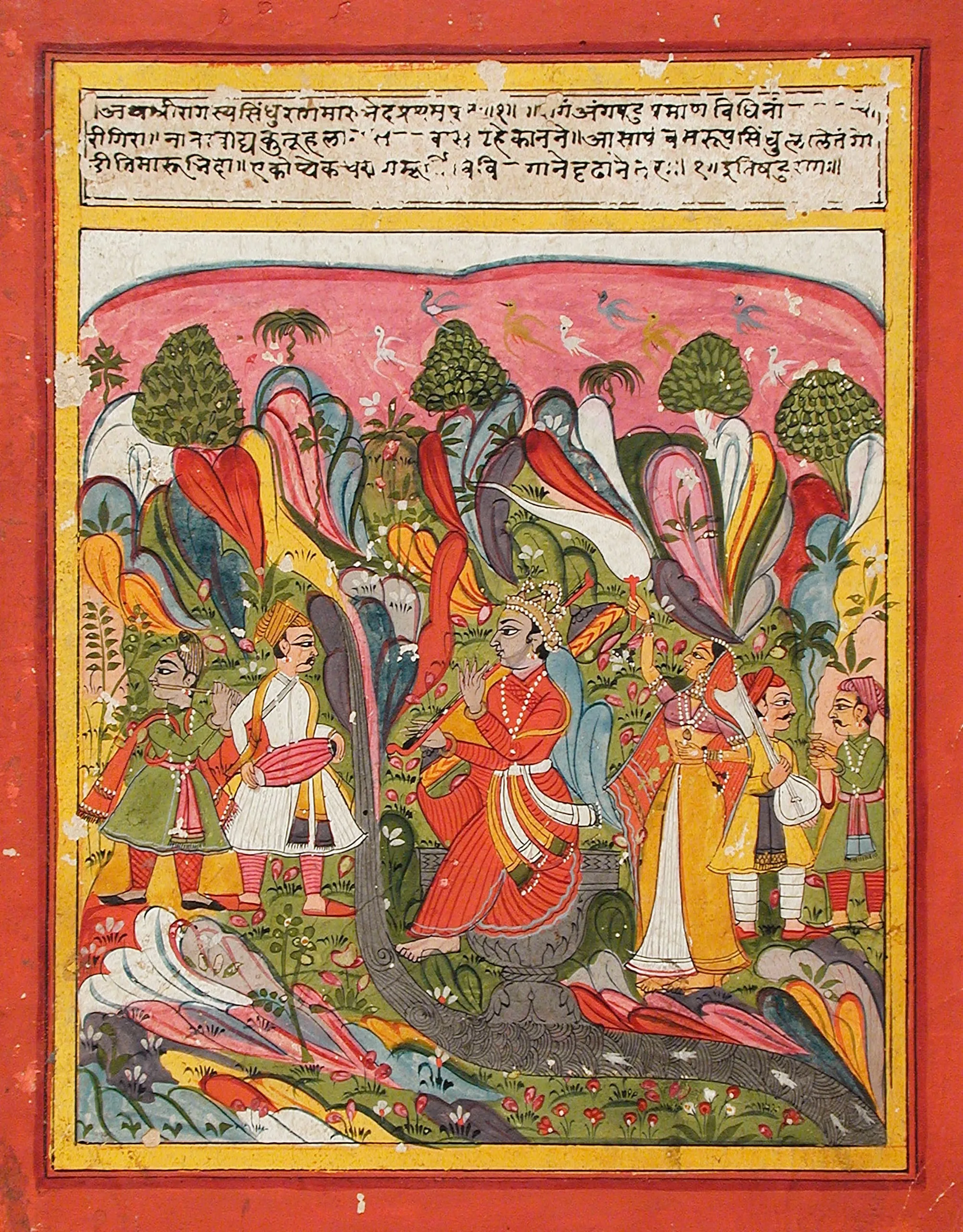
Sindhu Ragaputra, First Son of Shri Raga, Folio from a Ragamala (Garland of Melodies)circa 1775

Not on view
Indian miniature painting with Devanagari text panel, depicting a blue-skinned central deity in red and blue robes surrounded by attendant figures in a lush, stylized landscape
Artist or Maker
Unknown
Title
Sindhu Ragaputra, First Son of Shri Raga, Folio from a Ragamala (Garland of Melodies)
Place Made
India, Rajasthan, Marwar region
Date Made
circa 1775
Medium
Opaque watercolor, gold, and ink on paper
Dimensions
Image: 9 5/16 x 7 3/8 in. (23.65 x 18.73 cm); Sheet: 10 15/16 x 8 5/8 in. (27.78 x 21.9 cm)
Credit Line
Gift of William Theo Brown
Accession Number
M.77.130.2
Classification
Drawings
Collecting Area
South and Southeast Asian Art
Curatorial Notes

The partially effaced Sanskrit inscription in the header describes Sindhu Ragaputra, the son of Shri Raga, in the desert or Marwar tradition (Marubheda) as someone who is curious about many instruments and is engaged in singing. This is an unusual iconography, as Sindhu Ragaputra is more commonly portrayed in other ragamala regional traditions as a solitary or battling warrior.

Sindhu Ragaputra is the first son of Shri Raga in the variant ragamala (garland of melodies) classification system known as Meshakarna’s system (developed by Meshakarna, a court priest from Rewa, Madhya Pradesh, in his Ragamala of 1570), which was sometimes followed in Marwar ragamalas. Meshakarna’s system has six males (ragas), each of whom who has five or six wives (raginis) and eight or nine sons (ragaputras). The melodies are also compared to a sound in nature or a human activity. Sindhu Ragaputra is likened to the sound of a horse.

Here, Sindhu Ragaputra is personified as a prince playing a vina. Behind him is a woman waiving an honorific fly whisk made of the white tail-hairs of a yak (cauri or chowri). He is accompanied by four male musicians playing a flute, drum (mridangam), drone instrument (tambura), and hand cymbals (left to right). He sits on a footed dais in a lush landscape with exuberant rock forms.
Selected Bibliography
  • Pal, Pratapaditya. The Flute and The Brush: Indian Paintings from the William Theo Brown and Paul Wonner Collection. Newport Beach, CA: Newport Harbor Art Museum, 1976.