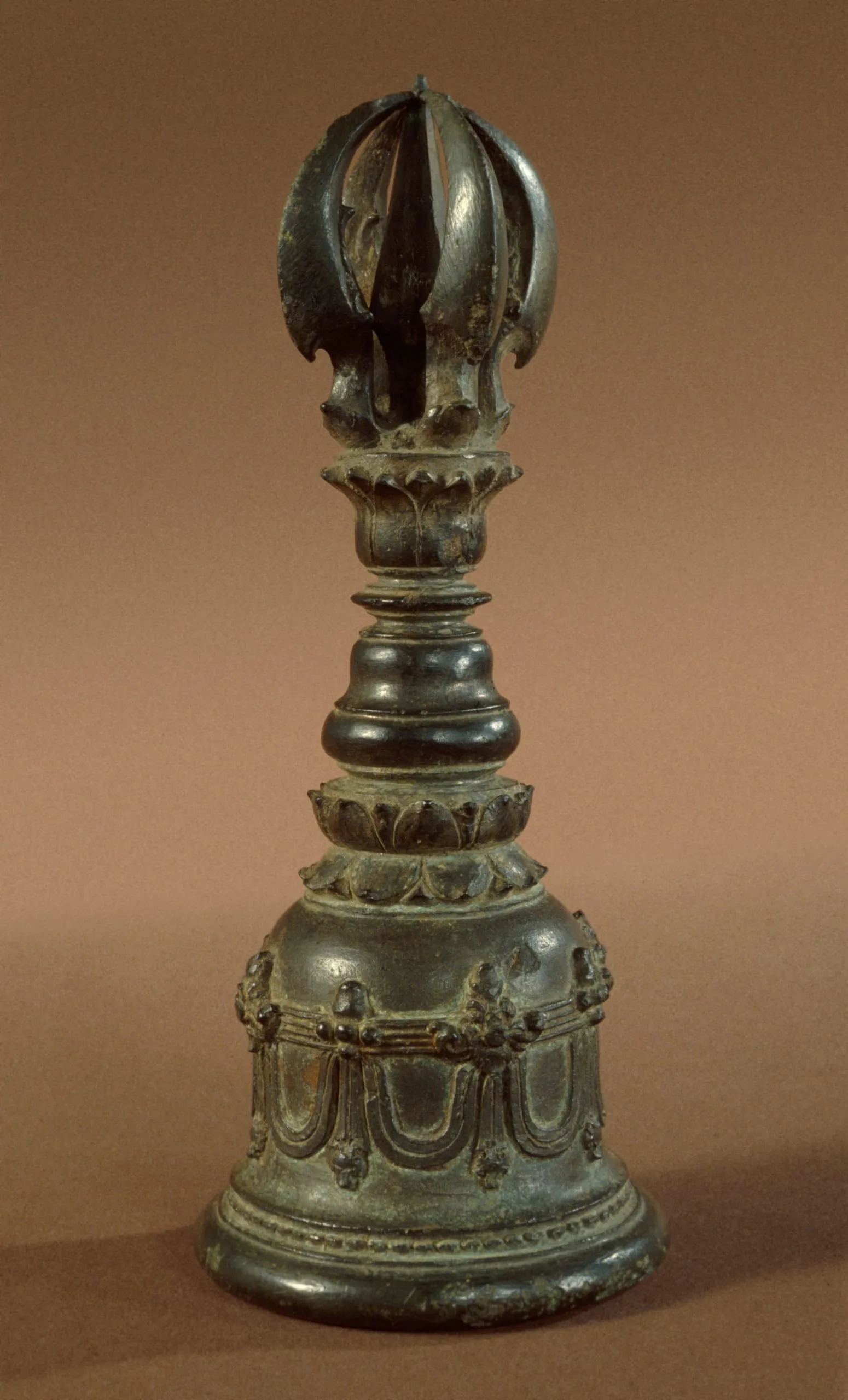
Javanese ritual priest’s bells (ghanta) are distinguished from hanging bells by having clappers to ring the bell and by the finial above the collar for gripping it being in the form of a five-pronged thunderbolt (vajra). In esoteric Buddhism, the thunderbolt symbolizes the adamantine or unchanging nature of eternity and the male component of compassion. The bell represents the female aspect of wisdom. The pairing of the thunderbolt and bell embodies the enlightened state of compassion and wisdom achieved through the perfect union of the male and female principles. A double lotus base is at the junction of the collar and stupa-shaped bell, which is adorned with pendant garlands. Although not depicted here, Central Javanese Buddhist priest’s bells often have four faces representing the five Jina Buddhas (the fifth face is understood). In Eastern Javanese priest’s bells, the exterior of the bell is typically plain and shaped like a hemisphere rather than a stupa. See J. E. van Lohuizen-de Leeuw, Indo-Javanese Metalwork (Stuttgart: Linden-Museum, 1984), pp. 95-111, nos. 61-77; Pauline Lunsingh Scheurleer and Marijke J. Klokke, Divine Bronze: Ancient Indonesian Bronzes from A.D. 600 to 1600 (Leiden: E. J. Brill, 1988), pp. 119-122, nos. 67-70; and Jan Fontein, The Sculpture of Indonesia (Washington: National Gallery of Art, 1990), pp. 238, 243-244, nos. 71, 76-77.
Comparable Javanese priest’s bells are in the Rijksmuseum, Amsterdam (MAK 314 [loan]) and Wereldmuseum (formerly called the Tropenmuseum), Amsterdam (4037-1). See also M.2001.158.2.