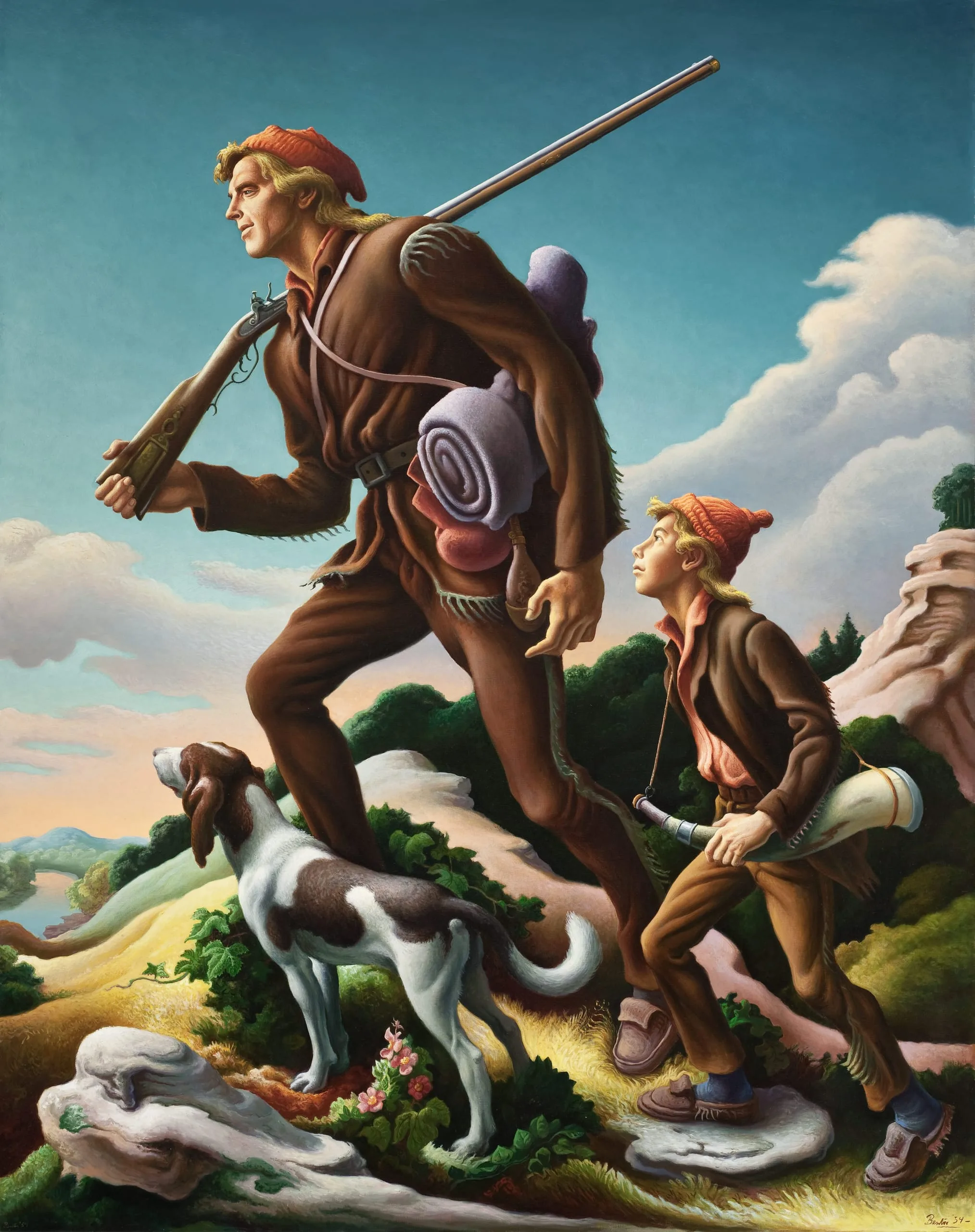
In 1953 the motion-picture company Norma Productions hired Benton to execute a painting to be used for publicity purposes for the movie The Kentuckian, starring Burt Lancaster. Lancaster and Harold Hecht, producers of the motion picture, admired Benton’s art, and it was upon their initiative that Benton received the commission. Except for its showing at the movie’s premiere in Washington, D.C., the canvas was never exhibited until its donation to the museum. It was, however, reproduced on labels for bottles of Beam’s Choice whiskey.
As early as the 1910s Benton had painted portraits and historical pieces for the budding motion-picture industry, which was then based in Fort Lee, New Jersey. In 1937 Benton was sent by Life magazine to paint Hollywood, 1937 (Nelson-Atkins Museum of Art, Kansas City, Mo.), perhaps his best-known work related to the industry. He visited the movie capital many times over the next decades and was often commissioned by the studios to create works used as advertisements, such as lithographs for The Grapes of Wrath and a painting for The Long Voyage Home. In 1946 he came to Hollywood to work with Walt Disney.
To capture the essence of The Kentuckian, Benton read the script and in the autumn of 1953 spent several days on location in Rockport, Indiana, watching the filming. The movie features a backwoodsman and his son who confront civilization in the form of a frontier village. Benton chose to epitomize the movie’s theme with the image of the backwoodsman, Big Eli Wakesfield, played by Burt Lancaster, and his son Little Eli, played by Donald MacDonald, just before they see the town for the first time.
The American West and the progress of civilization were of special interest to Benton, who had portrayed these themes in his early murals. In this painting the Kentuckian becomes the archetypal frontiersman leading his family to the golden land in the West. The Kentuckian heads toward the unseen village, located somewhere ahead in a sunny valley. He strides forward, high on a hill against a cloudfilled sky. This baroque compositional device, echoed by the diagonal positions of the boy and the dog, emphasizes the Kentuckian’s dynamic vitality. Although the painting’s large size may have been determined by the commission, the heroic presentation was surely Benton’s idea, for many of his late easel paintings are more tightly focused around a single large figure than were his early mural scenes. Also typical of Benton’s later paintings is his portrayal of the forms in strong colors with crisp outlines and an undulating plasticity.
Benton’s methodical working procedure was always laborious, and for The Kentuckian he created numerous drawings, including a cubist, diagrammatic study; preparatory oils; and a clay model of the boy’s figure. The full-length composition was painted in Benton’s Kansas City studio.