LACMA

ShopMembershipMyLACMATickets
LACMA
Los Angeles County Museum of Art
5905 Wilshire Blvd.
Los Angeles, CA 90036
info@lacma.org
(323) 857-6000
Sign up to receive emails
Subscribe
© Museum Associates 2025

Museum Hours

Monday

11 am–6 pm

Tuesday

11 am–6 pm

Wednesday

Closed

Thursday

11 am–6 pm

Friday

11 am–8 pm

Saturday

10 am–7 pm

Sunday

10 am–7 pm


  • About LACMA
  • Jobs
  • Building LACMA
  • Host An Event
  • Unframed
  • Press
  • FAQs
  • Log in to MyLACMA
  • Privacy Policy
© Museum Associates 2025
Collections

Georges de La Tour
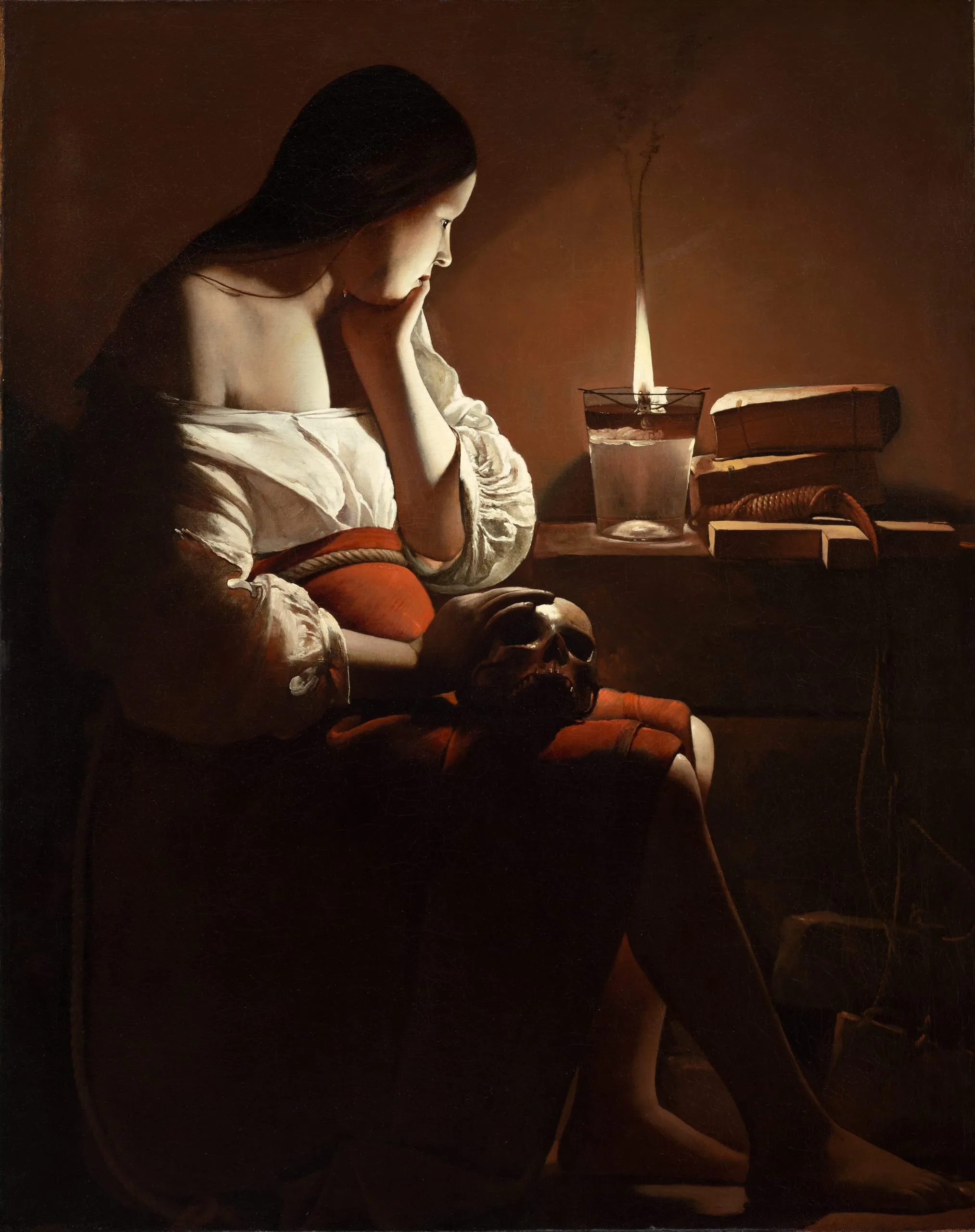
The Magdalen with the Smoking Flamecirca 1635-37

Not on view
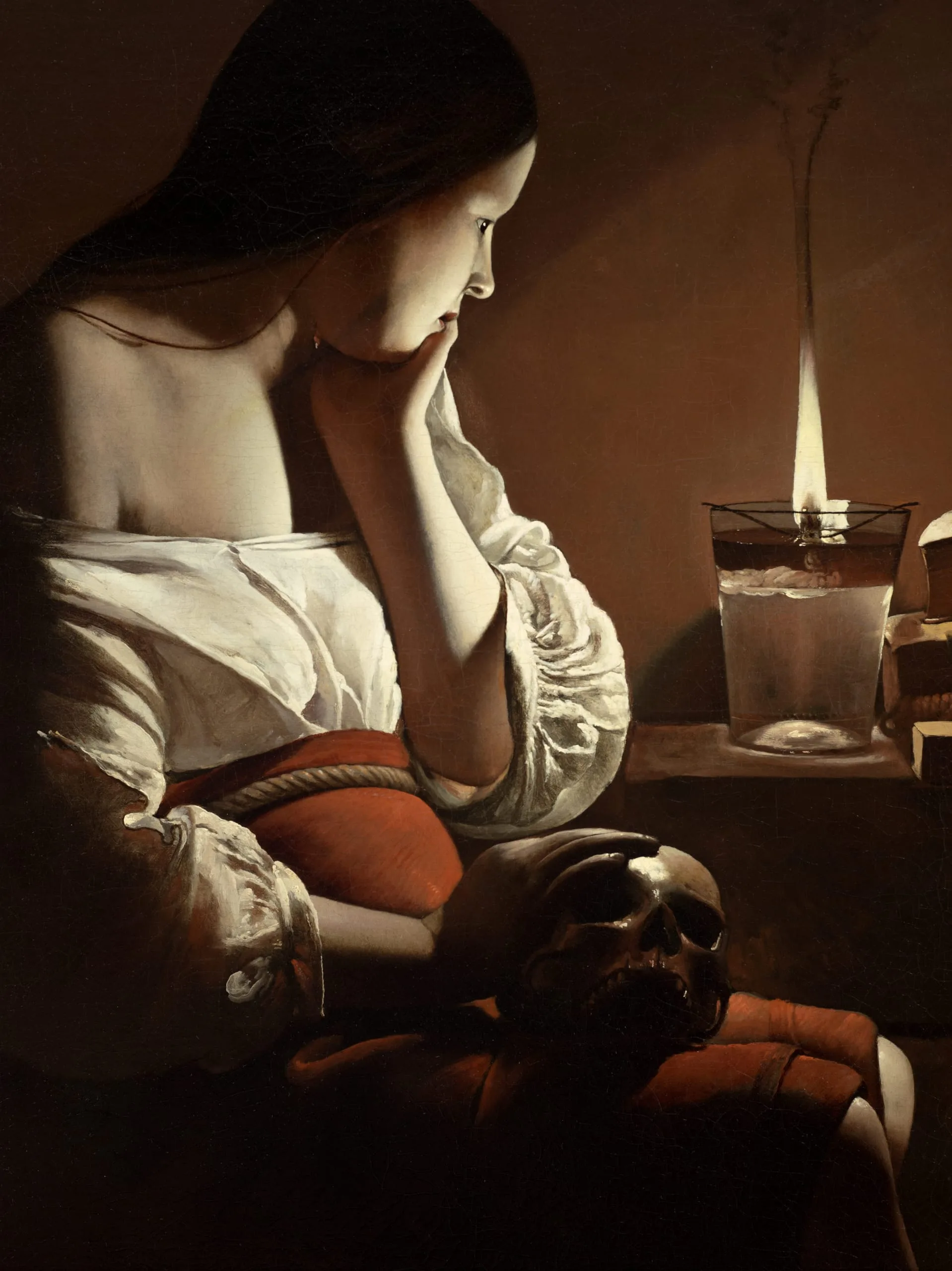
Oil painting of a seated young woman in candlelight, head bowed and resting on one hand, holding a human skull in her lap, with stacked books and a glass oil lamp on a table beside her
Oil painting of a young woman in a white linen blouse and red skirt, seated in profile with one hand raised to her cheek, cradling a human skull in her lap. A single candle in a glass vessel illuminates the dark brown background with warm, raking light. Smooth, precise brushwork in a Baroque chiaroscuro style.
Artist or Maker
Georges de La Tour
France, Vic-sur-Seille, 1593-1652
Title
The Magdalen with the Smoking Flame
Date Made
circa 1635-37
Medium
Oil on canvas
Dimensions
Canvas: 46 1/16 × 36 1/8 in. (117 × 91.76 cm) Framed: 57 1/4 × 47 1/2 × 4 1/2 in. (145.42 × 120.65 × 11.43 cm)
Credit Line
Gift of The Ahmanson Foundation
Accession Number
M.77.73
Classification
Paintings
Collecting Area
European Painting and Sculpture
Curatorial Notes
Although Georges de La Tour spent his entire artistic career in provincial France, far from cosmopolitan centers and artistic influences, he developed a poignant style as profound as the most illustrious painters of his day. In his lifetime his work appeared in the prominent royal collections of Europe. La Tour's early training is still a matter for speculation, but in the province of Lorraine he encountered the artist Jean Le Clerc, a follower of the Italian painter Caravaggio. From this source likely came La Tour's concern with simplicity, realism, and essential detail.
Mary Magdalen was traditionally depicted in her grotto or as an aged woman. The absence of explicit narrative in this painting emphasizes Mary's state of mind and heart rather than time and place. The simple composition of vertical and horizontal shapes draws the viewer into the Magdalen's contemplative world. The skull, books of Scripture, and scourge set the mood, but the chief symbol and true subject of the work is the candle at which Mary gazes in her meditation. Rendered in extraordinary detail and modulation, it emits the light that followers of St. John of the Cross called "the living flame of love," toward which spiritual pilgrims are drawn out of the "dark night of the soul."
La Tour scrupulously conveys the tactile quality of surfaces. The polished skull and leather books have different reflective qualities; Mary's heavy skirt, thin, wrinkled blouse, smooth flesh, and hair are meticulously distinct. Each spare detail is carefully regulated to achieve an overall balance of form and light.
Provenance

Chrétien de Nogent, ca. 1640(?). La Haye family, near Bordeaux, where traditionally attributed to Le Nain and was said to come from the eastern part of France. Simone La Haye, Paris, ca. 1943, sold 1977 to; LACMA.

Selected Bibliography
  • Lehmbeck, Leah, editor. Gifts of European Art from The Ahmanson Foundation. Vol. 2, French Painting and Sculpture. Los Angeles: Los Angeles County Museum of Art, 2019.
  • King, Jennifer, ed. Vera Lutter: Museum in the Camera. Los Angeles: Los Angeles County Museum of Art; Munich: DelMonico Books-Prestel, 2020.