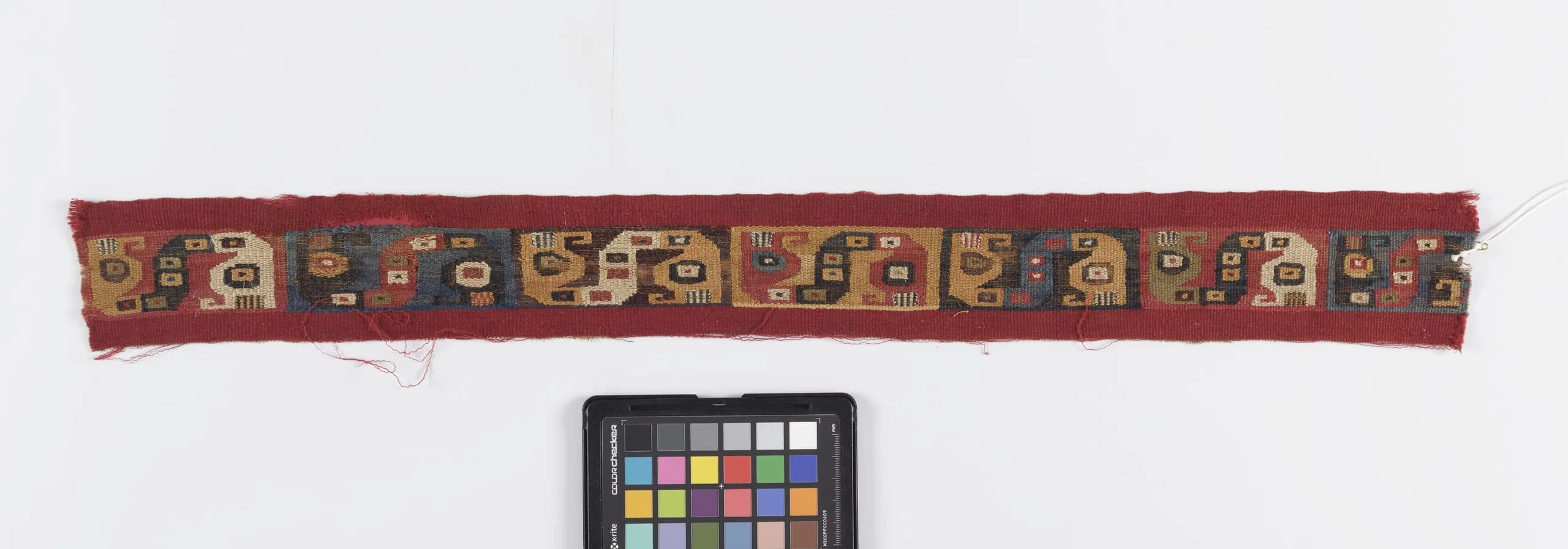
Images of the serpent, usually double-headed, figured importantly in the iconography of Mesoamerica and South America. In this fragmentary band, the nested squares of the snake’s body refer to jaguar markings, and the stylized lines on the composite creature’s two mouths suggest the teeth of animals.
Due to their ability to slough off their skins and grow new ones, snakes carried multiple associations of fertility, regeneration or rebirth, and agriculture. Additionally, their physical power and venomous toxicity symbolized the unpredictable danger inherent in nature. Serpents were frequently shown in association with raptor birds and jaguars—and together, stood as signs for the cosmic levels of the sky, earth, and watery ocean or underworld.
A fundamental tenet of Andean thought held that the universe was composed of dual but complementary opposites. The dual-headed serpent, abstracted in art as a vertical or horizontal S, may well be the symbol of that essential principle.
Nicole LaBouff via Kaye Spilker
2009