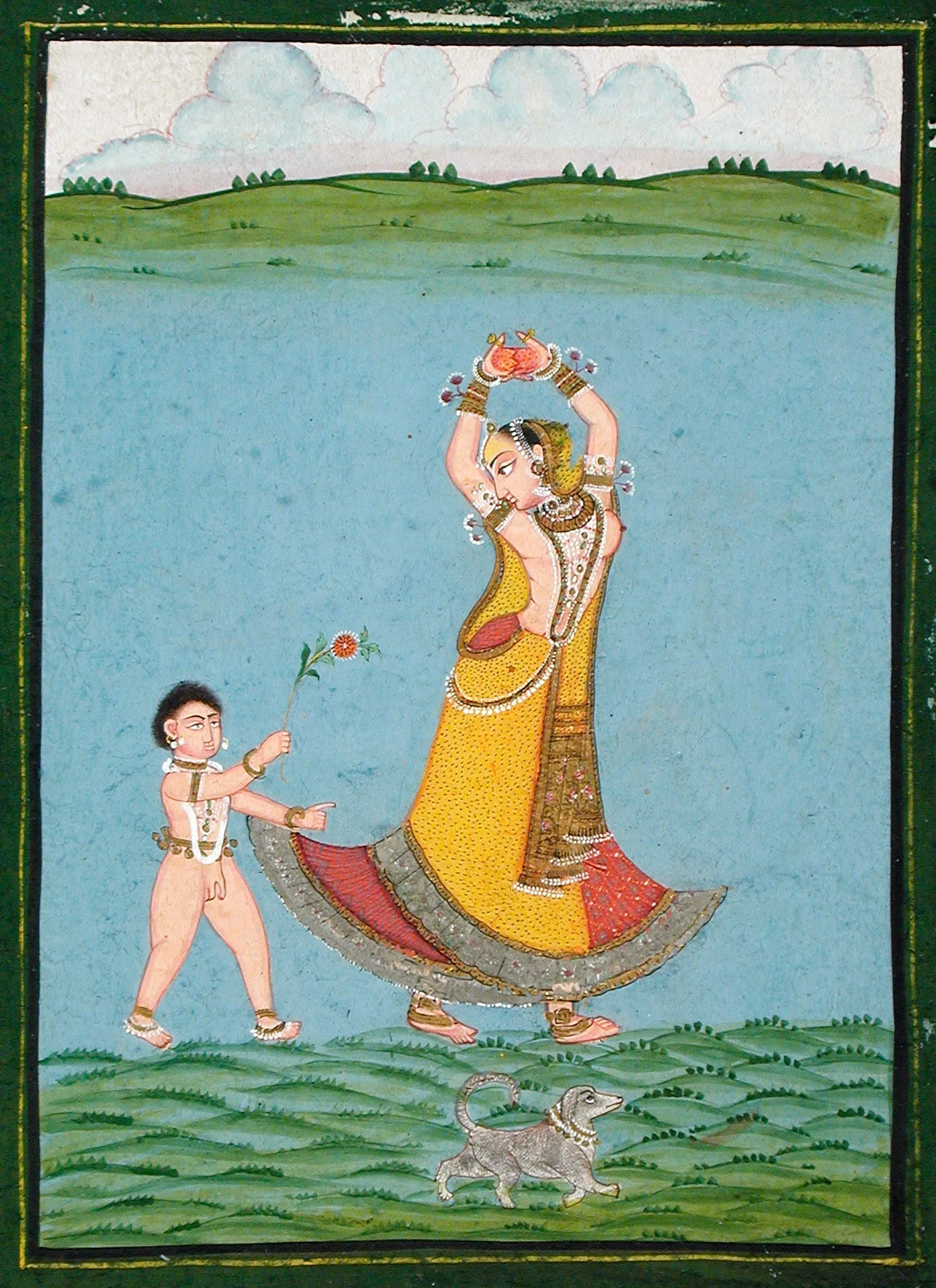
The image of a court beauty languorously stretching her arms above her head and accompanied by a young child demanding attention and/or a prancing small dog was a popular motif in both court and wall painting at Udaipur and the feudatory (thikana) of nearby Devgarh (or Deogarh. Perhaps inspired by the celestial nymphs (apsarasas) frequently adorning Indian temple exteriors (see M.76.48.2), the analogous illustrations of beautiful women languidly posed in Mewari painting may represent a secularized version of feminine beauty. The motif was particularly associated with a family of painters who worked at both courts. The patriarch was Bagta (or Bakhta, active circa 1761-1814). His younger son was Chokha (active 1799-18260, and his grandson was Baijnath (active circa 1820–1849). Images of A Court Beauty have survived by all three artists. In addition to this painting by Baijnath attributed to circa 1840 (M.77.63.2), see also a drawing by Bagta attributed to circa 1800 (M.87.278.4), and an often published large painting on cloth by Chokha attributed to circa 1805-1810 in the Metropolitan Museum of Art, New York (2022.228). In fact, Baijnath’s first known painting dated 1822 features another representation of A Court Beauty in the Collection of Nahar Singh II of Devgarh. See Milo Cleveland Beach and Rawat Nahar Singh II, "Rajasthani Painters. Bagta and Chokha: Master Artists at Devgarh," Artibus Asiae. Supplementum 46 (2005), pp. 94-96, figs. 113-115. For further discussions of this illustrious family of painters, see S. K. Andhare, "Painting from the Thikana of Deogarh," Prince of Wales Museum Bulletin 10 (1967): 43-53; Joanna Williams, Kingdom of the Sun: Indian Court and Village Art from the Princely State of Mewar (San Francisco: Asian Art Museum, 2007), pp. 56-62; and Milo C. Beach, "Bagta and Chokha," in Masters of Indian Painting II: 1650–1900, eds. Milo C. Beach, Eberhard Fischer, and B. N. Goswamy (Artibus Asiae Supplementum 48 (2011), pp. 733-752.
Here, the Court Beauty stands in a dancing pose with her hands joined above her head and the palms facing upwards in the gesture of Dawn (ushas mudra; see also M.85.35.2 and AC1994.15.1). She gazes lovingly at the small boy trying to get her attention offering her a sunflower. The treatment of the rolling hills and silhouetted tree line on the horizon is identical to that in Baijnath’s last known work of 1841 depicting an enthroned Krishna receiving Rama, Lakshmana, and Hanuman in the National Museum, New Delhi (62.96). See Andrew Topsfield, Court Painting at Udaipur: Art Under the Patronage of the Maharanas of Mewar, Artibus Asiae Supplementum 44 (Zurich: Museum Rietberg, 2008), p. 253, fig. 225, n. 47.